
How the Giant Wave off Sumatra was created
by Holger Dambeck (27.12.2004)
(translated from German: http://www.spiegel.de/wissenschaft/erde/0,1518,334557,00.html by Chuen Piau)
29.12.2004
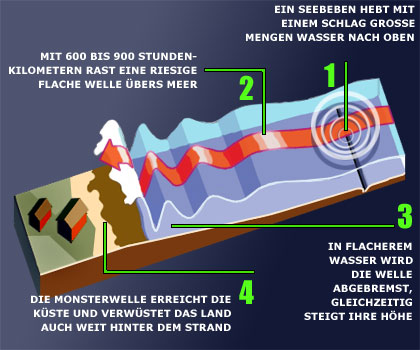
1. A seaquake pushes water up with a single blow/impact.
2. A single flat wave speeds up to 600 to 900km/h over the sea (just imagine!!).
3. In shallower waters the wave is slowed down, at the same time increasing in height.
4. Giant wave reaches the coast and devastates also the land far behind the beach.

On Sunday morning the "Big Bang" happened: On several hundred kilometers the see floor shattered. Within a fraction of a second huge pieces were pushed up by 10 meters thus releasing incredible forces of energy
What happened in South East Asia on Sunday morning was - for geophycisists - a result of sudden shifting of huge rock masses.
In the sea south off Sumatra and Indonesia two continental plates collide: the Indian-Australian (tectonic?) plate pushes itself with great pressure under the Eurasian.
This does not happen gradually, it happens suddenly/jerkily. Every "jerk" or sudden push is registered by
seismographs as earthquakes, sometimes hardly noticable and sometimes with catastrophic consequences.
On Sunday it wasn't just a minor push which sent measuring device readings off-scale:
A single impact resulted in a plate crack/break measuring at possibly around 500 kilometers in length,
according to analysis by Birger L�hr, earthquake expert at the Geology research centre in Potsdam(Germany).
Only this way the huge seaquake measuring a 8.9 magnitude could be explained.
Due to subsequent after-quakes the break/crack could have further increased to around 1000 kilometers in total, according to the geophycisist.
This results in an enormous, almost unimaginable energy being released, equivalent to the whole power consumption of the USA in one year, according to Klaus-Peter Hinzen from the earthquake insitute in Cologne. He estimates that the sea bed has shot up by 10 meters up. What then happened he explains via an experiment in the bath tub: "If you quickly move up a board in a tub filled with water, then the water level rises shortly and a wave is created."
How fast the generated wave travels depends on the water depth.
Off Sumatra the waves reached speeds of 700 km/h, almost as fast as an air liner. Scientists have also observed up to 900 km/h fast Tsunamis before.
At high seas the waves remain mostly unnoticable, their height is often just around few decimeters. Only when the wave heave is being slowed down in shallow waters will it form into a destructive wall of water. The word "Tsu-nami" translates into "Harbour wave".
Strictly speaking no water flows like in a river but rather the energy is transferred whereby a water molecule is pushed to another. Around 80% of all monster waves occur in the Pacific.
Most Tsunamis are generated by underwater quakes but volcano eruptions or metor impacts can also create monster waves.
Not only South East Asia and the Pacific region but Europe is also threatened by Tsunamis, although less strong. In 1755 60,000 Lisbons died (Lisboa, city in Portugal) when they fled to the Tejoufer after an Earthquake and were surprised by a huge wave there.


