



|
With Engels, Marx attended the second conference of the Communist League in London. He finished his Communist Manifesto in 1848, the year when various revolutions and oppressions happened. Being expelled in Brussels (because of engaging in political journalism), accepting the invitation of the leaders against King Louis Philippe, he moved again to Paris. Then, again, he moved to Prussia. He ended up being exiled permanently in London because of the failure of the revolutions and liberal groups. He never stopped his engagement with political organizations. He made his researches (Capital), then earned a living thru writing journals. When her daughter died, and his son became sick, he asked help form Engels, who inherited his father�s business in Manchester. Marx suffered from illness in ten years, and never recovered from his wife�s death in 1881. He died two years after her wife died. Marx was very engaged about French Revolution and its failure, critiques on Hegel, which brought him to ideas of liberty, equality, and fraternity, and new liberalism. He connected the ideas in three levels: the philosophical, the economic, and the political (at the center). His ideas on technology, and �relations of production� property relationships, were brought out by criticizing Adam Smith, David Ricardo, and the failure of the French Revolution. According to what Marx�s argued, the life of the state and political life of society was a result of class struggle for power, which occurred between these classes. And the state is being controlled by the ruling class which overpowers the subordinate classes. He referred to the �new working class�, as the class with the idea of liberty, equality and fraternity that which the French Revolution failed to do so.
(Craib, 1997:11-13)
|
|
Copyright 2005.
|
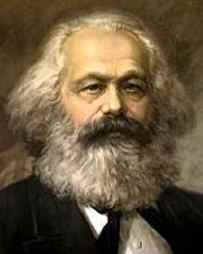 Karl
Marx was born in the year 1818 in Prussia, to a large Jewish family, with seven
brothers and sisters. To avoid persecution, the long line of rabbi ancestors was
ended by his father. He went to take up law in the University of Bonn. By that
time, he was secretly engaged with Jenny von Westphalen. He loved writing poems,
but was known to have a reputation of being wild and spendthrift. Marx became a
reformed character because of the influences of a group of radical thinkers,
when he moved to Berlin. Then 1841, he engaged himself in radical journalism.
Three years later, he moved to Paris with her wife, and started to write a new
journal. He wrote critiques on G.W.F. Hegel, Adam Smith, David Ricardo, and
French socialism. Marx moved to Brussels (and collaborated with Friedrich
Engels), when the French government expelled him.
Karl
Marx was born in the year 1818 in Prussia, to a large Jewish family, with seven
brothers and sisters. To avoid persecution, the long line of rabbi ancestors was
ended by his father. He went to take up law in the University of Bonn. By that
time, he was secretly engaged with Jenny von Westphalen. He loved writing poems,
but was known to have a reputation of being wild and spendthrift. Marx became a
reformed character because of the influences of a group of radical thinkers,
when he moved to Berlin. Then 1841, he engaged himself in radical journalism.
Three years later, he moved to Paris with her wife, and started to write a new
journal. He wrote critiques on G.W.F. Hegel, Adam Smith, David Ricardo, and
French socialism. Marx moved to Brussels (and collaborated with Friedrich
Engels), when the French government expelled him.