| Gradient gives | Speed (Velocity) |
| Gradient gives | Acceleration |
| Area under Graph gives | Distance |
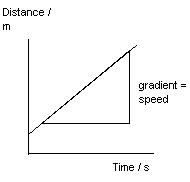
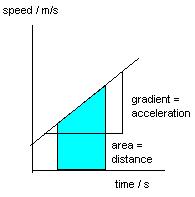
| Quantity | Definition |
|
|
| Speed | change of distance with time |
|
|
| Velocity | change of displacement with time |
|
|
| Acceleration | change of velocity with time |
|
|
|
|
|
||||||
|
|
||||||
|
|
|
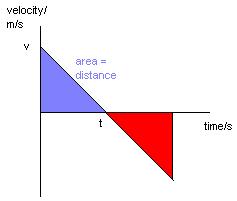
| Stone thrown
up and falling down
As the stone is thrown up, it slows down due to gravity until it stops ( v = 0) at the highest height. The height reached (blue triangle),
The acceleration due to gravity is 10 m/s2
This graph is also for stone rolling up a smooth slope. |
 |
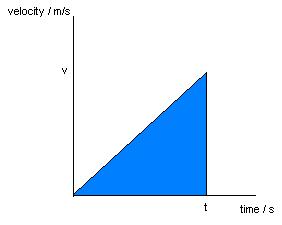
| Stone dropped from a height
As the stone falls, it increases its velocity (by 10m/s every second). When it hits the ground, it stops (v = 0). The height from which it was dropped is the area under the graph (blue triangle). The acceleration due to gravity (10m/s2) is v / t. |
 |
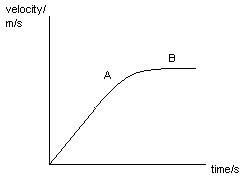
| Terminal Velocity
When an object falls through the air, it
experiences air resistance.
|
 |
Try some quiz questions