wave, traveling
A disturbance that travels in a medium due to repeated periodic motion of the particles of the medium. The motion is handed over from one particle to the next resulting in the net transfer of energy from the source, generating the disturbance to the surroundings.In transverse waves the displacements of the particles from the mean position are at right angles to the direction of propagation, while in longitudinal waves these are along the direction propagation.
In a simple harmonic wave each particle in the medium executes simple harmonic motion. The chief characteristics of such wave are its velocity, v frequency, n wavelength, l and amplitude, A.
The velocity (or the wave velocity) is the distance covered by the progressive wave in one second. The frequency is the number of oscillations executed by the particles of the medium in one second. The wave length is the distance between successive points in same phase in the wave. The amplitude is the maximum displacement of a particle from the mean position.
Since in time, T=1/n , the wave progresses by one wavelength, the wave velocity is given by,
v=n l
In a plane progressive simple harmonic wave the amplitude remains constant. The displacement from the mean position, y of a particle at a distance x from the source at an instant of time t is given by,
y=A sin {2p n t-(2p / l )x} (w1)
The term (2p /l )x is the phase lag between the source at x=0 and the point at distance x. The equation (w1) is also written as,
y=A sin (w t-kx) (w2)
where w =2p n , is the angular frequency and k=2p /l is the wave number. A wave moving in the -x direction is represented by,
y=A sin (w t+kx)
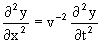
The wave equation: Traveling wave satisfy a differential equation called the linear wave equation, given by,
(w3)
where v is the wave velocity. One can see that y given by equation (w2) satisfies the wave equation (w3).
