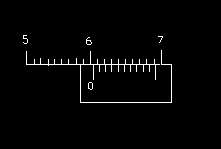
vernier scale
A short auxiliary scale that can slide along the main scale, enabling fraction of the main scale division to be read accurately. The vernier scale has divisions little shorter than the shortest division on the main scale. If n vernier divisions are equal to (n-1) main scale divisions then 1 vernier division is equal to (n-1)/n main scale division. The difference between one vernier scale division and one main scale division is 1/n.. This is called the vernier constant and is the least count of the vernier. While measuring the length of an object, suppose the zero of the vernier lies between 6.0cm and 6.1cm marks on the main scale as shown in fig v2. In order to find the fraction by which the zero mark has advanced beyond 6.0, look along the two scales and find the vernier division that coincides with any main scale division. This in fig. v2 is the fourth division. Hence the fraction is 4´ (vernier constant)=4´ (0.01) cm=0.04 cm. Therefore the total reading is 6.0 cm + 0.04 cm= 6.04 cm.
Fig. V2 Vernier scale
find more about vernier link