quantum statistics
(read Maxwell Boltzmann statistics before you read this article) Statistical description of systems consisting of particle that obey quantum mechanical laws. The fundamental feature of quantum statistics is that the particles are indistinguishable. Therefore the particles cannot be labeled as it is done in Maxwell Boltzmann statistics.In quantum statistics the phase space coordinates are defined as,
x, y, z, px, py, pz
According to the Heisenberg’s uncertainty principle* the co-ordinates of a particle in the phase space can not be specified smaller than the phase space volume h3 (h is the Planck’s constant).
The total available phase space is divided into cells, with energies w 1, w 2, w 3, . . . etc. The cells are further divided into compartments, each with volume h3. The volume of a cell is big enough to contain a large number of compartments, but it is small in comparison to the total volume of the phase space. The distribution of particles amongst the cells defines a macrostate. The distribution of particles amongst the compartments of a cell defines a microstate.
The problem is to find the thermodynamic probability (the number of microstates) corresponding to a macrostate. In equilibrium the thermodynamic probability is maximum.
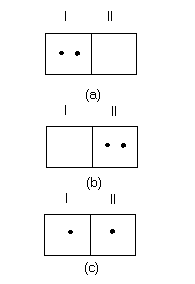
Consider a simple example; two particles to be distributed in a cell with two compartments. In fig. q1 all possible microstates are shown.
Fig q1 Illustration of possible microstates in BE statistics. The cell consists of only two compartments (I and II), and contains two indistinguishale particles. In FD statistics only (c ) is possible, with cell size h2/2..
The system is subject to two constrains,
(a) The total number of particles is constant.
(b) The total internal energy of the system is constant.
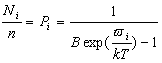
The expression for the number of particles in the ith cell is given by,
 . . . (q6)
which is the Bose Einstein (BE) distribution function. In the equation (q6), n is the number of compartments (or states) per cell, k the Boltzmann constant, and T the absolute temperature. Note that BE distribution function reduce to MB distribution when the number of phase points Ni is very small compared to the number of compartments.
The BE statistics is applicable for particles with integral spin which are called Bosons.
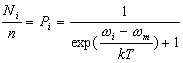
For particles with half integral spin the Pauli’s exclusion principle imposes restriction on the maximum number of particles each compartment of volume h3 can accommodate. If the volume of a compartment is taken as h3/2 then only one particle can occupy it. For such system the distribution function is given by,
 … (q7)
This is called the Fermi Dirac distribution function. The constant w m is called the Fermi energy. Pi is the probability of occupancy of a cell. When T goes to 0 K, Pi is unity for all cells with energy less than w m. For w I ³ w m, Pi abruptly falls to zero. This means that cells with w I < w m will be filled, and cells with w I ³ w m will be all empty (see fig. q2). At temperature T greater then 0 K, some particles below w m are thermally excited to higher cells as shown by the distribution function drawn for T>0 (fig.q2). At w m the value of the distribution function is equal to 1/2. Therefore Fermi energy can be defined as "The energy level that has 50% probability of occupancy".
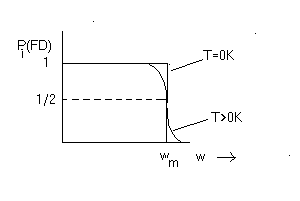
Fig q2 Plot of FD distribution function versus energy(w) at T= 0K and T>0K.