Engineering Thermodynamics
NON FLOW PROCESSES
Basic Terms
1.Thermodynamics:Thermo means heat and dynamics means study of matter in motion. The word thermodynamics means the study of heat related to matter in motion.
2. Thermodynamic System: The thermodynamic system or simply system may be broadly defined as a region of space where a thermodynamic process is taking place. The system is the region where our attention is focussed to study the process. It is surrounded by an imaginary boundary. Objects within the boundary comprise the system and those outside comprise the surroundings.
3. Working substances: All thermodynamic systems require some working substance in order that various operations required of each system can be carried out. The working substance takes part in the energy transfer, that is, it receives and rejects heat and it is used to deliver the work output or input. The working substances in general are fluids.
4. Fluids: Fluids are substances that can flow. As such the term embraces any or all of the following physical states: gases, liquids and vapours. In addition, the study of fluid behavior is based on the assumption that the chemical composition of the fluid remains constant. The measurable properties of the fluid are its temperature and pressure.
5. Temperature: Temperature determines the direction in which the flow of heat takes place. A body is at higher temperature compared to its surroundings when there is a net flow of heat from the body to the surroundings.
The unit of temperature in SI system is the kelvin K, though temperatures are often quoted in oC. The conversion between the two scales is given by
T(K)=T( oC)+ 273
6.Pressure: Pressure is the force exerted by a fluid on a given area:
P=F/A
Where the units of N/m2 is termed as pascal with symbol Pa. The pressure within a fluid depends not only on applied force but also on weight of the fluid itself. For a fluid in equilibrium the pressure difference between two points with height difference h is given by
D
p = r g hwhere r is the density of the fluid.
Closed Thermofluid System
A closed thermofluid system is defined as a region into and out of which there is no flow of fluid. It follows that a closed system contains a fixed amount of fluid.
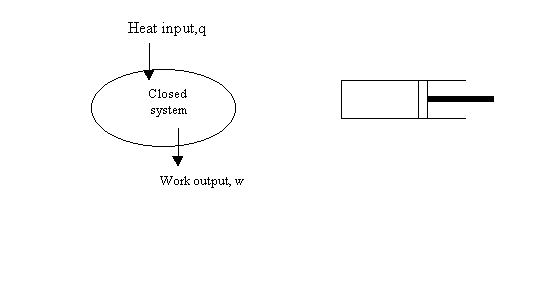
Fig . 1 (a) Closed thermofluid system (b) Cylinder and piston assembly
The basic features of a closed thermoflid system are shown in the fig. 1. These consist of the system itself, the boundary containing a fixed quantity of fluid, and the region outside the boundary called the surroundings. Although there is no movement of fluid across the boundary, there can be transfer of energy into, and out of the system in the form of heat and work. Heat can be transferred across the boundary due to a difference in the temperature. Work can either be transferred by the movement of the boundary or by means of rotating shaft.
Fig 2 shows a cylinder and piston containing a quantity of gas. Because the quantity of gas is fixed the cylinder and piston assembly represents a closed thermofluid system.
Another example of the closed thermofluid system is the steam plant consisting of boiler, turbine, condenser and pump. The plant contains a fixed quantity of gas therefore it a closed system. For this system heat is transferred in the boiler and in the condenser while work is transfer takes place in the pump and the turbine.
The processes taking place in a closed system are called non flow process. The energy equation governing such processes is called " Non Flow Energy Equation".
Non Flow Energy Equation(NFEE)
When a fluid in a close thermofluid system changes from one stable state to a second stable state, the system is said to have undergone a process. The energy equation for a closed system can be derived by applying the principle of conservation of energy to the system
.
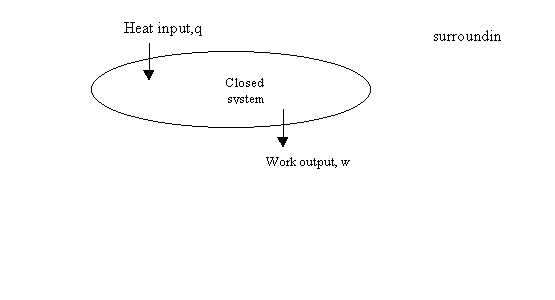
Fig. 2 illustrates a closed thermofluid system containing 1 kg of fluid
For 1 kg of fluid the heat and work transfer across the boundary are defined as q and w respectively, with units of J/kg. The conservation of energy for the system can be expressed as:
Energy entering the system - energy leaving the system = change in the energy of the system.
In order to quantify the energies, it is essential to define a sign convention for the energy entering and leaving the system. The sign convention used is : heat input to the system is positive, work output from the system is positive. It follows that a heat output is considered negative. Similarly work input is considered as negative.
Using this sign convention it is now possible to state the energy equation for a process with a closed thermofluid system as:
q - w = D (energy)
where D (energy) is the net change of energy for 1 kg of fluid within the system. The change of energy within the system can be assumed to comprise three possible forms of energy:
q - w = D KE + D PE + D u
In practice the changes of kinetic energy and potential energy within a closed system tend to be negligible compared to the change of the internal energy
D KE = 0
D PE = 0
therefore q- w = D u = u2 -u1
where u2 is the internal energy for the final state and u1 the internal energy for the initial state.
This equation is generally referred to as the non flow energy equation as it is applied for the closed thermofluid systems.
Internal Energy
The principal difference between internal energy and mechanical energy lies in the fact that internal energy is the energy of random molecular motion, while mechanical energy represents ordered motion.
The kinetic and potential energy associated with associated with random motion constitutes the internal energy.
The kinetic and potential energy associated with ordered motion constitutes the mechanical energy.
When a moving body makes an inelastic collision (that is its kinetic energy is lost during the collision) and comes to rest, the ordered mechanical energy is converted into random motion of the molecules. In this process the internal energy of the body increases.
The reverse is done in heat engines. They convert a portion of internal energy of the working substance into mechanical energy of the piston.
Process Diagram
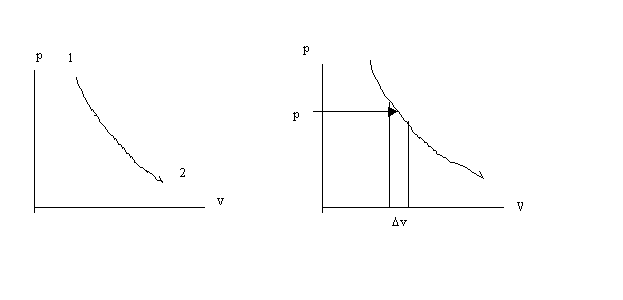
A process diagram is graphical representation of the change in the fluid properties during a process. Fig. 3 shows a typical process diagram of expansion of a gas in piston cylinder assembly. The pressure of the gas is plotted against the volume. It is useful way of visualizing the process,
.
because from P-V diagram the work done can be calculated.
Consider the piston cylinder assembly in which the system goes from 1 to
2. When the piston moves through a small distance the work done D w can be found from (see fig 3b),
Work done=force x distance
and force= pressure x area
D w = p D x A
where D x is the distance through which the piston moves and A the area of cross section of the cylinder.
D w = p D V
Since D x A gives the change in the volume of the gas. The same is depicted as shaded area in the figure.
For the whole process the total work done can be found by adding the areas of all small portions.
wtot = S p. D V = area under the graph
The area under a P-V diagram represents the work for all frictionless processes in a closed thermofluid system.
Reversible and irreversible processes
Some processes naturally take place only in one direction. Examples of such processes are:
These processes can never go in the reverse direction even though it will not violate the energy conservation principle. These are called irreversible processes.
The Non Flow Energy Equation we have derived is only applicable for reversible processes. Almost all processes in nature are irreversible. But processes can be made appproximately reversible in laboratory conditions. For example expansion of a gas in a frictionless piston cylinder assembly.
Reversible nflow processes
Now we will study different kinds of reversible non flow processes. In each case the work done can be calculated from the process diagram and from the equation
W = ò p dv
Which is represented by the shaded area under the process line.

Fig. 4
(a) The reversible constant volume process (also called the isochoric
process)
This is a process carried out such that the volume remains constant throughout the process.
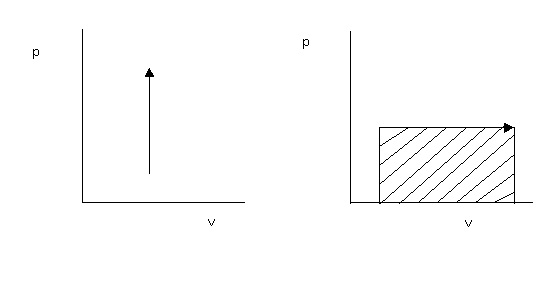
The process diagram for this process is shown in fig 4a.
Since the area under the curve =0
Work done in isochoric process = 0.
Fi4a isochoric process (b) isobaric processs
(b) The reversible constant pressure process (also called isobaric process)
This is a process carried out such that pressure remains constant throughout the process.
The process diagram is shown in the fig. 4b
Work done in this process can be found by finding the area of the rectangle 12v2v1
W= ò p dv = p (v2 - v1)
Change of state of working substances in thermodynamic systems are often brought about by the expansion or compression of the working substance. Suppose then that an experiment is conducted on a mass of working substance such that an expansion takes place changing the state from state 1 to state 2. Let the pressure change form P1 to P2 and volume

Fig. 5 Polytropic process
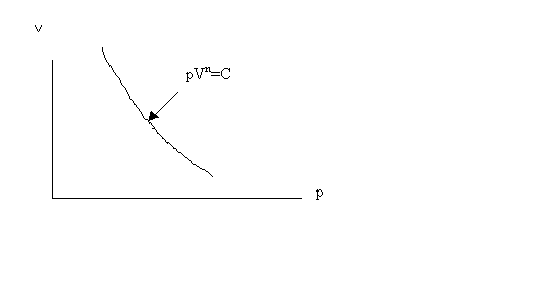
changes V1 to V2. Assume that arrangements are made to record the pressure and the volume as the experiment proceeds. If then the pressure and volume values are plotted on a P-V graph then a smooth curve results as shown in the fig. 5.
The law connecting pressure and volume is given by,
P Vn = C , a constant
Further experiments on different substances taking different quantities of substance and also including the case of compression as well as expansion will yield a similar result. Therefore the equation above may be considered as the law for the general case of expansion or compression of a substance and is termed as Potropic Processes.
The value of n generally lies within the range 1 to 1.7.
Further, note that if n=0 then the equation becomes
P V0 = P = C
Which indicates a constant pressure process.
Again taking n th root of the equation
P1/n V= C
When n goes to infinity
V= C
Which indicates a constant volume process.
Work done in polytropic process:
W = ò p dv = Cò v -n dv = [p1v1 - p2v2] / (n-1) (x)
Problems

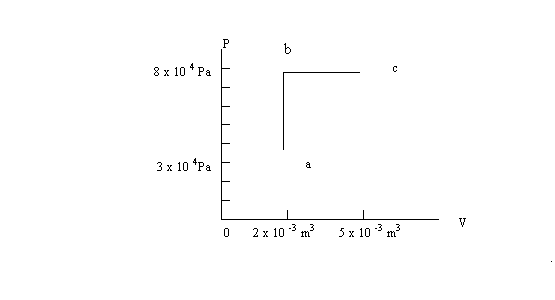
1. A thermodynamic process is shown in Fig. In process ab, 600 J of heat are added, and in process bc 200 J of heat are added Find (a) the internal energy change in processes ab and bc. (ans. 600J, -40J)
2.One gram of water (1 cm3) becomes 1671 cm3 of steam when boiled at a pressure of 1 atm. The heat of vaporization at this pressure is 2256 J.g-1 Compute the external work and the increase in internal energy. (ans.2087)
3. A quantity of steam with original pressure and volume being 140 kPa
and 0.15 m3, respectively, is compressed to a volume of 0.3 m3.
Given the law of compression PV1.2 =C.
Determine the final pressure and the work done.
[966 kPa, -39.9 kJ]
0.56 m3.
It is expanded according to law PV1.35 =C down to pressure of 340 kPa.
Determine the final volume and the work done. (ans. 2.615 m3, 1.8 kJ)
Energy Equation for a Cycle
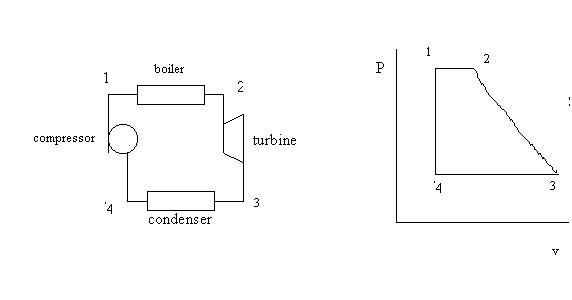
When a fluid inside a closed thermofluid system undergoes a series of different processes such that it starts at a particular state and returns to that state, it is said to have undergone a cycle. As a typical example, the steam plant shown in fig. 9 operates on a continuous cycle. The fig. shows the state points either side of each component. The P-V diagram in fig. 6 shows the processes in each component.

Fig. 6 The schematic diagram of steam plant and its process diagram
Between state points 1 and 2, water enters the boiler and is evaporated in a constant pressure process. Expansion of the steam takes place in the turbine between points 2 and 3 down to lower pressure. The exhaust steam is then condensed back to water between points 3 and 4. Finally the fluid leaving the condenser at 4 is pumped back into the boiler at 1, thus completing the cycle.
Since this is a closed system
q - w = D u = ufinal -uinitial
Since initial and final state is the same right hand side is equal to zero.
q - w =0
or, q = w
where q should be the sum of all heat transfers to the system and w, the sum of all work done with appropriate signs.
The heat transfer to the working fluid in the boiler, therefore should be positive (+q1) while in the condenser heat is transferred out of the system (-q2).
The work output at the turbine is positive (+w1) while the work input at the pump is negative(-w2). Therefore for the steam plant,
S q = S w
q1 - q2 = w1 - w2
The above equation is true for all cycles in a closed system and can be expressed in the following law:
When a closed thermofluid system undergoes a cycle, the net heat transfer to the system is equal to the net work done by the system.
Problem
A domestic refrigerator circuit consists of an evaporator, compressor, condenser and expansion valve . If the rate of heat transfer to the evaporator is 140 W and the rate of heat transfer from the condenser is 180 W determine the power input to the compressor.
Assume that the heat and work transfer to the expansion valve to be negligible. (ans –40W)