LASER AND ITS APPLICATION
The ordinary light is produced when an excited atom makes a spontaneous transition to a lower energy state. Since such spontaneous transitions in different atoms are completely random the emitted photons have random phases. Einstein (in 1917) deduced that the existence of equilibrium between a blackbody and electromagnetic waves requires another process of emission of photon from excited atoms. Such emission, called stimulated emission occurs when a photon having the same frequency as that the atomic transition would produce, interacts with the atom. The idea of stimulated emission attracted little attention until 1954, when Townes and coworkers were successful in producing microwave radiation by this mechanism using ammonia molecules. Subsequently similar devices were invented for light.
The photon produced by stimulated emission has the same phase, and moves in the same direction as that of the inducing photon. Accordingly this mechanism produces coherent light. The laser which stands for light amplification by stimulated emission of radiation, is a device that produces light by stimulated emission. A similar device for microwave frequencies is called maser.
The laser light is highly directional, intense, and monochromatic. These properties of laser make it an important tool for science, medicine and almost all branches of engineering and technology.
The concept of coherence
In Physical Optics we learnt that coherent sources capable of giving permanent interference pattern can only be obtained from a single source, whether it is in biprism, Michelson's interferometer or any other device. Radiation from individual atom occurs in random manner, and is for a short duration. As a result light waves come in wave trains. These wave trains have finite extension in space. We observe that even for a light beam from a single source, the phases at two points beyond certain separation in space are uncorrelated. Coherence is the existence of correlation in phases at different points in space. Two points between which coherence exists may be separated longitudinally, along the direction of the incident beam or transeversely. We would consider separately the longitudinal and transeverse separations.
Temporal coherence: The coherence along the direction of propagation is called temporal coherence, the significance of the name will be clear soon. As light emission is an atomic phenomenon, therefore the light beam is composed of independent wave trains. The length of a wave train, D s is called coherence length.
D s = N l (1)
where N is the number of waves and l is the wavelength. The coherence time D t, which is the time taken by a wave train to pass a point, is given by,
D t = D s/c (2)
where c is the velocity of light. Temporal coherence occurs because of finite value of coherence time.
Temporal coherence is demonstrated in interference due to thin film. We know that the path difference between the rays reflected from the top and bottom interface of the film produce the interference fringes. The film can either be bright or dark depending upon the path difference. If the thickness of the film is increased, beyond a point no interference pattern is discernible. At this point the path difference introduced by the film exceeds the limit of temporal coherence. In practice the temporal coherence of a beam is measured using the Michelson interferometer.
Spatial coherence: Spatial coherence is the phase relationship between the waves at different points in space that are separated transversely to the direction of propagation. Consider the interference due to a double slit. When the slits are close, the interference fringes are rather distinct with high contrast. As the two slits are moved apart, the fringes become more closely spaced and will lose contrast. This happens because as the two waves are taken apart by increasing the distance between the slits, their spatial coherence decreases progressively.
A laser beam possesses high degree of spatial and temporal coherence as the photons comprising the beam are produced by stimulated emission.
Principle of laser
When radiation interacts with matter, the atoms are raised to excited levels. The excited atoms revert back to the original state by emitting radiation. This process can take place in two ways. The first called spontaneously emission occurs without any external stimulus. The spontaneous radiation process is completely random and therefor the radiated photons are incoherent. Stimulated radiation on the other hand requires external stimulus to trigger it. This external stimulus is a photon of same frequency. The stimulated radiation is in the same direction and phase with the stimulating radiation.
Consider an ensemble of atoms in thermal equilibrium with surrounding blackbody radiation at absolute temperature T. N1 atoms are in state of energy E1 and N2 atoms are in the state of energy E2 with E2>E1. The distribution of atoms in the various levels is governed by the Boltzmann law. Therefore,

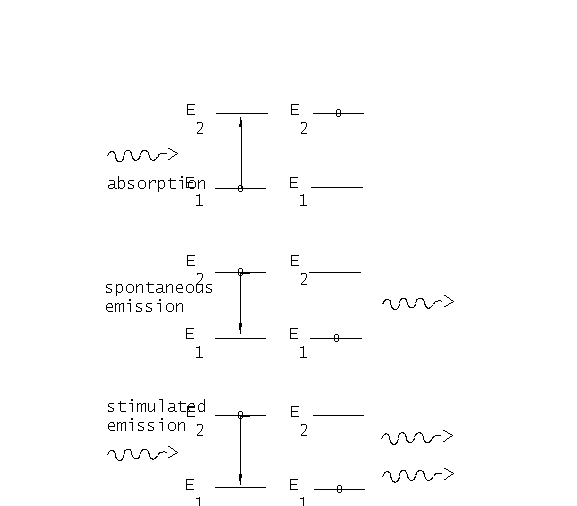
Fig.1 Interaction of photons with atomic system. Top- absorption of photon, middle- de excitation through spontaneous emission, and bottom- stimulated emission induced by an incident photon.
Since the difference in energy level is emitted as photon with energy equal to hn
E2 -E1 = hn (4)
Þ N2= N1 exp(-hn /kT) (5)
The rate of spontaneous transitions made from the state E2 to the state E1 is proportional to the number of atoms N2 ,
P21= A21N2 (6)
where A21 is the constant of proportionality. The rate of stimulated transitions (P¢ 21) is proportional to the number of the atoms N2 and the energy density of radiation of frequency n ( written as Un ),
P¢ 21=B21 N2Un (7)
Finally the rate of absorption of photons of frequency n by which the atoms are raised from the state E1 to the state E2, is P12. In the same way as P¢ 21 , P12 can be written as,
P12= B12N1Un (8)
where B12 is corresponding constant of proportionality. As the system is in thermal equilibrium, the rate of transition from E2 to E1 and E1 to E2 must be the same.
\ A21 N2 +B21N2 Un =B12 N1 Un
This yields using equation (5)
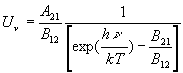 (9)
(9)
Comparing with the Planck's law,
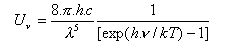 (10)
(10)
we obtain,

and B12=B21 =B (11)
These equations are called Einstein's relations and the coefficients A and B are known as Einstein's coefficients. Note that if the stimulated emission rate is zero, we do not obtain equation(9) in the form of Planck's law (equation(10)). This was observed by Einstein who introduced stimulated emission as another process of emission of photon.
For a system to lase, the rate of stimulated emission of photon should be substantial in comparison to spontaneous emission. The ratio of the rates of spontaneous to stimulated emission is given by,
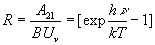 (12)
(12)
At optical frequencies and at normal temperatures the ratio R is very large (~ 1035) showing the predominance of spontaneous over stimulated radiation. Therefore it is very difficult to have visible and lower wavelength lasers.
To make R favourable for lasing in the optical region one has to resort to the following.
(a) Make the energy density of radiation Un very large. This will make the stimulation emission rate to predominate over the spontaneous rate. This is done by enclosing the radiation in a resonator and preventing the radiation from escaping out of the resonator.
(b) N2 should be made larger than N1, i.e. the number of atoms in the energy state E2 should be made larger than that in E1.
In certain atoms (or molecules), there exist states that have considerably greater lifetime compared to other excited states. These states are called metastable states. Fig. 2 shows such a system. The state E2 is a metastable state, and states E1 and E3 are two excited state respectively, while the state E0 is the ground state. If the system is irradiated with em radiation of frequency, n 1 such that,
hn 1 = E3- E0
then electrons will be raised to the state E3. From E3, the electrons make
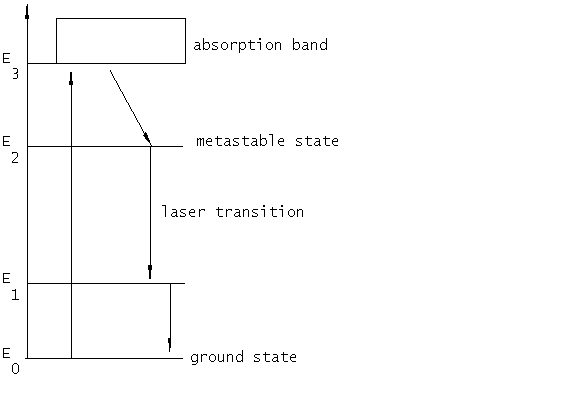
Fig. 2 Energy level diagram of a lasing system. Laser transitions take place from the metastable state to a state below it (E1 or E0).
transitions to the ground state E0 , or to the metastable state E2 , or to the state E1 with emission of photons. As the state E2 is metastable, the number of atoms in this state becomes larger than that in the ground state, if the atoms are continuously irradiated. This situation is called "population inversion". Now a photon with frequency n , given by the equation,
h n = E2-E1
produces stimulated emission of photon by inducing transition from metastable to ground state when it encounters another atom in the metastable state. The photons produced by stimulated emission are all in phase and have the same frequency. The population of photons is multiplied by reflecting the light beam back and forth through the lasing medium using mirrors.
Solved example
At what wavelength is the rate of stimulated transition is equal to the rate of spontaneous transition for an object at room tempearture (T=27oC).
Solution: Absolute temperature, T=273+27=300K
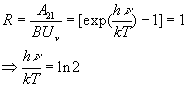
Substituting appropriate values,
n =43.22´ 1011/s
or, l =69.4m m
Laser systems
The first laser was constructed by Miaman in 1960 using ruby crystal (Al2O3 with 0.05% Cr2O3). The process of population inversion is achieved by xenon flash tube lamp, which wounds a cylindrical ruby crystal, several cm long and few mm in diameter. The ends of the ruby crystal are polished flat, normal to the axis, to act as cavity mirrors.
More common laser in the laboratory is the He-Ne laser. Fig. 3 shows a schematic diagram of this laser. The electrodes produce an electric field in the tube. The ionization of gases produces a stream of accelerating electrons. The lighter He atoms can be easily excited to higher states by collision with accelerating electrons. The He atoms which are 10 times more than Ne atoms, are raised to the excited states He2 and He3 (see fig. 4). These metastable states have energy close to that of the higher neon states. These excited He collide with Ne atoms and excite them to metastable states Ne4 and Ne6. Laser transition takes place from these states to the states labelled Ne3 and Ne5 respectively. One of the light wavelength is reinforced by choosing mirrors with high reflectivity for the particular wavelength desired.
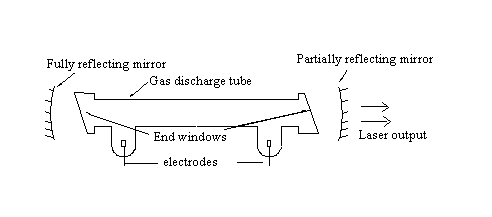
Fig.3 Essential elements of He-Ne laser
The advantage of having the end windows set at Brewster's angle is that the laser produced is plane polarized. The light returning back into the cavity after suffering reflection at the mirror is incident on the window at Brewster's angle. The reflected light at the window takes away the component of light oscillating normal to the plane of incidence. The transmitted light becomes dominantly linearly polarised oscillating in the plane of incidence. This will occur at each passage of the light beam. As the beam goes back and forth a large number of times, therefore the emerging laser output is plane polarized.
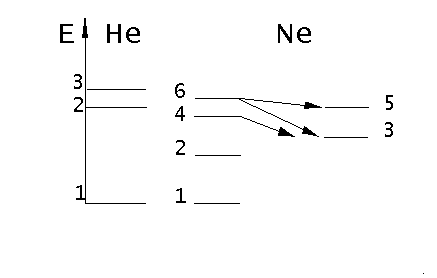
Fig. 4 Energy level diagram of He-Ne laser
An example of molecular gas laser is the CO2 laser. There are several possible laser transitions between states which are vibrational rotational states of the CO2 molecule. The produced lasers are in the the infra red region, from 9.2m m to 10.8m m. Normally output is taken at 10.6m m. The output wavelength is adjusted by inserting prisms or grating into the cavity. The collisions by the molecules of nitrogen produce excitation CO2 molecules. A CO2 laser, 1m in length can provide about 80W in continuous operation. In the pulsed mode peak power in excess of megawatt has been achieved in specially designed configuration. The laser's high power output and efficiency, ( ~ 15-20%) make it a valuable tool for cutting drilling and other similar jobs.
Semiconductor laser: The working of semiconductor laser is somewhat different. It converts electrical energy directly into light without the necessity of a separate unit for optical pumping. A light emitting semiconductor diode (LED) can be designed to give laser. Generally these are made of gallium arsenide crystals. The junction is forward biased so that the holes move toward the p side and electrons move towards the n side across the junction. This creates a population inversion. A hole and an electron can now combine giving a photon of energy equal to the energy gap (Eg) of the semiconductor. This happens when an electron and a hole have the same momentum. To have a large population inversion the impurity concentration is made large (~ 0.1%) and high current ( >3 ´ 108A/m2) is necessary. The end faces of the crystal are polished to work as cavity. The semiconductor laser has a high efficiency. The laser wave length is 840nm and output power 10mW in continuous operation The other advantage is the small size (1mm across), of the laser. Their main areas of applications are in optical communication, and integrated optics.
Application of laser
The applications of laser have grown rapidly and in fact it is one of the most active area of applied research. We will discuss its applications in general and describe in detail its three special applications, namely, holography, optical communication, and laser machining techniques.
High directionality and high intensity make laser an excellent tool for surveying. The laser light beam is taken as reference line when aligning a bridge or a tunnel. The most interesting surveying application by laser is the measurement of relative motion of the plates that make the Earth's crust. In 1969 astronauts placed laser reflectors on the surface of the moon. By measuring the time delay for laser pulse to return, the Earth moon distance can be found very accurately. From two locations stationed at USA and Japan, scientists are able to determine the relative motion between these stations. This relative distance is found to vary which is due to the motion of the Pacific plate.
In pollution monitoring of the atmosphere optical radar technique called lidar (light detection and ranging), is used for the detection of pollutants too small to be detected by conventional microwave radar. A laser beam is directed towards the haze or smoke clouds. From the reflected laser light the composition of the gases forming the smoke is found.
In fusion energy research high power delivering capacity of pulsed laser beam is used to heat rapidly deuterium helium solid pellets. The energy delivered is so fast that it can trigger fusion reaction giving large amounts of energy.
In military, high powered laser beam is finding application in many weapon systems. A high powered laser can drill hole though any armour. In 1989 during the war in the Middle East a bomb fitted with a high powered laser could penetrate an underground Iraqi bunker. Application of this deadly weapon brought a quick surrender by Iraq. In star war programme of the US extremely high powered laser was planned to be commissioned. Mirrors fitted on artificial satellites then would have focused these laser beams on any target anywhere on the globe. Fortunately this programme was withdrawn after US and Soviet governments came to an understanding,
Lasers have numerous applications in surgery. It is used for eliminating the malignant cancerous tissues on the skin. In eye surgery low powered laser is used for spot welding the retinal detachments somewhat as in microelectronics.
Holography: It is a two step process for recording and viewing of images with three dimensional perspective. An ordinary photograph records the information of the amplitudes of waves but information about the relative phases of the waves from different regions is lost. Gabor in 1971, devised a method, whereby both amplitude and phases of the wavefronts are preserved on a photographic plate known as hologram.
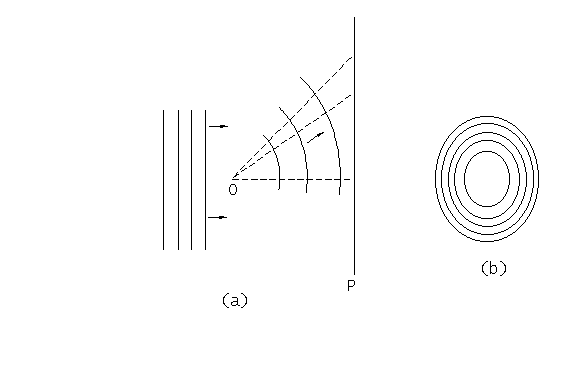
Fig. 5 (a) Interference between plane wave front and spherical wave front originating from the point O. (b) The interference pattern on the screen P resembles Newton rings.
Consider interference of a plane reference wave with spherical wavefronts that are scattered from a point object( fig. 5). The interference fringes are recorded on thin plate P parallel to the reference wavefront. The interference pattern looks similar to Newton's rings. When the plate is illuminated by a coherent plane wavefront of the reference wave. it acts as grating with variable spacing, like that of zone plate. When a parallel beam of light falls on it, two diffracted beams are produced, one which converges at I2, and the other appears to diverge from I1 (fig. 6). On viewing from right we see the virtual image I1 where the point object was situated . Any finite sized object is collection of point sources from which spherical waves are emitted or scattered. A hologram of such an object can reconstruct exact replica of the original waves from the object itself giving a virtual image with 3 dimensional perspective.
Some important uses of holographic technique are, information storage, many forms of non destructive testing, determination of particle sizes etc.
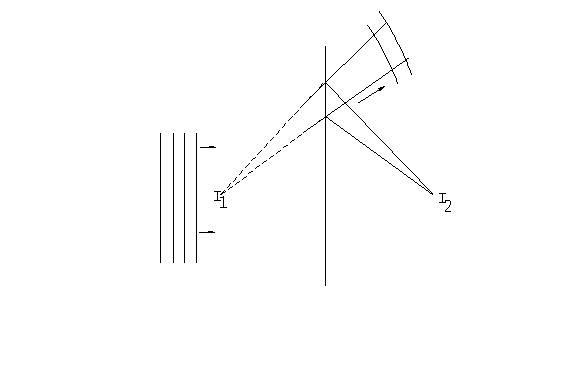
Fig. 6 The photographic plate exposed by the fringe pattern when illuminated by a plane wave front, diffracts the beam producing the real image I2 and virtual image I1.
Optical communication: The optical-fiber technology has developed since the fifties. The optical-fiber is less expensive, lighter in weight, equally flexible, not subject to electrical interference, secure to interception and can be made with negligible losses (~ 1dB/km). Its several advantages have produced rapid growth of optical fiber network replacing the metallic transmission medium. The long life span together with considerable less capital required in commissioning the system has made this communication medium compete even with satellite communication. An intercontinental network which passes through several oceans connecting many countries across the world has been commissioned.
Optical-fiber consists of transparent core of glass of a given refractive index surrounded by a cladding layer of material of lower index. The light carrying the information travels inside the core as it is contained there by the total reflection at the core cladding interface. The light can only escape if the angle of incidence at the interface becomes less than the critical angle. This can happen when the fiber is bent sharply.
A basic point to point circuit consists of a transmitter, a receiver, and a length of fiber. This length may be from a few meters to 50 or more kilometers long, with segments joined together with connectors. The electrical signals are used as a control voltage to vary the light intensity of a laser source. The output of a semiconductor laser is varied around a mid brightness intensity level. The intensity varying light is focused onto the end of the miniscule diameter glass fiber. At the other end of the fiber, attenuated blinking light is focused onto a photo detector, which converts the light intensity variations back into an electrical signal.
Light centered on three groups of wavelengths (called windows) is used in information transmission systems. In these windows, attenuation per kilometer is substantially lower than other wavelengths in the infrared spectrum. Window III centered on 1550 nm has the least attenuation, only 0.5 decibel per kilometer.
The fibers are made from SiO2 boules on optical lathe. Then hair thin (0.125 mm diameter) optical fiber is drawn under extreme care and immediately protected with a plastic coating. They are fully tested to ensure that they do not break during their expected 25-year life. Once tested, the fibers are shipped to the cable factories. Here four fibers are embedded in the cable. The cable consists of an inner core, containing the transmission fiber, surrounded by an interlocking array of steel wire. This provides longitudinal strength to the cable. It also protects the fibers from ocean pressure that can change the fiber characteristics.
Additional protection comes from the watertight copper jacket . The copper jacket acts as current conductor for dc at 7500 V, 0.9 A necessary for the equipments along the path. A layer of high density polyethylene plastic insulates the copper jacket.
In the present systems minimum distortion in the transmission is achieved by transmitting binary digital representation of the original analog information signals, which may be human voice, still or motion video images.
The optical signal needs to be amplified en route after every 45 to 85 km, because of the attenuation of signal due to absorption. In the new technique - an optical amplifier in which the incoming optical signal is boosted by an erbium doped fiber amplifier. Erbium atoms replace up to 0.1 percent of the atoms in the fiber core. The erbium atoms enter an excited state when pumped by a 10 to 30 mW semiconductor laser at 1480nm wavelength. When the 1558 nm light from the signal laser arrives, it triggers the erbium to emit at the same wavelength as the signal, thus amplifying the signal. Both wavelengths nicely match the ~ 1500nm band, in which the optical transmission fibers have their lowest signal losses.
Laser machining: Laser machining of materials is now widely used in industry. Laser drilling is used for rough drilling like in watch jewels, diamond dies and other machine parts where high precision is not needed. Another promising application of high powered continuous wave laser is separation of materials (cutting, scribing and thermal cleaving). Cutting is done using the CO2 and garnet lasers. The CO2 lasers are most advantageous ones for cutting since they have high efficiencies (about 15-20%). Moreover the radiation at the wavelength 10.6m m is most easily absorbed by numerous materials, e.g., metal oxides, glasses, quartz, natural organic materials (wood, leather etc.), man made materials etc.
The material can be cut by total removal of the material along the cutting line or by a partial removal by drilling small diameter holes along the cutting line in a plate and subsequently breaking the plate along this line. This cutting technique is called scribing. Plates of brittle material can be cut by thermal cleaving without removing any material.
During laser cutting the typical procedure is to blow a gas through the cutting zone. For inflammable materials an inert gas like nitrogen is used. For metals oxygen is used which converts the metal into oxide. The flowing gas removes the disintegration products.
The amount of energy required for cutting materials with continuous wave laser radiation is determined by the optical and thermal properties of the material. Polished metal have high reflectivity for wavelength 10.6m m. However the efficiency of the process is significantly increased due to the oxidising atmosphere and high temperature.
The laser cutting has the numerous advantages compared to the other techniques which are, a narrow cutting zone, very small size of the heat affected zone, small mechanical shear force in the material due to the absence of cutting force, possibility of cutting the material along lines of any shape in two or more planes and high cutting rates
Laser welding is especially useful when it is essential to limit the size of the heat affected zone (e.g. metal semiconductor welding in microelectronics), to reduce the roughness of the welded surface and to eliminate mechanical effects. Lasers are generally used for welding multilayer materials in which there are discontinuities in thermal properties at the interface.
Laser safety
Laser is particularly dangerous for the eye even at low intensities. The reason is that focused laser beam produces extremely high energy density. Due to spatial coherence of laser, the amplitudes from all the points on the wavefront add up giving very high intensity. This is in contrast to an ordinary light beam which due to incoherence gives less intensity. If the laser light is seen with accommodated eye, the focused laser will instantly burn the spot. The 1mW He-Ne laser used in laboratory experiment has maximum permissible exposure time of 0.1s for the eye. This is shorter than the human reaction time. Therefore extreme care should be taken while working with lasers.
Questions and Exercise
1. At what temperature would the number of spontaneous and stimulated transition be equal at 5893Å ?
2. A molecule is in its first excited state of energy 1meV, and is situated in a thermal radiation field at room temperature. Find the ratio of spontaneous to stimulated emission rates.
3. Think of the possible ways of dissipation of input energy in a laser system that usually results in a low efficiency?
4. Why a high powered laser can only be operated on pulsed mode?
5. Laser is produced by transition of atomic states, and therefore it must give sharp spectral lines. Why then there is always a small frequency spread around a line?

About the author of this page: Dr. Atish Mozumder is college professor in Physics and freelance writer. His primary focus is to make science more interesting for the learners. He holds a Ph.D. in High Energy Physics from the University of Delhi. His other interests are Java programming and trekking in the Himalayas.>find more details