capacitor Capacitor is an electrical device that
stores charge. The most general configuration of a capacitor is a pair
of parallel conducting plates, separated by a distance d with a
dielectric in between the plates.
Consider such
a parallel plate capacitor without the
dielectric for simplicity. The potential difference between the plates
is Ed where E is the electric field. The charge of each plate is
e oE A (this can be shown by Gauss Law*), where e o
is the permittivity of free space and A is the area of each plate.
The ratio of charge on any plate to the potential difference is
called capacitance (SI unit Farad, symbol F). The capacitance of parallel
plate capacitor is e 0 A/d. Introduction of dielectric
in between the parallel plates increases the
capacitance by a factor of dielectric constant of
the material. Various dielectric materials are
used for the production of capacitors, e.g. paper, plastics or ceramics.
A capacitor can
confine strong electric fields in a small volume. The electric
field is a reservoir of energy. Therefore the capacitor serves
to store energy, which is released when discharging of
the capacitor occurs. In electronic circuits, they are
used in conjunction with other devices, to reduce
voltage fluctuations in electronic power supplies, to
transmit pulsed signals, to generate
or detect electromagnetic oscillations
at radio frequencies, and to provide time delays.
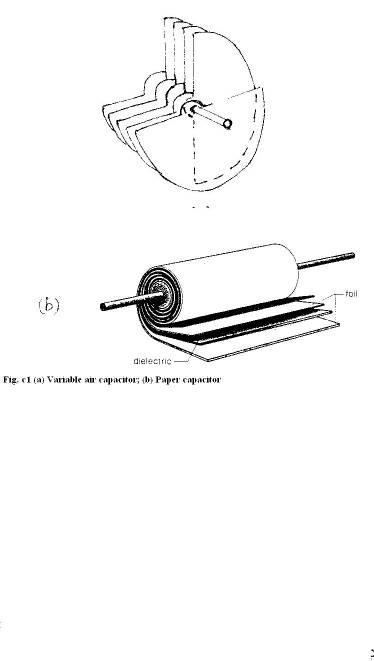
Practical forms of capacitor: Air capacitors are the most simple and have precisely known capacitance. It has low insulation strength. The tuning capacitor in a radio is a variable air capacitor (fig.c 1-a). The capacitors are also made like swiss roll; a paper of dielectric constant 5 rolled in between a pair of aluminium foils (fig.c 1-b). This arrangement is packed in a cylinder of metal or waxed cardboard. Capacitances of such capacitors range from 10-3 m F to 10 m F and are suitable for frequency range 100 Hz to 100 MHz. Electrolytic capacitors have the largest capacitance. An electric current through a solution of aluminium borate using Al electrodes produces a very thin layer of oxide on the anode. This oxide film is the dielectric in electrolytic capacitors. An electrolytic capacitor has one terminal marked + , showing the way it has to be connected. They are damaged if they are connected wrong way round.