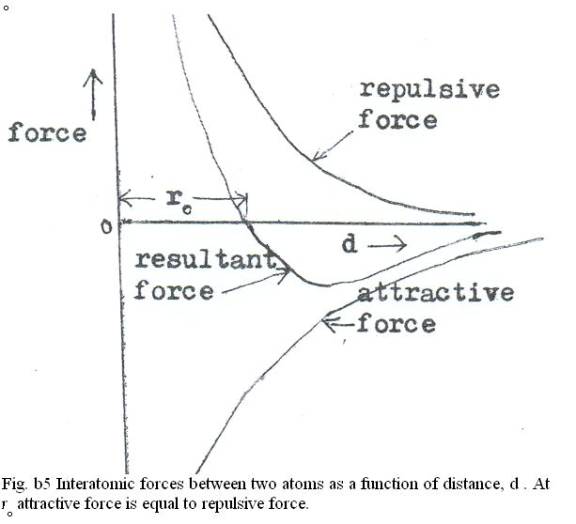
bonding in atoms The variation of force between two atoms
with inter atomic distance is shown schematically in fig 1. At large
distance of separation, the significant force is attractive. At closer distance
a repulsive force also becomes significant and increases rapidly with
decreasing distance of separation. At one point the attractive and repulsive
forces exactly balance. At this point the potential energy of the system of two
atoms is minimum, and is called the `bond energy'.

According to strength, the bonds
can be classified as primary and secondary bonds. Primary bonds have bond
energies between 1 to 10 eV/bond. Ionic, covalent and metallic bonds are
primary bonds. Amongst these the metallic bonds are the weakest. Secondary
bonds have energies in the range of 0.01 to 0.5 eV/bond. Van der Waal bond and
hydrogen bonds are examples of secondary bonds.
Ionic bonds : Ionic bonding forms between two
oppositely charged ions. The ions are produced by transfer of electrons from an
atom of one element to an atom of another element. We consider the example of
sodium chloride. Sodium (Z = 11) with electronic configuration 1s22s22p63s1
has its first ionization potential 5.1 eV/atom. The outermost electron is
removed by supplying this much of energy.
Na -à Na+ + e-
The released electron is
accepted by Chlorine atom to fill its outermost vacant state.
Cl + e- -à Cl-
The electron affinity of
Chlorine is 3.8 eV/atom. Therefore the electron transfer results with a net
increase of potential energy E = 1.3 eV/pair. This increase is more than
compensated by the energy decrease due to electrostatic attraction between
oppositely charged ions.
Covalent bonding: It occurs by sharing two electrons
between neighboring atoms. A good overlap of the orbitals is necessary, so that
the shared electrons are close to both the nuclei. It results with a net
decrease of potential energy. This occurs when there exist vacant electron
states in the outermost orbital of the bonding atoms. Depending upon how much
the number of outer electrons differ from close shell configuration an atom is
limited in the number of covalent bonds it can make. For example in carbon,
which has four outermost electrons, can be involved in four bonds at
tetrahedral angles 109.5o, which is seen in crystalline diamond and
innumerable other organic compounds.
Overlapping orbitals are
directionally oriented, and not spherically symmetric. This gives
directionality of covalent bonds. Sharing of electrons and formation of
covalent bonds readily occur between atoms which have unfilled p orbitals. The
p orbitals are directional in nature and therefore permit efficient overlapping
of orbitals in the direction of maximum probability density. The overlapping
can either be end-to- end (s bond) or lateral (p bond), which are shown in the figure 2.


Metallic bonding : Metallic characteristics are shown by
elements which are left to the fourth column in the periodic table. In these
elements the sharing of electrons between neighbouring atoms is not possible,
as there are not enough electrons to produce inert gas configuration around
each atom. The electrons form a common pool, called the free electron gas, in
which all atoms have contributed their outer electrons. These electrons have
freedom to move anywhere within the crystal and act like all pervasive, mobile
glue holding the positive core together. This freedom makes the metallic bond
non directional.
Secondary bonding : Many molecules posses permanent dipole
moment. This arises because in a molecule centres of positive charge and
negative charge do not coincide. The best example is water molecule. Two water
molecules form weak bond by orienting positive and negative charged ends. This
bond is directional.
The bonding between atoms of
inert gases, when they are in solid crystalline form, at very low temperature,
is called Van der Waal bonds. The momentary fluctuations in charge distribution
around atom result in weak fluctuating dipole moment. The electric field of
this imbalance can induce dipole moment in the neighbouring atom, in such a way
as to attract it. This dipole induced dipole attraction is non directional in
nature. The Van der Waal bond energies are very small.