binding energy The mass of a nucleus is always less
than the sum of masses of the neutrons, and the protons of which it is
composed. The energy equivalence of the difference of mass of the nucleus, and
the total mass of the particles constituting the nucleus is the binding energy
of the nucleus. Obviously it is the energy that holds the nucleus together.
Binding energy can be defined as the amount of energy required to break the
nucleus into isolated particles.
The binding energy can be found
from the mass defect D m, which is defined as,
D m = ( Z mH + N mn
) - m (b7)
where Z is the number of
protons, N the number of neutrons, mH the mass of hydrogen atom
(consisting of a proton and an electron), mn the mass of a neutron,
and m the mass of the atom. The masses mH, mn in atomic
mass unit (u) is given by,
mH = 1.007825u
mn = 1.008665u
The value of u = 931 MeV. To obtain
the binding energy D m will have to be multiplied by the conversion factor 931
MeV/u.
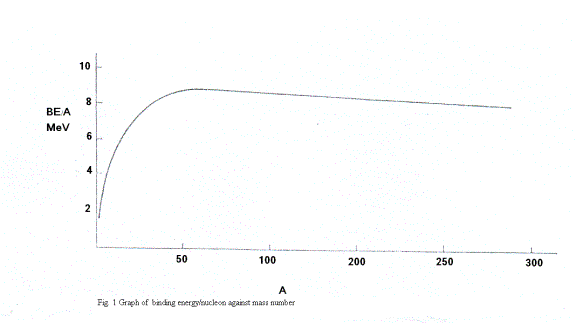
The graph of binding energy /
nucleon (BE/A), against mass number A is shown in the fig.b4. BE/A increases
sharply up to mass number 50 to 60, after which it decreases slowly. This graph
indicates that there are two ways by which energy can be released from the
nucleus. The first is to split a large nucleus into smaller nuclei (fission).
The other possibility is to combine smaller nuclei into a large nucleus (fusion).