Band Theory of Solids The presence of periodic potential in a
crystal leads to energy bands, which are essentially energy intervals between which
energy levels are nearly continuous. In fig1b the resulting potential energy
function for a row of atoms is shown. The inner electrons have allowed energy
that are localized in the vicinity of the nuclei. By comparison the 3s
electrons are not localized to any particular atom. This happens in a metal
like sodium, where 3s energy levels (or wave functions) overlap to such an
extent that allowed energy values of these electrons are virtually independent
of position in the crystal and constitute a continuous band extending through
the entire crystal.

Fig b1
In nonmetals, the broad bands
that lie above the inner electron bands can be divided into two groups: the valance
band, whose available states are occupied by valance electrons, and the
conduction band, whose available states are occupied by electrons that can
participate in electric conduction. These bands are separated; the difference
between the lowest possible energy value of conduction band and the highest
possible energy value of valance band is called band gap (see fig b2).
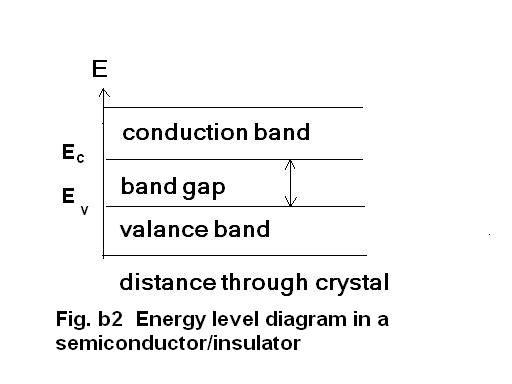
At absolute zero temperature,
the available states in the valance band of a nonmetal are completely filled,
while in the conduction band they are completely empty. At a higher
temperature, the electrons that are sufficiently energetic overcome the gap.
This happens in a semiconductor where the gap is small (~ 1 eV). Thus in a
semiconductor, electrons are available for conduction at room temperatures. In
an insulator the band gap is so large ( >3 eV) that no electron can overcome
this gap at normal room temperatures.
In a metal either the valance
band and conduction band overlap or it has partially filled valance band. Hence
electrons in large number are available for conduction.