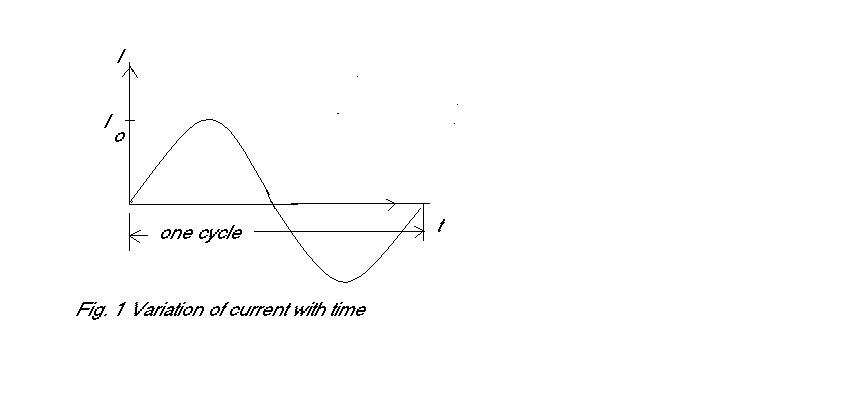
alternating current (ac) Unlike the direct current the alternating current does not remain constant with time. The variation of current with time is shown in fig.1. The number of times the ac cycle (see fig. 1) repeats in a second is called the frequency, f. In ac mains f= 60 cycles/s,in USA and f=50 cycles/s elsewhere.
The value of current at any instant of time, t can be found from the expression,
I = Io sin 2p ft = Io sin w t
where w = 2p f, is the angular frequency. Similarly the voltage also varies as,
V = Vo sin 2p ft = Vo sin w t
When ac voltage is applied to a resistor R, Vo and Io are related as,
I0 = V0 / R
which is Ohm's law, as in direct current.
If a pure inductance L is connected to an ac source,the current is sinusoidal and of the same frequency, but p /2 or 90° behind the voltage in phase. In addition amplitude of the current is,
I0= V0 /w L
It shows that w L(=XL) plays the same role as R. It is called the inductive reactance.
If a capacitor C is connected to an ac source then,
I0 = w C V0
showing 1/w C (= XC) playing the same role as R. XC is called capacitive reactance. In this case the current leads the applied voltage by p /2.
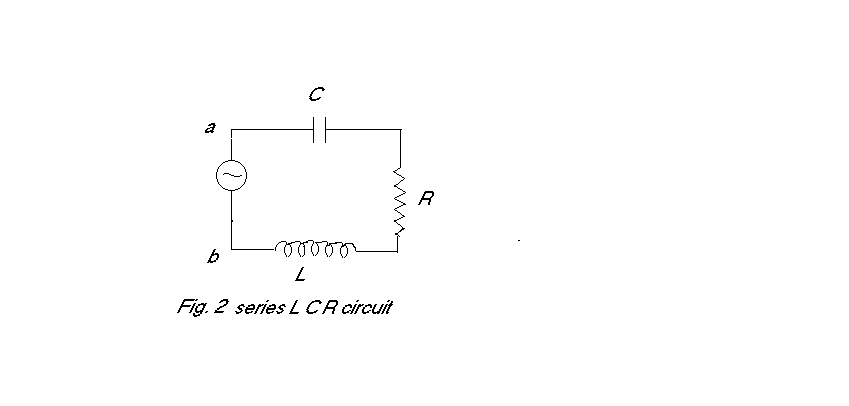
If all three elements are connected in series as in fig.2, with Vab as the driving emf,
Vab =VR +VL +VC
where each of these voltages can be represented as a vector as shown in fig a3. The voltage VR is represented on the horizontal axis, while the voltages VL and VC are represented on vertical axis. VC lags VR by 90° , therefore we represent it by downward vector, while VL leads VR by 90° and we represent it by upward vector. Obviously the ac current lags the driving voltage by an angle q . Vab can be found from the fig. 3,
Vab = Io Z
where Z = [R2 + (XL -XC)2]1/2
Z is called the impedance of the circuit. It can be defined as the ratio of amplitude of emf to current for the whole circuit. The inverse of impedance is called admittance. q can be found from the equation,
tan q = (XL-XC)/R
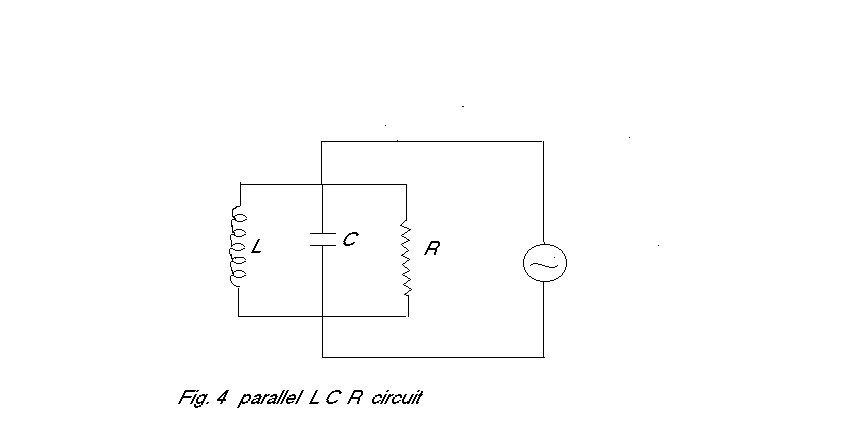
If R,L, and C are connected across ac source in parallel as in fig.4, then impedance of the circuit is given by,
Z-1 = [ R-2 + (XC-1 – XL-1)2 ]1/2
In this case the current leads the voltage. The phase difference q is given by,
tan q = [ XL-1 – XC-1 ] R
Instead of instantaneous values, root mean square values of the current and voltage are more useful. These are comparable to dc values, in being a measure of the ability of the current to transmit power,
Irms = Io /Ö 2 , and Vrms = Vo /Ö 2
The average power dissipated in purely resistive circuit is
P= Vrms.Irms
When current and voltage are not in phase, the average power dissipated is,
P = Irms.Vrms.cos q
where q is the phase difference between voltage and current. P is also given by,
P = I2 .R
which is the heat dissipated in the circuit.