
accelerator A machine employed for increasing kinetic energy of charged particles, used for research in nuclear and particle physics.
Charged particles (produced when excited atoms release electrons giving e- and ions) are accelerated in an electric field. The gain in the kinetic energy, K for a particle with charge e when it passes through a potential difference V, is given by,
K = e V
Thus higher the potential difference, higher will be the energy of the particle. Hence earlier attempts were directed in producing higher voltages, like the Van de Graaf generator*. There is a limit of producing very high voltages. The maximum energy obtainable by such methods were 10 MeV.
Alternatively one may apply potential difference along the particle path, a large number of times. In a linear accelerator a similar method is applied. A series of tubes arranged in a straight line are connected to radio frequency power supply, so that particle arrive at each tube when phase of the electric field in the unit provides maximum acceleration.
Reduction of the size of the accelerator is achieved in an orbital accelerator. A magnetic field is applied at right angles to the particle trajectory which constrains the accelerating beam to a spiral or circular orbit. This method is used in cyclotron, synchro-cyclotron, synchrotron etc.
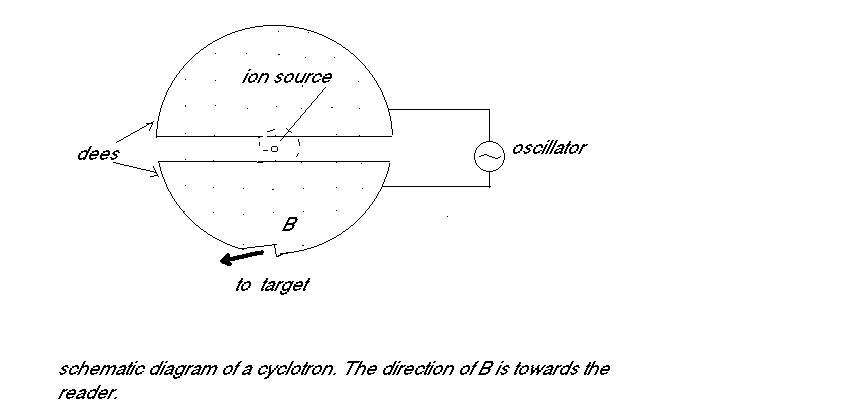
In a cyclotron,(see fig) two Dee shaped cavities, placed back to back with a gap between them, are enclosed in a vacuum box and the whole structure is placed between the pole faces of a large electromagnet which produces a magnetic field at right angles to the plane of the Dees. The two cavities are connected to an alternating voltage supply . The particle ion source is at the center of the machine.
The cyclotron frequency, fc can be obtained by equating the Lorentz force* and the centrifugal force,
e v B = g m0v2 / R
where e is the charge of the particle of rest mass m0, R is the radius of the orbit and B is the applied magnetic field. g is the Lorentz factor* to take into account the relativistic effect. As, v = w R = 2p fc R , equation (a7) gives,
As long as the value of g for the accelerating particles remains close to unity, fc is independent of the radius of the orbit. A fixed frequency can be chosen for alternating voltage supply so that particles passing the gap between the cavities always experiences an electric field that causes the acceleration. Particles from an ion source therefore spiral outwards gaining energy at each traversal of the gap between the Dees. The cyclotron can operate for protons up to 30 MeV.
When the relativistic increase in the value of g can no longer be ignored, particles traversing the acceleration gap in a cyclotron would get out of phase with applied electric field. In a synchro cyclotron this is overcome by changing the frequency of the voltage supply to the Dees.
The energy loss due to synchrotron radiation is the most important limiting factor for such machines. The energy loss per revolution, W is proportional to g 4.
Very high energy particle beams are produced by synchrotron. An evacuated tube is bent to form a large ring that passes through a number of magnets and acceleration stations round its circumference. Synchrotron producing protons up to 70 GeV employ electromagnet. But for energies >100 GeV, superconducting magnets are used. Particles are injected into the ring having first been accelerated by linear accelerator up to 50 MeV. As the particle energy increases, the magnetic field and the frequency of radio frequency power supply are increased so that the beam orbit is kept within the tube and the particle continues to accelerate.