acceleration Symbol a. SI unit is meter per second squared (m/s2). Acceleration is defined as the rate of change of velocity with time.
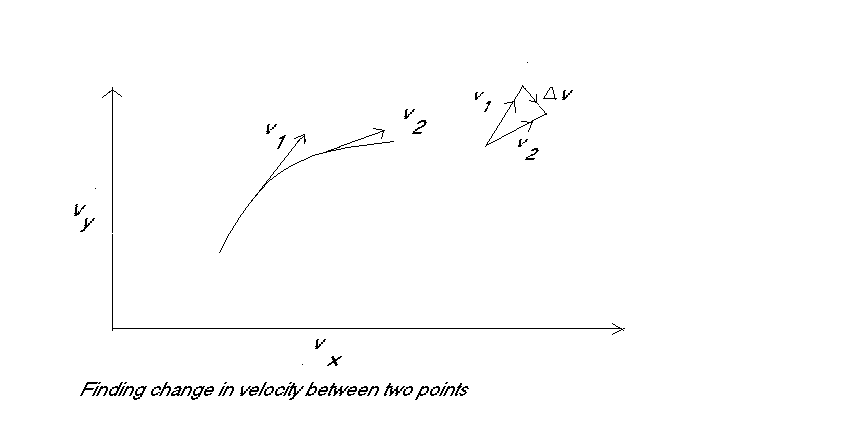
Consider a particle that is at the point A and moving with velocity. v1 (see fig) Since velocity is a vector it is represented by an arrow. The direction of the arrow gives the direction of the vector and its length gives the magnitude. After time interval D t the particle is at point B and its velocity has changed to v2. The difference (v2-v1) divided by D t gives the average acceleration, a (also a vector).
a=(v2 - v1)/D t
A particle can also undergo variable acceleration, in that case we define instantaneous acceleration
a=dv/dt
Uniform acceleration in one dimension: For a particle undergoing constant acceleration in one dimension, the following kinematical equation (equations of motion without force) can easily be obtained.
v = u + at
s = ut +(1/2) at2
v2 - u2 = 2as
where u is the initial velocity, v the velocity at time t and s the distance traveled by the particle in time t. The vector signs have been dropped since motion is confined in one dimension.