the cookie monster ate my night lunch ...
Historic Lick Observatory was once the home of the largest refracting telescope in the world.
Yerkes observatory in Williams Bay quickly claimed that title at the cost of a much poorer
quality site due to the low elevation.
James Lick was a millionaire who made his fortunes importing chocolate and then
buying up land in San Francisco during the gold rush.
His dying wish was to build an obelisk in San Francisco or a large telescope
both of which eventually got built.
In the 50s, Palomar observatory comissioned a nearly 2/3 scale mirror for its
200 inch reflector. The scale mirror was donated to Lick observatory
resulting in the curiously long focal length Shane 120 inch telescope still
in use today. Lick observatory has been the site of a lot of firsts in
UC astronomy including the first working AO system and more recently the
first on sky laser AO system.
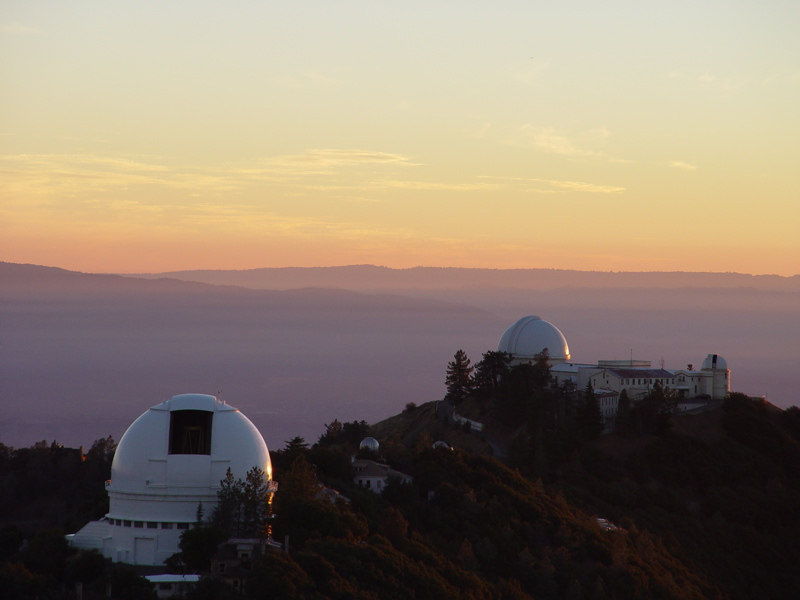
I almost got arrested trying to take this picture. I had to wait for just
the right moment when the trees were getting some nice red light and
you could see the Shane 120 inch inside the slit in the dome.
I earned this one. It was cold as hell up there!
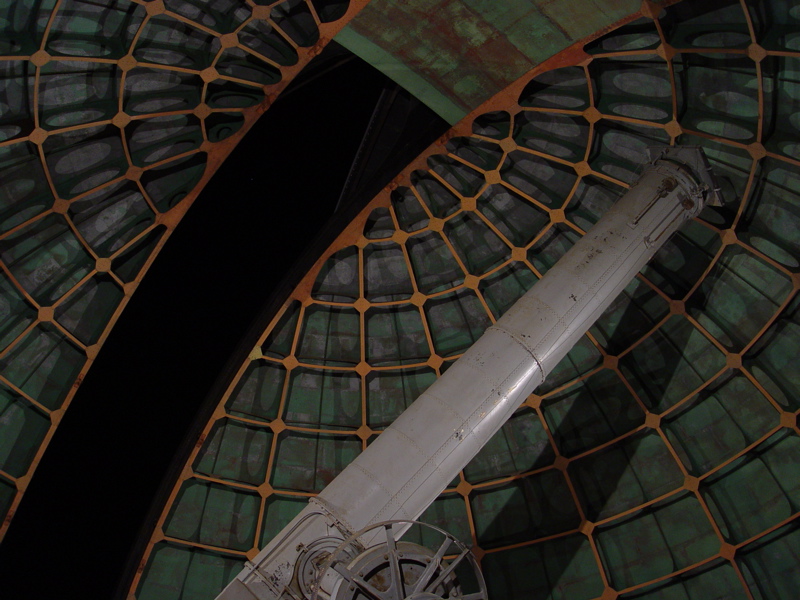
The 36 inch refractor inside its dome.
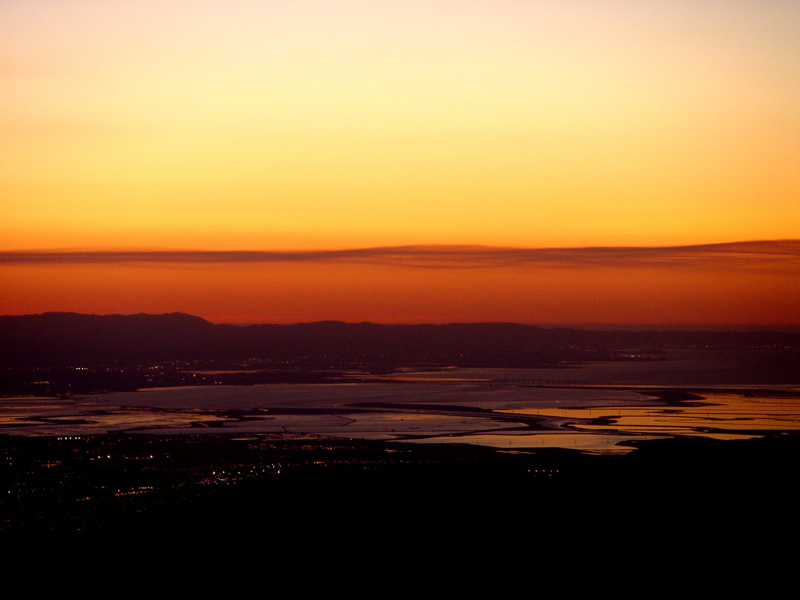
San Jose from the parking lot in front of the main building.
From this vantage point you can see downtown San Francisco on a good day.
On a really exceptional day you can see the Yosemite Valley!
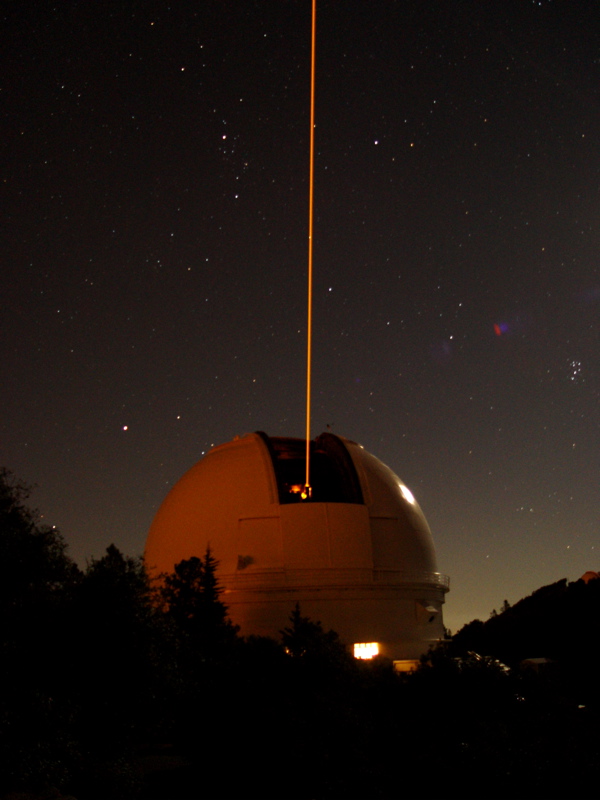
Pulsed dye laser used for laser guide star adaptive optics.
I once overheard someone at Starbucks say: "I saw a laser up on Mt. Hamilton
and they were trying to shoot something down!"
That is incorrect. The purpose of the laser is to shine a nice bright dot
on the sodium layer in the atmosphere to use as a guidestar. The laser is not
even powerful enough to bother a bird much less shoot something down.
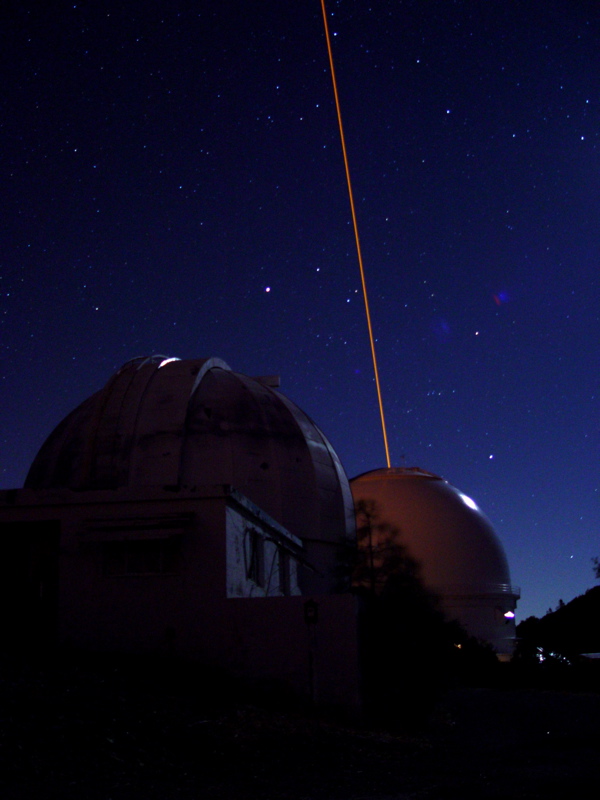
Another shot of the laser fron in front of the now defunct astrograph.
The jpg algorithm didn't seem to like the laser beam.
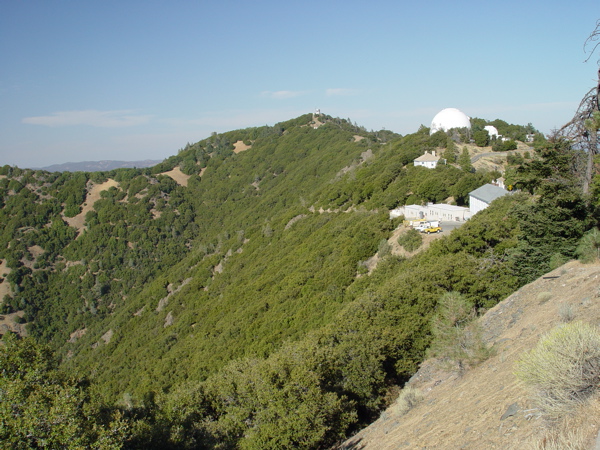
(Left) The North face of Mt. Hamilton is covered with oak trees.
In light of the recent Mt. Stromlo disaster this is a bit worrisome.
In the distance is the firetower where I took my famous sunset pic.
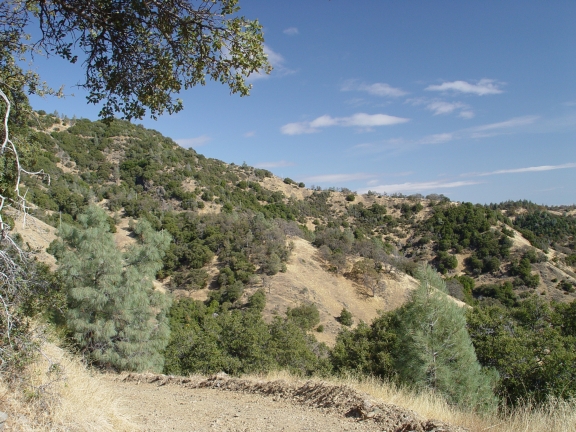
(Right) The terrain around the South slope which is characteristic of
of the inland mountain ranges around here.
Bands of wild boar roam these mountains freely and it can be startling to
chance upon a pack of grumpy pigs while hiking!
One of the off limits areas is a place called "Trumpler's Garden" where Trumpler grew the vegetables
that he would sell to people in San Jose just so he could continue observing during the great depression.
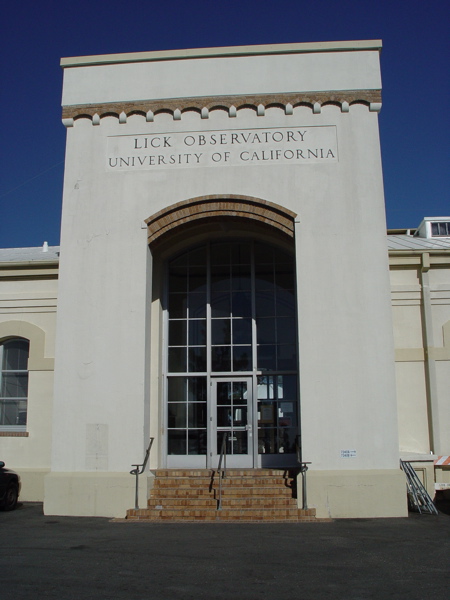
The entrance to the old building that houses the 1-meter nickel and the
36 inch refractor. There also used to be a really nice dormatory for the visiting
astronomers here, but fire claimed that in the 30s.
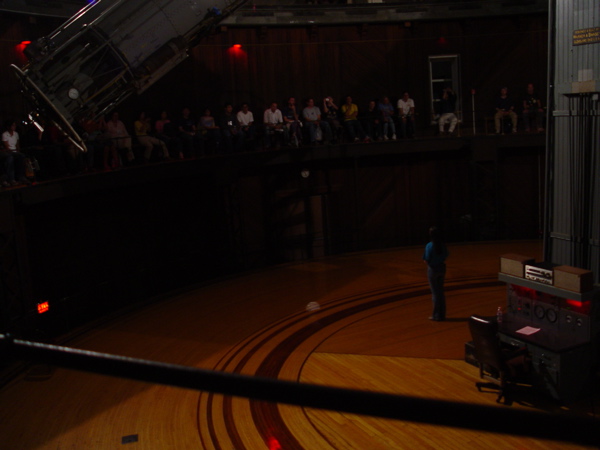
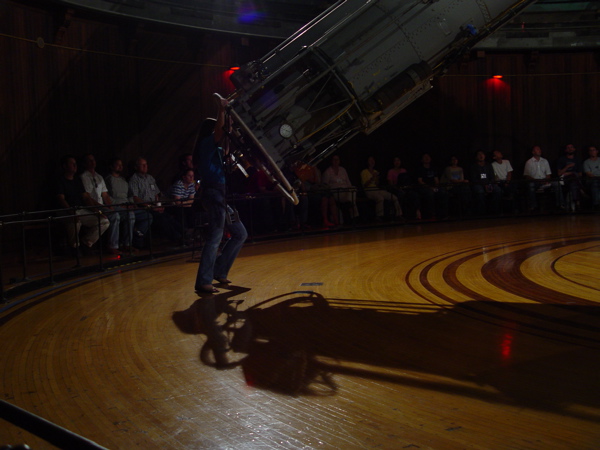
Dr. Ellie Gates demonstrates the principles of refractor telescope operation.
(Left) Because the refractor is so long, the observer must operate an elevator
to accomodate the changing angle of observation.
(Right) The observer moves the telescope by hand. Even though it weighs as much as an
elephant it is perfectly balanced. The telescope is a mechanical marvel for its time
since it has indicators for right ascension and declination built in and
can track an object once it is set into postion.
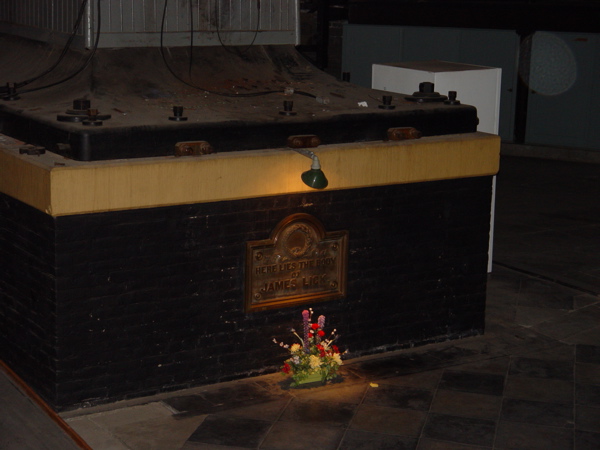
Something most people never notice is Lick's grave underneath the
36 inch refractor elevator.
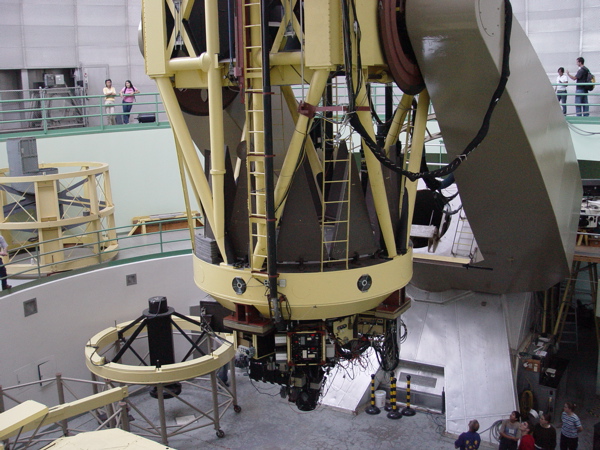
The Shane 120 inch telescope.

A modern instrument, IRCAL, is a dewar cooled infrared camera.
Lick Observatory has been known as having really great food.
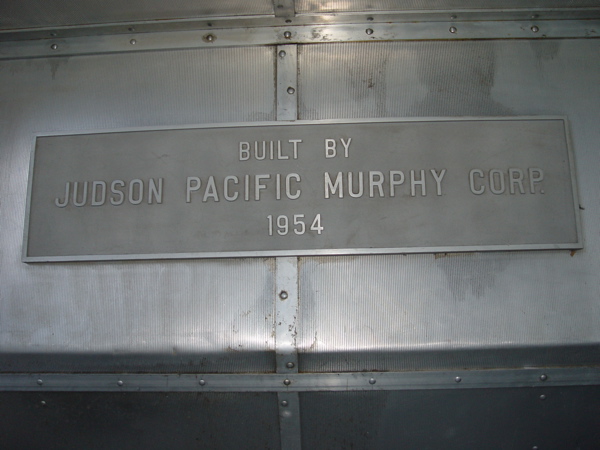

(Left) Maker's mark on the 120 inch.
(Right) The Prime Focus cage. Before the era of modern instruments at Cassegrain Focus,
astronomers were more like photographers in the sense that they
had to ride around with the telescope and their photographic plates.
The hole is where the light from the telescope comes into focus. Ellie
described this spot at "swimming in stars".
Of course riding around on the telescope had disadvantages including downright
mind numming cold.
A picture recently published in Smithsonian shows Margaret Burbidge sitting
in the prime focus cage.