

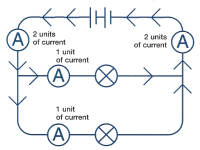
In a parallel circuit, there are junctions placed so that there are multiple paths for the current to follow. As the number of bulbs increase, so does the amount of current flowing through them, because the resistance is spread throughout the paths. Also, the current is not the same at all points in the circuit. The main advantage of a parallel circuit system is that if one item (such as a bulb) shorts out, the rest of the bulbs will stay on.
Series
Circuits
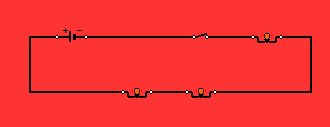
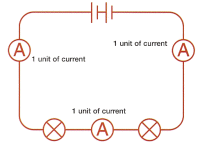
In
a series circuit, there are no wire junctions, and all bulbs are placed
consecutively on the same path. The more bulbs there are in a series
circuit, the more resistance to flow tthere will be, meaning less overall
current in the circuit. Thus, you can regulate the amount of current
not to overflow by simply adding more bulbs. The advantage to a series
circuit system is that if a necessary item shorts out, the whole system
will shut down rather than run dangerously.
Calculating
Resistance and Current
The
main formula in calculating resistance and current is E=IR; where E stands
for voltage, measured in volts; I stands for current, measured in amperes
(amps); and R stands for resistance, measured in ohms.
In a series circuit, each
bulb's resistance adds up to create a total resistance, and you then divide
the voltage in the circuit by the total resistance to arrive at the current
for the circuit. For example, if a series circuit has a 9-volt battery
and 3 1-ohm resistors connected, then the total resistance is 3 ohms, and
the total current is 9 / 3 = 3 amps.
In a parallel circuit, each
bulb's current adds up to a create a total current, and you then divide
the voltage in the circuit by the total current to arrive at the resistance
of the circuit. For example, if you have a 120-volt circuit with
3 10-amp bulbs, then the total current is 30 amps, and the total resistance
is 120 / 30 = 4 ohms.
by Pradeep
