 |
| Electricity and Magnetism |
| Electricity and magnetism deal with the characteristics of electric charges, currents, electric fields, and magnetic fields. The practical applications of this knowledge led to development of electric machinery and of electronics.The movement of a compass needle, near a conductor through which a current is flowing, indicates the presence of a magnetic field around the conductor. When currents flow through two parallel conductors, the magnetic fields of the conductors attract each other when the current flow is in the same direction in both conductors, and repel each other when the flows are in opposite directions. The magnetic field caused by the current in a single loop or wire is such that if the loop is suspended near the earth, it will behave like a magnet or compass needle and swing until the wire of the loop is perpendicular to a line running from the north and south magnetic poles of the earth. |
|
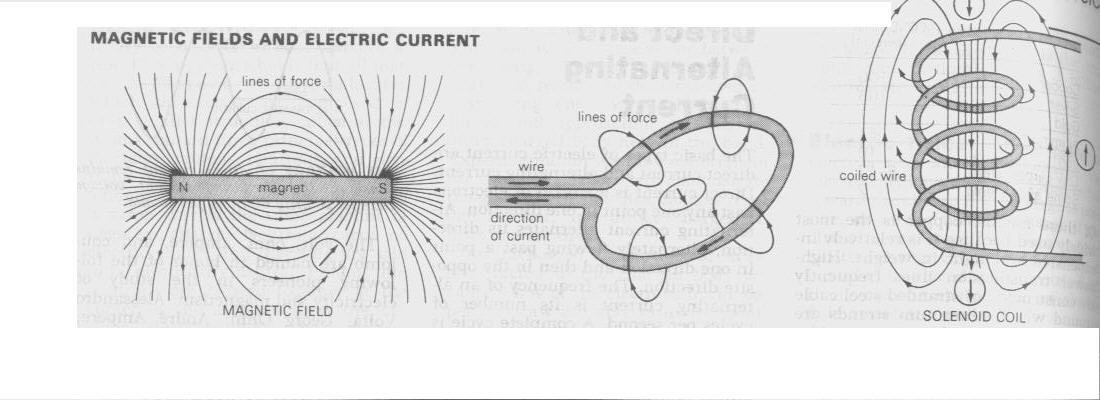
| The magnetic field around a magnet can be represented by lines of force joining the north and south poles. An electric current in a wire creates a magnetic field represented by lines of force in circles around the wire. The magnetic field created by a solenoid (a coil of wire) is identical to the magnetic field created by a bar magnet. |
| Different materials have different characteristics in an applied magnetic field; there are four main types of magnetic behaviour: antiferromagnetism, ferromagnetic, paramagnetism, and diamagnetism. Antiferromagnetism is a phenomenon in some magnetically ordered materials in which there is an anti-parallel alignment of spins in two interpenetrating structures so that there is no overall bulk spontaneous magnetisation. Ferromagentic is a phenomenon in some magnetically ordered materials in which there is a bulk magnetic moment and the magnetisation is large. Paramagnetism is a phenomenon in some magnetically ordered materials in which there is incomplete cancellation of the anti-ferromagnetically arranged spins giving a net magnetic moment; observed in ferrites and similar materials. Diamagnetism is a phenomenon in some materials in which the susceptibility is negative, i.e. the magnetisation opposed the magnetising force. It arises from the precession of spinning charges in a magnetic field. |
| Sources Deblij, Harm J.; "The Volume Library"; vl.2; Hammond Publiations; Nashville, Tennessee; 1987 magnetism@ encarta.msn.com electricity and magnetism @ phsics.about.com |