Alternating current and direct current, besides providing the name for a popular Australian metal band, are different methods of generating and transmitting electricity. Direct current (DC), most frequently used in batteries, is always sent in the same direction. In the late 19th century, all electricity was transmitted in this manner. At the time, scientists at General Electric observed a major problem with DC: hysteresis. Hysteresis is the loss of current due to excessive resistance, and it was most severe in motors. Thomas Edison insisted on using DC power, and during the 19th century, nearly all of America's power plants produced DC.
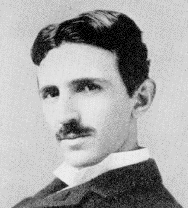
In the late 19th century, a Swedish scientist named Wenstrom discovered alternating current (AC). However, he most important scientist of the 19th century with respect to electricity was probably Russian scientist Nikola Tesla (above). He discovered the most important advantage of AC: voltage transformation (Kurtus, 2001). DC loses its voltage over long distances and, therefore, cannot be transmitted over long distances. AC, however, can be generated at staggering voltages and go through a transformer to lower the voltage shortly before it reaches consumers.
Today, most electrically powered items in the U.S. are designed to operate at 60 Hz (Goldsmith, 1963: p. 61) because all electricity generated in the United States is transmitted as AC. For example, a household lamp that is designed to work at 60 Hz will flicker wildly at frequencies above and below 60 Hz. Alternating current, while useful for motors, lights, and heating coils, cannot be used to charge batteries because its change of direction will cause any chemical change that occurs in the electrolyte to be completely negated after a single cycle.
Because alternating current changes its
direction to the complete opposite every every 1/120 of a second, the conductors
that lead to an AC device carry both positive and negative charges and
cannot be labeled as positive or negative (Goldsmith, 1963: p. 64). Therefore,
the conductor that leads directly to a device is labeled the neutral, while
the conductor that goes from the power source to the switch is the hot.
The conductor that leads from the switch to the device is designated a
return. With DC, these conductors are designated simply positive and negative.
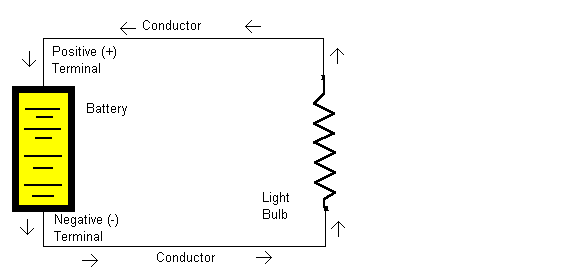
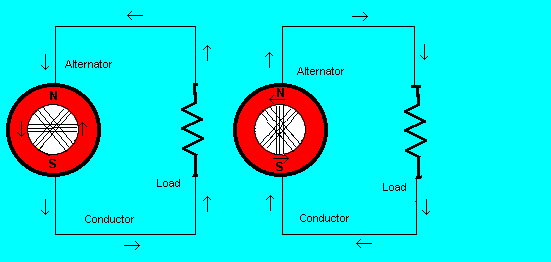
Direct current circuit (top) and alternating current circuit (above)
Author: Jonathan
Sources:
Charles Proteus Steinmetz.
www.invent.org. 7 May 2001. <http://inventors.about.com/science/inventors/gi/dynamic/offsite.htm?site=http://www.invent.org/book/book%2Dtext/99.html>.
Goldsmith, J. Lyman and Robert L. Woodward. An Introduction to Applied Electricity-Electronics. Englewood Cliffs, NJ: Prentice-Hall, 1963.
Kurtus, Ron . Alternating
Current (AC) Electricity. Kurtus Technologies. 10 May 2001. <www.school-for-champions/science/ac.htm>.
