|
HOME
|
| I | INTRODUCTION |
Wave Motion, in physics, mechanism
by which energy is conveyed from one place to another in mechanically propagated
waves without the transference of matter. At any point along the path of
transmission a periodic displacement, or oscillation, occurs about a neutral
position. The oscillation may be of air molecules, as in the case of sound
traveling through the atmosphere; of water molecules, as in waves occurring on
the surface of the ocean; or of portions of a rope or a wire spring. In each of
these cases the particles of matter oscillate about their own equilibrium
position and only the energy moves continuously in one direction. Such waves are
called mechanical because the energy is transmitted through a material medium,
without a mass movement of the medium itself. The only form of wave motion that
requires no material medium for transmission is the electromagnetic wave; in
this case the displacement is of electric and magnetic fields of force in space
(see Electricity; Electromagnetic Radiation; Electronics; Field).
| II | TYPES OF WAVES |
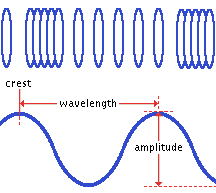
Waves are divided into types according to the direction of the displacements in relation to the direction of the motion of the wave itself. If the vibration is parallel to the direction of motion, the wave is known as a longitudinal wave (see Fig. 1). The longitudinal wave is always mechanical because it results from successive compressions (state of maximum density and pressure) and rarefactions (state of minimum density and pressure) of the medium. Sound waves typify this form of wave motion. Another type of wave is the transverse wave, in which the vibrations are at right angles to the direction of motion. A transverse wave may be mechanical, such as the wave projected in a taut string that is subjected to a transverse vibration (see Fig. 2); or it may be electromagnetic, such as light, X ray, or radio waves (see Radio; X Ray). Some mechanical wave motions, such as waves on the surface of a liquid, are combinations of both longitudinal and transverse motions, resulting in the circular motion of liquid particles.
For a transverse wave, the wavelength is the distance between two
successive crests or troughs. For longitudinal waves, it is the distance from
compression to compression or rarefaction to rarefaction. The frequency of the
wave is the number of vibrations per second. The velocity of the wave, which is
the speed at which it advances, is equal to the wavelength times the frequency.
The maximum displacement involved in the vibration is called the amplitude of
the wave.
| III | BEHAVIOR |
The velocity of a wave motion in matter depends on the elasticity and density of the medium. In a transverse wave on a taut string, for example, the velocity depends on the tension of the string and its mass per unit length. The velocity can be doubled by quadrupling the tension, or it can be reduced to one-half by quadrupling the mass of the string. The motion of electromagnetic waves through space is constant at about 300,000 km/sec (about 186,000 mi/sec), or the speed of light. This velocity varies slightly in passage through matter.
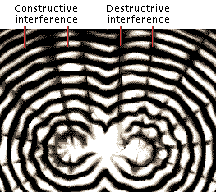
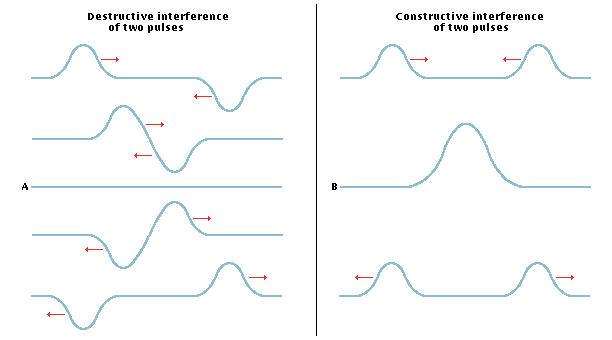
When two waves meet at a point, the resulting displacement of that point will be the sum of the displacements produced by each of the waves. If the displacements are in the same direction, the two waves reinforce each other; if the displacements are in the opposite direction, the waves counteract each other. This phenomenon is known as interference. See also Diffraction.
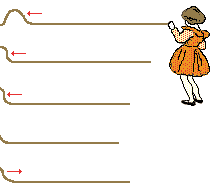
When two waves of equal wavelength and amplitude travel in opposite directions at the same velocity through a medium, stationary, or standing, waves are formed. For example, if one end of a rope is tied to a wall and the other end is shaken up and down, waves will be reflected back along the rope from the wall. Assuming that the reflection is perfectly efficient, the reflected wave will be half a wavelength behind the initiating wave. Interference will take place, and the resultant displacement at any given point and time will be the sum of the individual displacements. No motion will take place at points where the crest of the incident wave meets the trough of the reflected one. Such points are called nodes. Halfway between the nodes, the waves meet in the same phase; that is, crest will coincide with crest and trough with trough. At these points the amplitude of the resultant wave is twice as great as that of the incident wave. Thus, the rope is divided into sections one wavelength long by the nodes, which do not progress along the rope, while the rope between the nodes vibrates transversely.
Stationary waves are present in the vibrating strings of musical instruments. A violin string, for instance, when bowed or plucked, vibrates as a whole, with nodes at the ends, and also vibrates in halves, with a node at the center, in thirds, with two equally spaced nodes, and in various other fractions, all simultaneously. The vibration as a whole produces the fundamental tone, and the other vibrations produce the various harmonics.
In quantum mechanics , the structure of
the atom is explained by analogy to a system of standing waves. Much of the
development of modern physics is based on the elaboration of the theory of waves
and wave motion.