|
HOME
|
| I | INTRODUCTION |
Sound, physical phenomenon that stimulates the sense of hearing. In humans, hearing takes place whenever vibrations of frequencies from 15 hertz to about 20,000 hertz reach the inner ear. The hertz (Hz) is a unit of frequency equaling one vibration or cycle per second. Such vibrations reach the inner ear when they are transmitted through air. The speed of sound varies, but at sea level it travels through cool, dry air at about 1,190 km/h (740 mph). The term sound is sometimes restricted to such airborne vibrational waves. Modern physicists, however, usually extend the term to include similar vibrations in other gaseous, liquid, or solid media. Physicists also include vibrations of any frequency in any media, not just those that would be audible to humans. Sounds of frequencies above the range of normal human hearing, higher than about 20,000 Hz, are called ultrasonic.
This article deals with the physics of sound. For the anatomy of the human and animal hearing mechanism, see Ear. For the architectural science of designing rooms and buildings for desirable properties of sound propagation and reception, see Acoustics. For the general properties of the generation and propagation of vibrational waves, including sound waves, see Wave Motion. See also Oscillation.
In general waves can be propagated, or transmitted, transversely or longitudinally. In both cases, only the energy of wave motion is propagated through the medium; no portion of the medium itself actually moves very far. In transverse waves, the material through which the wave is transmitted vibrates perpendicular to the wave’s forward movement. As a simple example, a rope may be tied securely to a post at one end, and the other end pulled almost taut and then shaken once. A wave will travel down the rope to the post, and at that point it will be reflected and returned to the hand. No part of the rope actually moves longitudinally toward the post, but each successive portion of the rope moves transversely. This type of wave motion is called a transverse wave. Similarly, if a rock is thrown into a pool of water, a series of transverse waves moves out from the point of impact. A cork floating near the point of impact will bob up and down, that is, move transversely with respect to the direction of wave motion, but will show little if any outward, or longitudinal, motion.
A sound wave, on the other hand, is a longitudinal wave. As the
energy of wave motion is propagated outward from the center of disturbance, the
individual air molecules that carry the sound move back and forth, parallel to
the direction of wave motion. Thus, a sound wave is a series of alternate
increases and decreases of air pressure. Each individual molecule passes the
energy on to neighboring molecules, but after the sound wave has passed, each
molecule remains in about the same location.
| II | PHYSICAL CHARACTERISTICS |
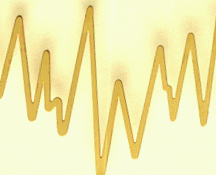
Any simple sound, such as a musical note, may be completely described
by specifying three perceptual characteristics: pitch, loudness (or intensity),
and quality (or timbre). These characteristics correspond exactly to three
physical characteristics: frequency, amplitude, and harmonic constitution, or
waveform, respectively. Noise is a complex sound, a mixture of many different
frequencies or notes not harmonically related.
| A | Frequency |
Sounds can be produced at a desired frequency by different methods. Sirens emit sound by means of an air blast interrupted by a toothed wheel with 44 teeth. The wheel rotates at 10 revolutions per second to produce 440 interruptions in the air stream every second. Similarly, hitting the A above middle C on a piano causes a string to vibrate at 440 Hz. The sound of the speaker and that of the piano string at the same frequency are different in quality, but correspond closely in pitch. The next higher A on the piano, the note one octave above, has a frequency of 880 Hz, exactly twice as high. Similarly, the notes one and two octaves below have frequencies of 220 and 110 Hz, respectively. Thus, by definition, an octave is the interval between any two notes whose frequencies are in a two-to-one ratio.
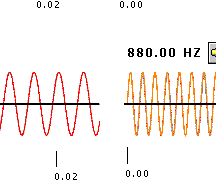
A fundamental law of harmony states that two notes an octave apart,
when sounded together, produce a pleasant-sounding combination. Other
combinations of notes can also be pleasing. Physically, an interval of a fifth
consists of two notes, the frequencies of which bear the arithmetical ratio 3 to
2, and a major third, the ratio 5 to 4. Fundamentally, the law of harmony states
that two or more notes sound pleasant when played together if their frequencies
bear small, whole number ratios; if the frequencies do not bear such ratios, the
intervals are dissonant. On a fixed-pitch instrument, such as the piano, it is
not possible to arrange the notes so that all of these ratios hold exactly, and
some compromise is necessary in tuning.
| B | Amplitude |
The amplitude of a sound wave is the degree of motion of air molecules within the wave, which corresponds to the changes in air pressure that accompany the wave. The greater the amplitude of the wave, the harder the molecules strike the eardrum and the louder the sound that is perceived.
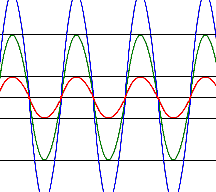
The amplitude of a sound wave can be expressed in terms of absolute
units by measuring the actual distance of displacement of the air molecules, the
changes in pressure as the wave passes, or the energy contained in the wave.
Ordinary speech, for example, produces sound energy at the rate of about one
hundred-thousandth of a watt. All of these measurements are extremely difficult
to make, however, and the intensity of sounds is generally expressed by
comparing them to a standard sound, measured in decibels (see Sensations of Tone
below).
| C | Intensity |
The distance at which a sound can be heard depends on its intensity.
Intensity is the average rate of flow of energy per unit area perpendicular to
the direction of propagation, similar to the rate at which a river flows through
a gate in a dam. In the case of spherical sound waves spreading from a point
source, the intensity varies inversely as the square of the distance, provided
there is no loss of energy due to viscosity, heat conduction, or other
absorption effects. Thunder, for example, is four times as intense at a distance
of 1 km (0.6 mi) from the lightning bolt that caused it as it would be at a
distance of 2 km (1.2 mi). In the actual propagation of sound through the
atmosphere, changes in the physical properties of the air, such as temperature,
pressure, and humidity, produce damping and scattering of the directed sound
waves, so that the inverse-square law generally is not applicable in direct
measurements of the intensity of sound.
| D | Quality |
If A above middle C is played on a violin, a piano, and a tuning
fork, all at the same volume, the tones are identical in frequency and
amplitude, but different in quality. Of these three sources, the simplest tone
is produced by the tuning fork; the sound in this case consists almost entirely
of vibrations having frequencies of 440 Hz. Because of the acoustical properties
of the ear and the resonance properties of the ear's vibrating membrane,
however, it is doubtful that a pure tone reaches the inner hearing mechanism in
an unmodified form. The principal component of the note produced by the piano or
violin also has a frequency of 440 Hz, but these notes also contain components
with frequencies that are exact multiples of 440, called overtones, at 880,
1320, and 1760 Hz, for example. The exact intensity of these other components,
which are called harmonics, determines the quality, or timbre, of the note.
| E | Speed of Sound |
The frequency of a sound wave is a measure of the number of waves passing a given point in one second. The distance between two successive crests of the wave is called the wavelength. The product of the wavelength and the frequency equals the speed of the wave. The speed is the same for sounds of all frequencies and wavelengths (assuming the sound is propagated through the same medium at the same temperature). The wavelength of A above middle C, for example, is about 78 cm (about 2.6 ft), and its frequency is 440 Hz. The wavelength of A below middle C is twice as large, about 156 cm (about 5.1 ft), but its frequency, 220 Hz, is only half as large. The product of the wavelengths and frequencies for each note is the same, so the speed of sound is also the same.

The speed of sound in dry, sea level air at a temperature of 0°C (32°F) is 332 m/sec (1,088 ft/sec). The speed of sound in air varies under different conditions. If the temperature is increased, for example, the speed of sound increases; thus, at 20°C (68°F), the speed of sound is 344 m/sec (1,129 ft/sec). The speed of sound is different in other gases of greater or lesser density than air. The molecules of some gases, such as carbon dioxide, are heavier and move less readily than molecules of air. Sound progresses through such gases more slowly. Conversely, sound travels through helium and hydrogen faster than through air because atoms of helium and hydrogen are lighter than molecules of air. Stated mathematically, the speed of sound varies inversely as the square root of the density. The speed of sound in gases also depends on one other factor, specific heat. See Temperature.
Sound generally moves much faster in liquids and solids than in
gases. In both liquids and solids, density has the same effect as in gases. The
speed of sound also varies directly as the square root of the elasticity of the
medium. Elasticity is the ability of a substance to regain its original shape
and size after being deformed. The speed of sound in water, for example, is
slightly less than 1,525 m/sec (5,000 ft/sec) at ordinary temperatures—almost
five times as fast as in air. The speed of sound in copper, which is more
elastic than water, is about 3,350 m/sec (about 11,000 ft/sec) at ordinary
temperatures. In steel, which is even more elastic, sound moves at a speed of
about 4,880 m/sec (about 16,000 ft/sec). Sound is propagated very efficiently in
steel.
| F | Refraction, Reflection, and Interference |
Sound moves forward in a straight line when traveling through a medium having uniform density. Like light, however, sound is subject to refraction, which bends sound waves from their original path. In polar regions, where air close to the ground is colder than air that is somewhat higher, a rising sound wave entering the warmer less dense region, in which sound moves with greater speed, is bent downward by refraction. The excellent reception of sound downwind and the poor reception upwind are also due to refraction. The velocity of wind is generally greater at an altitude of many meters than near the ground; a rising sound wave moving downwind is bent back toward the ground, whereas a similar sound wave moving upwind is bent upward over the head of the listener.
Sound is also governed by reflection, obeying the fundamental law that the angle of incidence equals the angle of reflection. An echo is the result of reflection of sound. Sonar depends on the reflection of sounds propagated in water. A megaphone is a funnel-like tube that forms a beam of sound waves by reflecting some of the diverging rays from the sides of the tube. A similar tube can gather sound waves if the large end is pointed at the source of the sound; an ear trumpet is such a device.
Sound is also subject to diffraction and interference. If sound from
a single source reaches a listener by two different paths—one direct and the
other reflected—the two sounds may reinforce one another; but if they are out of
phase they may interfere, so that the resultant sound is actually less intense
than the direct sound without reflection. Interference paths are different for
sounds of different frequencies, so that interference produces distortion in
complex sounds. Two sounds of different frequencies may combine to produce a
third sound, the frequency of which is equal to the sum or difference of the
original two frequencies.
| III | SENSATIONS OF TONE |
The ears of an average young person are sensitive to all sounds from about 15 Hz to 20,000 Hz. The hearing of older persons is less acute, particularly to the higher frequencies. The ear is most sensitive in the range from A above middle C up to A four octaves higher. Sounds in this range can be perceived hundreds of times more acutely than sounds an octave higher or two octaves lower.
The degree to which a sensitive ear can distinguish between two pure notes of slightly different loudness or slightly different frequency varies in different ranges of loudness and frequency. Differences of about 20 percent in loudness (about 1 decibel, dB), and 0.33 percent in frequency (about 1/20 of a note) can be distinguished in sounds of moderate intensity at the frequencies to which the ear is most sensitive (about 1,000 to 2,000 Hz). In this same range, the difference between the softest sound that can be heard and the loudest sound that can be distinguished as sound (louder sounds are “felt,” or perceived, as painful stimuli) is about 120 dB (about 1 trillion times as loud).
All of these sensitivity tests refer to pure tones, such as those
produced by a tuning fork. Even for such pure tones the ear is imperfect. Notes
of identical frequency but greatly differing intensity may seem to differ
slightly in pitch. More important is the difference in apparent relative
intensities with different frequencies. At high intensities the ear is
approximately equally sensitive to most frequencies, but at low intensities the
ear is much more sensitive to the middle high frequencies than to the lowest and
highest. Thus, sound-reproducing equipment that is functioning perfectly will
seem to fail to reproduce the lowest and highest notes if the volume is
decreased.
| A | Three Important Types of Ordinary Sound |
In speech, music, and noise, pure tones are seldom heard. A musical note contains, in addition to a fundamental frequency, higher tones that are harmonics of the fundamental frequency. Speech contains a complex mixture of sounds, some (but not all) of which are in harmonic relation to one another. Noise consists of a mixture of many different frequencies within a certain range; it is thus comparable to white light, which consists of a mixture of light of all different colors. Different noises are distinguished by different distributions of energy in the various frequency ranges.
When a musical tone containing some harmonics of a fundamental tone, but missing other harmonics or the fundamental itself, is transmitted to the ear, the ear forms various beats in the form of sum and difference frequencies, thus producing the missing harmonics or the fundamental not present in the original sound. These notes are also harmonics of the original fundamental note. This incorrect response of the ear may be valuable. Sound-reproducing equipment without a large speaker, for example, cannot generally produce sounds of pitch lower than two octaves below middle C; nonetheless, a human ear listening to such equipment can re supply the fundamental note by resolving beat frequencies from its harmonics. Another imperfection of the ear in the presence of ordinary sounds is the inability to hear high-frequency notes when low-frequency sound of considerable intensity is present. This phenomenon is called masking.
In general, reproductions of speech and musical themes are
recognizable even if only a portion of the frequencies contained in the
originals are copied. Frequencies between 250 and 3,000 Hz, the frequency range
of ordinary telephones, are normally sufficient. A few speech sounds, such as
th, require frequencies as high as 6,000 Hz. For high quality reproduction,
however, the range of about 100 to 10,000 Hz is necessary. Sounds produced by a
few musical instruments can be accurately reproduced only by adding even lower
frequencies, and a few noises can be reproduced only at somewhat higher
frequencies.
| IV | HISTORICAL DEVELOPMENT |
The elementary phenomena of sound were the subject of much speculation among ancient peoples; however, with the exception of a few lucky guesses, little was known about the science of sound until about 1600. Starting at that time, the knowledge of sound increased more rapidly than knowledge of the corresponding phenomena of light, because the latter are more difficult to observe and measure.
The ancient Greeks cared little for the scientific study of sound, but they had a great interest in music, and considered music to represent “applied number,” in contrast to “pure number,” the science of arithmetic. Greek philosopher Pythagoras discovered that an octave represents a two-to-one frequency ratio and enunciated the law connecting consonance with numerical ratios.
Aristotle, in brief remarks on sound, made a fairly accurate guess
concerning the nature of the generation and transmission of sound, but no
scientifically valid experimental studies were made until about 1600, when
Galileo made a scientific study of sound and enunciated many of its fundamental
laws. Galileo stated the relationship between pitch and frequency and the laws
of musical harmony and dissonance, essentially as stated in this article. He
also explained theoretically how the natural frequency of vibration of a
stretched string, and hence the frequency of sound produced by a string
instrument, depends on the length, weight, and tension of the string.
| A | The 16th, 17th, and 18th Centuries |
During the early 17th century, French mathematician Marin Mersenne determined the speed of sound by measuring the time of return of an echo. He arrived at a figure that was in error by less than 10 percent. Mersenne also made the first crude determination of the actual frequency of a note of a given pitch. He measured the frequency of vibration of a long, heavy wire that moved so slowly that its motion could be followed by the eye. Then, from theoretical considerations, he calculated the frequency of a short, light wire that produced an audible sound.
In 1660 the dependence of sound on a gaseous, liquid, or solid medium for transmission was demonstrated by Anglo-Irish scientist Robert Boyle, who suspended a bell in a vacuum by means of a string and showed that, although the clapper could be seen to strike the bell, no sound was heard.
The mathematical treatment of the theory of sound was begun by English mathematician and physicist Sir Isaac Newton in his Philosophiae Naturalis Principia Mathematica (Mathematical Principles of Natural Philosophy, 1687). The propagation of sound through any fluid was shown to depend only on measurable physical properties of the fluid, such as elasticity and density, and Newton calculated from theoretical considerations the speed of sound in air.
The 18th century was primarily a period of theoretical development. Calculus provided a powerful new tool to scientists in many fields, and mathematicians such as the French Jean le Rond d'Alembert and Joseph Louis Lagrange, the Dutch Johann Bernoulli, and the Swiss Leonhard Euler contributed to the knowledge of subjects including the pitch and quality of sound produced by a particular musical instrument and the speed and nature of transmission of sound in various media. The complete mathematical treatment of sound, however, depends on harmonic analysis, which was discovered by French mathematician Baron Jean Baptiste Joseph Fourier in 1822 and applied to sound by German physicist Georg Simon Ohm.
Variations in sound, called beats, inherent in sound waves, were
discovered about 1740 by Italian violinist Giuseppe Tartini and German organist
Georg Sorge. German physicist Ernst Chladni made numerous discoveries in
acoustics at the close of the 18th century, notably concerning the vibration of
strings and rods.
| B | The 19th and 20th Centuries |
The 19th century was primarily a period of experimental development. The first accurate measurements of the speed of sound in water were made in 1826 by French mathematician Jacques Sturm, and throughout the century numerous experiments were made determining the speed of sound of various frequencies in various media with extreme accuracy. The fundamental law that the speed is the same for sounds of different frequencies and depends on the density and elasticity of the medium was determined in these experiments. The stroboscope, the stethoscope, and the siren were all used in the study of sound during the 19th century.
The standardization of pitch occupied much attention in the 19th century. The first suggestion for a standard had been made about 1700 by French physicist Joseph Sauveur, who proposed C equals 256, a convenient standard for mathematical purposes. German physicist Johann Heinrich Scheibler made the first accurate determination of pitch corresponding to frequency and proposed the standard A equals 440 in 1834. In 1859 the French government decreed that the standard should be A equals 435, based on the research of French physicist Jules Antoine Lissajous. This standard was accepted in many parts of the world, including the United States, until well into the 20th century.
During the 19th century the telephone, the microphone, and the phonograph, all of which were useful for further study of sound, were invented. In the 20th century, physicists for the first time had instruments that made possible simple, accurate, quantitative study of sound. By means of electronic oscillators, waves of any type may be produced electronically, then converted into sounds by electromagnetic or piezoelectric means (see Electronics). Conversely, sounds may be converted into electrical currents by means of a microphone, amplified electronically without distortion, and then analyzed by means of a cathode-ray oscilloscope. Modern techniques permit extremely high-fidelity recording and reproduction of sound.
Military necessity in World War I (1914-1918) led to the first use of sound for underwater detection of vessels; sound is now also used for studies of ocean currents and layers, and for sea-bottom mapping (see Sonar). In addition, ultrahigh-frequency (ultrasonic) sound waves are now used in a wide range of technical and medical applications.