Things to note about Einstein’s Special
Theory of Relativity
1. The speed of light is the same (a constant
value), no matter how fast you are moving.
2. So the distance that light travels
divided by the time elapsed stays the same value:
Distance that light travels
= 300 000 000 meters per second
Time elapsed
3. So, in the diagram below, light has the same
speed for both observers, BUT to the stationary observer outside the moving
rocket, the distance that the light travels is LONGER.
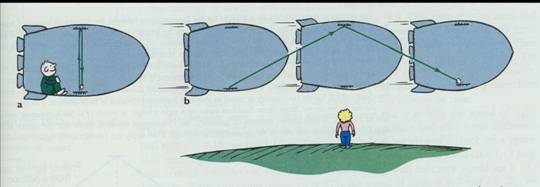
4. So, in order to make the speed of light the
SAME for both observers, the TIME elapsed of the moving rocket from the
stationary perspective outside the rocket MUST BE LONGER TOO.
5. Consequences?
Both observers experience time as usual, but the stationary observer
will notice that the moving observer’s watch is ticking SLOWER.
6. So, the faster you move with respect to a
stationary observer, the slower your watch ticks TO THE STATIONARY OBSERVER
(not to yourself).
Fact: Radioactive particles with known half-lifes (statistical decay times) moving at near light speed
decay slower than when the particles are not moving.
This is
called TIME DILATION. Mike will now talk
about the Twin Paradox.
Other consequences:
If a meter
stick went by you at near relativistic speeds, it will appear shorter to
you. A person traveling with the moving
meter stick will not notice any changes to the meter stick’s length. This is called LENGTH CONTRACTION.
The mass of
the moving meter stick will also be measured as greater (to the stationary
observer) than when it is at rest. This
is called RELATIVISTIC MASS INCREASE.
The famous
relation, E = mc2, comes about from looking at energy relationships
for moving vs. stationary objects. E is
the energy (in joules) of an object at rest, m is the object’s mass in
kilograms, and c2 is the speed of light (300 000 000
m/s) multiplied by itself. In short, the
energy contained in a mass of material is TREMENDOUS, if it were allowed to be
completely converted into pure energy.
The conversion occurs under certain conditions; like when the nuclei of
the atoms that make up the mass are split or combined (or bombarded by
particles) under tremendous temperatures and pressures. This is what happens in an atomic bomb (nuclear
fission, splitting the atomic nuclei) or in a star like our Sun (nuclear
fusion, jamming atomic nuclei together).
Oh, if we could only harness the energy in a clean and efficient manner
here on Earth…