| a. |
Using
suitable sketched graph, explain carefully why energy is released in each
of the following nuclear processes:
 |
4
marks |
|
|
|
|
 |
1 |
|
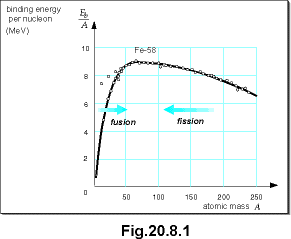
The binding energy per nucleon is the largest
for A = 58. It means that the largest energy per nucleon is released when
constituent nucleons combine to form Fe-58. |
1 |
|
This indicates that the fusion reaction is
possible: when two light nuclei, for example H-2 and H-3, are separated
into constituent nucleons and then recombine into a heavy nucleus, for
example, He-4 plus n-1, there is a net energy release. |
1 |
|
|
|
|

|
|
|
|
|
|
This also indicates that the fission reaction
is possible: when a heavy nucleus, for example U-235, is separated into
constituent nucleons and then recombine to form two light nuclei, for example,
Ba-144 and Kr-90, there is a net energy release. |
1 |
|
|
|
| b. |
State
which of the above nuclear processes is currently being used in power-generating
stations and explain the difficulties encountered in exploiting the other
nuclear process. |
3
marks |
|
|
|
|
Nuclear fission is currently in use for power generating
stations. |
1 |
|
Nuclear fusion faces the following difficulties: |
|
|
-
Require very high initial temperature. e.g. initiated by atomic bomb. The
k.e. of the light nuclei must be high enough to overcome the electrostatic
repulsion between the nuclei.
-
Problem of containment due to very high temperature. No solid container
can withstand the high temperature required without vaporizing or melting.
-
Problem of controlling the reaction. Unlike nuclear fission which requires
neutrons to trigger the chain reaction, fusion is trigger by high temperature.
Once started, it is difficult to control the supply of energy.
|
2 |
|
|
|
| c. |
Sketch
a diagram to show the basic structure of a pressurized water reactor and
explain the functions of
i)
the fuel elements |
7
marks |
|
|
|
|
 |
2 |
|
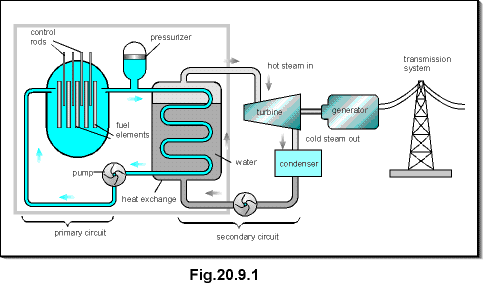
The fuel element consists of enriched U-235,
which are to be bombarded by thermal neutrons and release energy in the
form of heat. New neutrons are generated to bombard other U-235 atoms producing
a chain reaction. |
1 |
|
|
|
|
ii)
the control rods |
|
|
|
|
|
The control rods are usually boron-steel or cadmium. Their
function is to absorb neutrons. As neutrons are absorbed the rate of heat
generated would decrease because nuclear fission requires continual supply
of thermal neutrons. |
1 |
|
When accident occurs, e.g. temperature too
high, or pressure changes unexpectedly, the control rods are lowered between
the fuel rod to stop the reaction. |
1 |
|
|
|
|
iii)
the moderator |
|
|
|
|
|
Fast moving neutrons could not trigger fission. Moderator
is used to slow down the neutrons. They must be light nuclei so that the
k.e. energy transfer to the moderator is efficient. In PWR, moderator is
water at high pressure. |
1 |
|
|
|
|
iv)
the coolant. |
|
|
|
|
|
The coolant is water, which has a high specific heat capacity.
Its function is to bring the heat energy from the fuel rod to the turbines. |
1 |
|
|
|
| d. |
State
one way of handling the spent fuel in a nuclear reactor. |
2
marks |
|
|
|
|
Spent fuels are usually recycled, otherwise, they would
be regarded as nuclear waste. |
|
|
Recycling spent fuel is to carry out enrichment so that
the percentage of U-235 is raised again. |
1 |
|
|
|
|
Nuclear waste has three levels of radioactivity: low, intermediate
and high. |
|
|
For low and intermediate level spent fuel, they are stored
in metallic concrete drum in shallow land disposal or ground surface repositories. |
|
|
The high level spent fuel would be dumped deep
beneath the ground or ocean floor. |
1 |
|
|
|