| a. |
Explain
the meaning of the mass defect and the binding energy of an atomic nucleus.
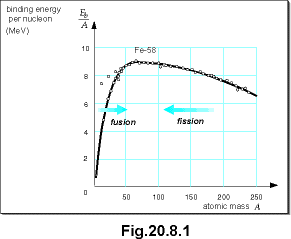
Sketch a graph to show the variation of binding energy per nucleon with
the number of nucleons. Using your graph, explain the feasibility of
i)
nuclear fission |
7
marks |
|
|
|
|
Mass defect of a nucleus is the difference
between the mass of separated nucleons and the combined mass of the nucleus.
The loss in mass is converted into energy, according to |
1 |
|
E = m c2 |
1 |
|
where m is the mass converted and c
is the speed of light. |
|
|
|
|
|
The binding energy of a nucleus is defined
as the work done on the nucleus to separate it into its constituent neutrons
and protons. |
2 |
|
|
|
|
 |
1 |
|
The larger is the binding energy per nucleon,
the lower is the nuclear potential energy -- more energy is required to
break up the nucleus. |
|
|
It is possible for a heavy nucleus of small
Eb/A to be separated into constituent nucleons and then
recombines to two light nuclei of larger Eb/A. |
|
|
Thus nuclear fission is possible. |
1 |
|
|
|
|
ii)
nuclear fusion. |
|
|
|
|
|
It is possible for a two light nuclei, each
of small Eb/A, to be separated into constituent nucleons
and then recombines to a heavier nucleus of larger Eb/A. |
|
|
Thus nuclear fusion is possible. |
1 |
|
|
|
| b. |
Distinguish
between radiostability and the feasibility of nuclear fission or nuclear
fusion in terms of binding energy per nucleon. State the similarities and
differences between radioactivity and nuclear fission. |
6
marks |
|
|
|
|
Radiostability refers to whether an isotope would undergo
radioactive decay spontaneously. It is not related to the binding energy
per nucleon. It is determined by the ratio of neutrons to protons in the
isotope. In general, if the neutrons are in excess, there would be beta
decay; if the protons are in excess, there would be alpha decay. |
2 |
|
Feasibility of nuclear fission of nuclear fusion refers
to whether the binding energy per nucleon after fission or fusion is higher
than before. If it is higher than before the process is feasible. |
2 |
|
Radioactivity occurs spontaneously. Nuclear fission requires
triggering by slow moving neutrons. Nuclear fusion requires very high temperature
for two light nuclei to have enough k.e. to come close against the strong
electrostatic repulsion. |
1 |
|
Both involve a conversion from mass into energy, according
to |
|
|
E = m c2 |
|
|
where m is the mass converted and c
is the speed of light. |
1 |
|
|
|
| c. |
Explain
why thermal neutrons (neutrons with energy less than 0.04eV) are important
in nuclear fission and state how chain reaction is accomplished in an atomic
bomb. |
3
marks |
|
|
|
|
The thermal neutrons are slow moving neutrons. They are
used to collide the U-235 nucleus causing the following reaction to take
place: |
1 |
|
 |
1 |
|
Since the reaction releases neutrons, when
these neutrons are slowed down, they would collide with other U-235 nucleus,
which gives out other neutrons. Thus, a chain reaction is accomplished. |
1 |
|
|
|