| a. |
Describe
how the nature of a-particles has been established experimentally. |
4
marks |
|
|
|
|
 |
1 |
|
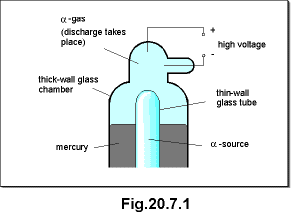
The apparatus is used to collect a-particles
for studying its nature. a-particles emitted
from the radioactive substance pass through the thin-walled glass tube
and enter the thick-wall glass chamber. They are trapped in the space between
the glass walls. |
1 |
|
When a high voltage is applied across the electrodes,
light is emitted. |
1 |
|
From the light spectrum, a-particles
are identified to be Helium atoms. |
1 |
|
|
|
| b. |
What
do you understand by the relative biological effectiveness (r.b.e.)? Give
a reason why the r.b.e for a-emission
is much greater than other emissions. |
4
marks |
|
|
|
|
The biological damage produced by ionizing
radiation is different for different kinds of radiation. Given the same
amount of energy imparted to a human body, a-particles
cause greater damage than b-particles or g-rays. |
2 |
|
In fact, the a-particles
produce Q = 20 times damages than the same intensity of b-particles
or g-rays. Thus, the r.b.e. of a-particles
is 20 and that of b-particles or g-rays
are 1. |
1 |
|
The reasons that a-particles
has a greater r.b.e. is because of their high ionizing power. |
1 |
|
|
|
| c. |
What
is meant by radiostability? State and explain how radiostability depends
on the ratio of the number of neutrons to the number of protons for
i)
a light nucleus
ii)
a heavy nucleus.
With reference to
the transformation within the nucleus, state and explain which kind of
radioisotopes would emit a-particle
and which would emit b-particle. |
8
marks |
|
|
|
|
Radiostability is used to indicate whether an isotope would
undergo decay or not. |
|
|
A radio-unstable isotope would decay by emitting a-particles,
b-particles or g-rays. |
|
|
|
|
|
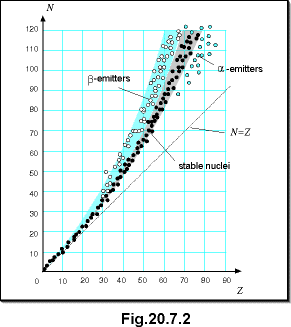
For light nucleus, radiostable isotopes have equal number
of proton and neutrons. |
|
|
For heavy nucleus, radiostable istopes require more neutrons
than protons. |
|
|
|
|
|
When there is excessive protons, the isotope would undergo
a-decay. |
|
|
 |
|
|
When there is excessive neutrons, the isotope
would undergo b-decay. |
|
|
 |
|
|
|
|
|
 |
|
|
|
|
|
|
|