| a. |
What
do you understand by exponential decay? |
2
marks |
|
|
|
|
Exponential decay is that the quantity falls
by a constant factor in equal time interval. |
1 |
|
Mathematically, |
|
|
 |
1 |
|
|
|
| b. |
Given
two samples of radioactive substances containing the same amount of radioactive
atoms. Discuss how their activities depend on their half-lives. |
2
marks |
|
|
|
|
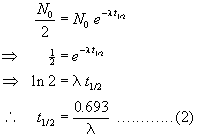
The half-life of a sample is given by |
|
|
 |
1 |
|
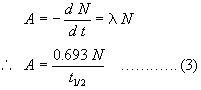
The activity of a given sample is |
|
|
 |
|
|
The longer is the half-life, the lower is the
activity, and vice versa. |
1 |
|
|
|
| c. |
Outline
the methods in measuring the half-lives of two radioactive materials, P
and Q. It is given that material P has a half-life of several minutes only
and material Q has a half-live of order 109 years. |
8
marks |
|
|
|
|
Short half-life P |
|
|
Since the half-life of P is short, it is possible to monitor
the activity of P in an experiment. |
|
|
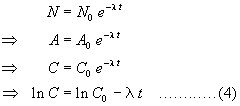
The count rate C is measured in successive time-interval,
say 30 s, for about 1 hour. |
|
|
Tabulate the results of C and t. Plot a graph of ln C against
t. |
|
|
 |
|
|
The graph should be a straight line. The slope of the graph
gives value of l. The half-life is therefore |
|
|
 |
|
|
|
|
|
Long half-life Q |
|
|
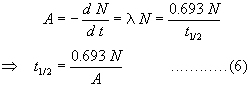
Long half-life is found by recording the activity A and
estimating the number N of radioactive nuclei and then apply |
|
|
 |
|
|
N could be found by chemical methods. |
|
|
|
|
| d. |
Explain
the method of archaeological dating using carbon-14. |
4
marks |
|
|
|
|
The action of cosmic rays in the atmosphere causes a steady
production of the radioactive C-14 from N-14. Subsequently C-14 forms radioactive
carbon dioxide. It can be proved that in living plants the ratio of C-12
to C-14 is a constant for many years. |
1 |
|
However, when a plant dies, C-14 starts to
decay. The half-life is about 5600 years. |
1 |
|
By measuring the residual activity per unit
mass, the age of an ancient carbon-containing material can be estimated. |
2 |
|
|
|
|
|
|
|
|
|
|
|
|