| a. |
State
the result of the alpha scattering experiment performed by Rutherford.
Explain the importance of the result. |
3
marks |
|
|
|
|
 |
1 |
|
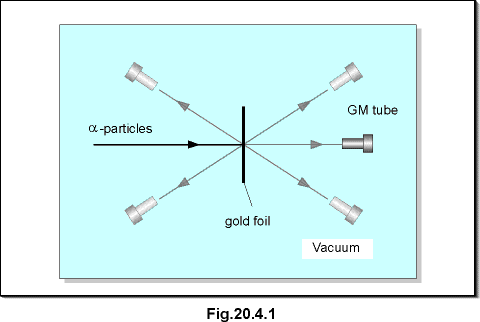
When a-particles
are sent towards a thin gold foil, while GM tube gives reading on the opposite
side of the foil, it also give a small reading on the same side. |
1 |
|
This shows that some a-particles
are reflected by more than 180o. |
|
|
|
|
|
The explanation to this phenomenon is that
the mass and charge of gold atoms are concentrated in a small volume, called
nucleus, while there is a very large clear space around the nucleus. |
1 |
|
|
|
| b. |
Explain
how the upper limit of the size of nucleus is estimated. (Simple mathematical
formula and rough numerical values are expected, but detailed calculations
are not necessary.) |
2
marks |
|
|
|
|
 |
0.5 |
|
To estimate the size of the nucleus, a-particles
of known energy (e.g. 5.4 MeV) are sent towards the gold nucleus. The closest
position of the a-particle from the centre of
the nucleus is where the k.e. of the a-particles
are used up in overcoming the electrostatic repulsion. In simple terms,
the k.e. of the a-particles is converted into
electrical p.e. |
0.5 |
|
|
|
|
Let the atomic number of gold be Z. The closest
distance r is given by |
|
|
 |
1 |
|
|
|
| c. |
In
artificial nuclear transformations, slow-moving neutrons are used to collide
with the nuclei of a specimen. Explain why
i)
protons are not used as the colliding particles |
5
marks |
|
|
|
|
Proton is not used because it has positive charge and is
repelled by the protons of the target nucleus. |
1 |
|
|
|
|
ii)
a neutron can be captured by a target nucleus |
|
|
|
|
|
Neutrons are neutral so that they can pentrate inside the
nucleus. |
1 |
|
The strong nuclear force, which is very short
range, would bind the neutron inside the nucleus. |
1 |
|
|
|
|
iii)
the resulting nuclei usually give off b-particle. |
|
|
|
|
|
Since there is an excess of neutron inside the nucleus,
a neutron will be converted into a proton: |
|
|
 |
1 |
|
At the same time a b-particle
is emitted. |
1 |
|
|
|
| d. |
Give
an everyday use for each of the following particles
i)
slow-moving neutrons |
6
marks |
|
|
|
|
Nuclear reactor |
1 |
|
Slow moving neutrons are used in the fission
of U-235 and gives out energy. |
1 |
|
 |
|
|
|
|
|
ii)
a-particles |
|
|
|
|
|
Smoke detector |
1 |
|
When smoke gets into the space between the
electrodes of an ionization chamber, some ions would lose their energy
by colliding with the smoke particles. As a result, the ionization current
would fall. This triggers an alarm to sound continuously. |
1 |
|
|
|
|
iii)
g-rays |
|
|
|
|
|
Sterilization |
1 |
|
g-rays are useful in killing
bacteria and viruses. |
1 |
|
|
|