| a. |
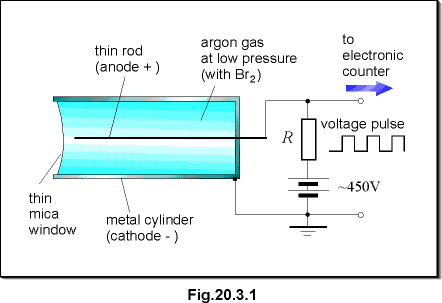
Sketch
a diagram to show the essential components in a Geiger Muller (GM) Tube.
Explain the terms electron avalanche, dead time and quenching agent in
connection with the operating principle of a GM tube. |
8
marks |
|
|
|
|
 |
2 |
|
When an ionization particle/photon gets inside
the tube, the argon atoms are ionized along its track. The electrons produced
would be accelerated to a high speed by the strong electric field near
the rod to cause further ionization, producing more and more charge. This
is called electron avalanche. |
2 |
|
|
|
|
In producing electrons near the rod, positive
ions are also produced. They are heavier and therefore move slower. As
a result, they accumulate near the rod. Effectively, they enlarge the cross-section
of the rod. During this time, when another particle gets in, the tube would
not produce another pulse. This period is called dead time. It lasts
until the positive ions have migrated towards the cathode. |
2 |
|
|
|
|
As the positive ions move towards the cathode,
their speed increases. This would produce another electron avalanche as
they collide with the neutron argon atoms. This would produce an incorrect
count, confusing the result. To avoid this secondary electron avalanche,
bromine is added to the gas. The energy of the positive ions are used up
in decomposing the molecules. The bromine used in this way is called quenching
agent. |
2 |
|
|
|
| b. |
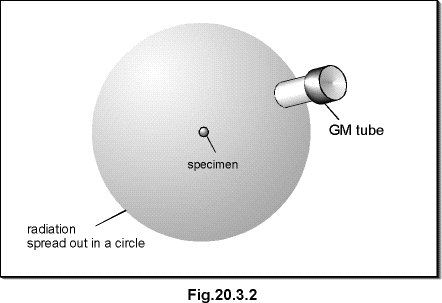
Give
two reasons why the count rate of a GM tube is less than the actual activity
of the specimen investigated. |
2
marks |
|
|
|
|
A GM tube measures activity on a small area
on one side of the specimen, while the specimen gives out radiation in
all directions. |
1 |
|
 |
1 |
|
|
|
| c. |
Discuss
how the count rate of a GM tube varies with the thickness of a lead sheet
placed between a g-source
and the GM tube. Explain the meaning of half-thickness. |
4
marks |
|
|
|
|
The intensity of g-rays is halved
by several cm of lead. Thus, the intensity is an exponential function of
thickness of lead used. |
1 |
|
 |
2 |
|
Half thickness is the thickness of lead that reduces the
intensity of g-rays by 50%. |
1 |
|
|
|
| d. |
Design
an experiment to verify the inverse-square law for g-rays. |
2
marks |
|
|
|
|
Put the GM tube at a known distance r from the g-source.
Record the count rate. Increase the distance r, measure the count
rate again. Repeat this for a number of times. |
1 |
|
Tabulate the count rate, distance r
and 1/r 2. |
|
|
Plot a graph of count rate against 1/r 2.
A straight line graph verifies the inverse-square law for g-rays. |
1 |
|
|
|