| a. |
State
one source of the energy of radioactive emissions. Give a reason why the
speed of the particles in b-decay
does not have a well-defined value. |
3
marks |
|
|
|
|
The energy mainly comes from mass-defects.
A very small fraction of mass of a nucleon is converted into energy, according
to Einstein's equation: |
|
|
 |
1 |
|
Beta decay is the conversion of an unstable
neutron into a proton: |
|
|
 |
|
|
More advanced experiment shows, that besides
b-particles, a particle with no charge and no
mass would also be emitted. This elementary particle is called neutrino. |
1 |
|
 |
1 |
|
Since neutrino carries energy, the energy of
b-particles does not have a well-defined value. |
|
|
|
|
| b. |
Sketch
a diagram to show the essential components of an alcohol diffusion cloud
chamber. State the preparations you would make before using the cloud chamber
and explain why an ionizing radiation would leave behind visible tracks
in the detector. |
6
marks |
|
|
|
|
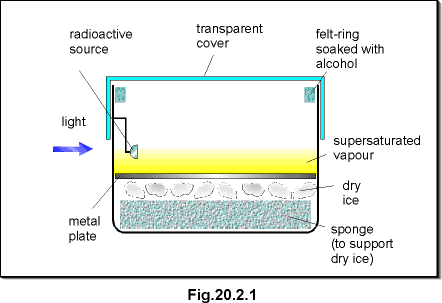 |
2 |
|
Before the cloud chamber is used, the residual
ions inside must be swept out. This can be done by |
|
|
-
establishing an electric field inside the chamber by joining a suitable
p.d. across the base plate and the top of the chamber
-
rubbing the plastic top with dry duster to form a clearing field
|
1 |
|
The air inside the cloud chamber is saturated
with alcohol vapour. |
|
|
The floor of the chamber is cooled by dry ice,
establising a temperature gradient. |
1 |
|
Thus, there is a steady diffusion of alcohol
vapour downward. |
|
|
As a result, the vapour just above the plate
is supersaturated. |
1 |
|
When a radiation moves in, ions would be left
behind and act as a condensation center for the vapour. Thus, droplets
of alcohol would be formed. |
|
|
A white track is seen, which is due to reflection
of light by the droplets. |
1 |
|
|
|
| c. |
Explain
why an a-particle
produces a straight-line track in a cloud chamber whereas a b-particle
produces straggly track. State, roughly, a value for the range of an a-particle
in air at normal pressure. |
3
marks |
|
|
|
|
a-particles produces straight
and thick line because they have |
|
|
-
the strongest ionization power
-
the highest momentum
|
1 |
|
b-particles give straggly track
because they are light in mass. Thus, the path is easily changed by heavier
air molecules. |
1 |
|
|
|
|
The range of a-particles in
air is about 5 cm. |
1 |
|
|
|
| d. |
State
the conditions in which right-angled forks may be observed in a cloud chamber.
(Mathematical proof of right-angled forks is not required.). |
2
marks |
|
|
|
|
Right angle fork is due to oblique collision
of two particles with the same mass, one being initially at rest. |
1 |
|
Right angled fork would be seen in a cloud chamber when |
|
|
-
the source is alpha
-
the space is filled with Helium gas
|
1 |
|
|
|
| e. |
State
an application of the energy released from a-decays,
explaining how the energy is converted into a useful form. |
2
marks |
|
|
|
|
An example of application is the pacemaker, which is used
to correct an abnormal or irregular heart rate. The electricity required
is converted from the heat generated by the a-decay
of plutonium, using a series of thermocouples. |
|
|
Other applications like the energy source of
space probe. |
|
|
|
|