| a. |
State
three health hazards due to exposure in ionizing radiations. |
3
marks |
|
|
|
|
Health hazards |
|
|
-
Somatic effects -- damage of whole organs due to extra high dosage
-
Cancer
-
Genetic effects -- damage of genes and affects the next generation
|
3 |
|
|
|
| b. |
What
do you understand by the chain reaction in nuclear fission? Distinguish
between uncontrollable and controllable fissions. |
3
marks |
|
|
|
|
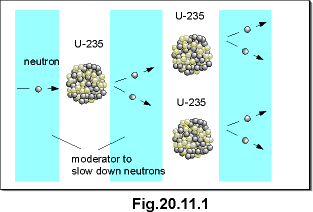
In nuclear fission, a neutron is needed. After
the reaction, two new neutrons are generated. Thus, the reaction could
be carried out automatically. This is called chain reaction. |
1 |
|
 |
|
|
In an uncontrollable fission, since the number
of neutrons is increased in geometric progression, a large amount of energy
would be released in a short time interval, until all the U-235 are used
up. An example of uncontrollable fission is atomic bomb. |
1 |
|
In a controlled fission, the number of neutrons
is partially absorbed by control rods which keep the number of neutrons
a constant at any time. An example of controlled fission is nuclear reactor
of electric station. |
1 |
|
|
|
| c. |
By
comparing with coal power, discuss the pros and cons of generating electricity
using nuclear power. |
3
marks |
|
|
|
|
Advantages of nuclear power |
|
|
-
clean (no discharged gas and smoke particles from burning coal)
-
emits less radioactive substance into the air than coal
|
1.5 |
|
Disadvantage of nuclear power |
|
|
-
problems in handling nuclear waste, and transportation of fuel rods
-
expensive
-
unacceptable by the society psychologically (because of serious accident
occurred before).
|
1.5 |
|
|
|
| d. |
Give
full names for CAT, PET and MRI in connection with diagnostic imaging. |
3
marks |
|
|
|
|
CAT: computerized axial tomography |
|
|
PET: positron emission tomography |
|
|
MRI: magnetic resonance imaging (also called
NMR: nuclear magnetic resonance) |
3 |
|
|
|
| e. |
Discuss
the formation of cosmic-ray shower of g-photons. |
4
marks |
|
|
|
|
 |
|
|
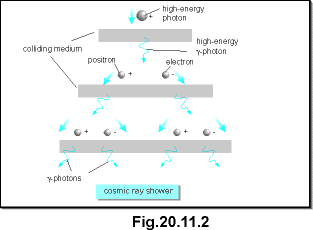
High energy protons from the Galaxy reach the atomosphere
and collide with oxygen and nitrogen nuclei producing high energy g-ray
photons. |
1 |
|
These photons would then undergo annihilation
to form a positron and electron. |
1 |
|
Each of these particles produces a number of
lower energy g-ray photons as they collide with
the atoms in the atmosphere. |
1 |
|
If the energy of these g-ray
photons are still high enough, annihilation would occur again, producing
positrons and electrons, each of them can produce more g-ray
photons. |
1 |
|
As a result, a single high energy proton would
give rise to a large number of g-ray photons
at the same time. |
|
|
|
|