| a. |
A
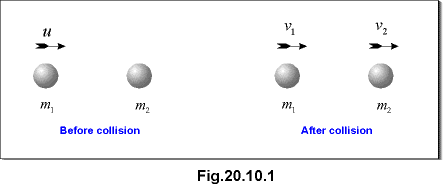
particle of mass m1 moving at speed u makes a perfectly elastic
head-on collision with a stationary particle of mass m2. After
the collision, the particles move off with speed v1 and v2
respectively. Show that
 |
4
marks |
|
|
|
|
 |
|
|
Conservation of momentum and energy give |
|
|
 |
2 |
|
Define k = m1/m2. |
|
|
From (1), |
|
|
 |
|
|
From (2), |
|
|
 |
|
|
Multiply (3) with (u + v1)
and compare with (4), we have |
|
|
v2 = u
+ v1 .............(5) |
|
|
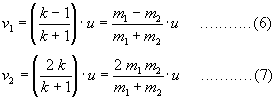
Putting into (3), we have |
|
|
 |
2 |
|
|
|
| b. |
Using
the results in (a), explain how you would choose the atoms which make up
the moderators in a nuclear reactor. |
4
marks |
|
|
|
|
If m1 is about the value
of m2, v1 would be close to zero. Thus,
in order to slow down m1, m2 should
be of similar mass to m1. |
1 |
|
In a nuclear fission, the neutrons used to
carry out fission must be slow moving (moving at the same speed as room
temperature), otherwise, a new product U-238 is formed. |
1 |
|
Moderator is used to slow down neutrons. |
1 |
|
The atoms in the moderator are at rest and
the collision is perfectly elastic. Thus, they should have masses similar
to a neutron. In other words, they are light nuclei. |
1 |
|
|
|
| c. |
In
the annihilation of a positron and an electron, the masses of the particles
are converted into two g-photons
which move in opposite directions. Write down an expression to illustrate
the conservation of energy in the annihilation process. Explain why the
photons move in opposite directions. |
4
marks |
|
|
|
|
Mass is a form of energy according to Einstein's equation:
E = m c2. |
1 |
|
Photon is a package of energy according to Planck's Equation:
E = h f. |
1 |
|
Thus, the equation for the above annihilation is |
|
|
 |
1 |
|
The photons move in opposite directions in order to obey
the law of conservation of momentum. (Note: photons have momentum!) |
1 |
|
|
|
| d. |
Explain
how you can work out the loss in mass in an a-decay
from the kinetic energy of the emitting a-particles.
Comment on the result of your method. |
4
marks |
|
|
|
|
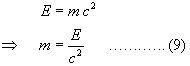
Let E be the kinetic energy of the a-particle.
The loss in mass in each decay is given by |
|
|
 |
2 |
|
The mass loss would be greater than given above
because, by conservation of momentum, the daugther nucleus would move in
opposite direction as the a-particle, with a
lower speed. |
2 |
|
|
|