| a. |
State
the important facts about mass, charge and velocity associated with a,
b and g-radiations
respectively. State the effect, if any, of the emission of each of these
radiations on
i)
the mass number and
ii)
the atomic number
of the element concerned. |
6
marks |
|
|
|
|
| |
a-particle
|
b-particle |
g-ray |
| Mass |
4 a.m.u. |
1/1840 a.m.u. |
0 |
| Charge |
+2e |
-e |
0 |
| Velocity |
~0.1 c |
~0.3 c |
c |
|
3 |
|
* In the following nuclear equation, P represents
the parent nucleus, D represents the daughter nucleus |
|
|
In a-decay, |
|
|
 |
|
|
Thus, the mass number of the parent nucleus
decreases by 4 and the atomic number decreases by 2. |
1 |
|
In b-decay, |
|
|
 |
|
|
Thus, the mass number of the parent nucleus
remains unchanged and the atomic number increases by 1. |
1 |
|
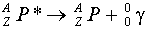
In g-decay, the
excited nucleus returns to its ground state: |
|
|
 |
|
|
Thus, the mass number of the atomic number
remain unchanged. |
1 |
|
|
|
| b. |
Describe
how you would use a GM tube to establish that all the three kinds of radiations
are present in the emissions from a radium source. |
3
marks |
|
|
|
|
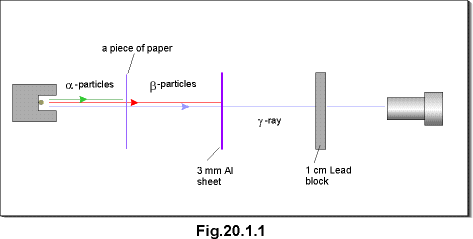
Method 1 Absorption by different
medium |
|
|
 |
1 |
|
Different medium is placed along the path of the radiation,
between the source and the GM tube. If reading falls appreciably, the radiation
is absorbed and is proved to exist. |
1 |
|
A piece of paper can stop a-particles.
A 3 mm Aluminium sheet can stop b-particles.
A 1 cm Lead block can reduce the intensity of g-radiation. |
1 |
|
|
|
|
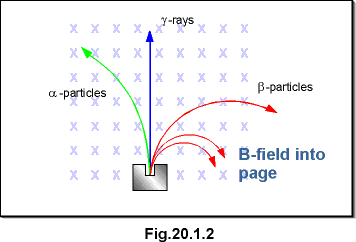
Method 2 Deflection in a B-field |
|
|
 |
1 |
|
Charged particle moving in a magnetic field would undergo
deflection. |
1 |
|
a-particles, being positively
charged, would be deflected to the left. b-particles,
being negatively charge, would be deflected to the right. g-rays
being uncharged would not be deflected. |
1 |
|
|
|
| c. |
Explain
how an ionization chamber can be used together with a voltage supply (0
- 1kV) and an electrometer to detect the radiations from an a-source.
Describe briefly how the current detected varies with the voltage used.
Give your reason. |
5
marks |
|
|
|
|
 |
2 |
|
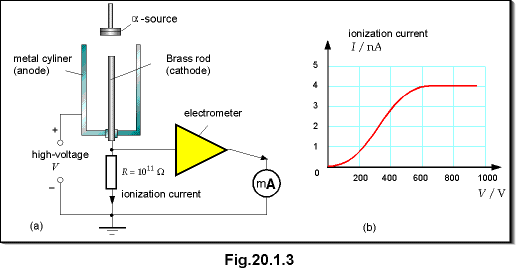
a-particles produce
ion-pairs in air. The ions move in the space between the electrodes, positive
ions towards the cathode and negative ions towards the anode. |
1 |
|
The movement of ions is equivalent to flow
of charge that constitutes a current. The current causes a p.d. across
the built-in input resistor of the electrometer. |
1 |
|
Thus, a reading is shown on the meter. The
higher is the intensity of the radiation, the larger is the current. |
|
|
The high voltage between the electrodes is
used to set up an electric field. The ionization current, however, depends
on the rate of production of ions. Thus, as the high voltage reaches a
certain value, the current saturates. (i.e. increasing the voltage further
would not increase the ionization current anymore) |
1 |
|
|
|
| d. |
State
one everyday application of ionization chamber and explain why it is used. |
2
marks |
|
|
|
|
An application of ionization chamber is smoke detector,
which comes with an a-source. |
1 |
|
When smoke gets into the space between the
electrodes, some ions would lose their energy by colliding with the smoke
particles. As a result, the ionization current would fall. This triggers
an alarm to sound continuously. |
1 |
|
|
|