| a. |
Explain
the terms population inversion and stimulated emission in connection with
lasers. |
3
marks |
|
|
|
|
Population inversion is the state in
which many atoms are excited but do not undergo spontaneous emission. |
1 |
|
Stimulated Emission occurs when the
excited atoms in population inversion are stimulated by a suitable photon
so that they return to the ground state and emit radiation simultaneously.
The photon that is required to cause stimulation is of the same type of
photon that is emitted by the excited atoms. |
2 |
|
|
|
| b. |
Describe
the production of light with an example either from a solid laser or a
gas laser. |
5
marks |
|
|
|
|
In producing laser, atoms are usually excited
by traditional method and then remain in a metastable state, where they
can stay for a considerably long period. A population inversion is established. |
1 |
|
When a stray photon emits an excited atom,
the atom is stimulated to emit a new photon. This new photon would cause
another excited atom to emit a new photon. A cascading effect is then triggered.
Eventually, many excited atoms emit photon at the same time. |
1 |
|
To ensure that all photons are stimulated to
emit photons, a full mirror and a partial mirror are used to reflect light,
so that photons move inside to stimulate other excited atoms. Amplification
of light is achieved. Although a small fraction of light leaves, the intensity
can be very high. |
1 |
|
|
|
|
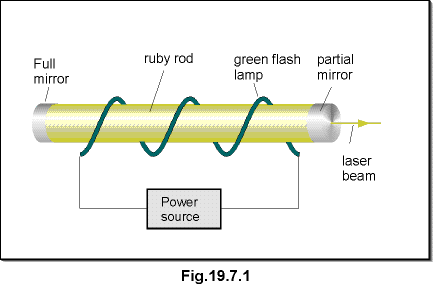
Solid laser (Ruby
Laser) |
|
|
 |
1 |
|
Ruby consists of chromine atoms. Under the
green flash, the chromine atoms are excited and then keep in the metastable
state, awaiting for other photons to start stimulate emission. |
1 |
|
|
|
|
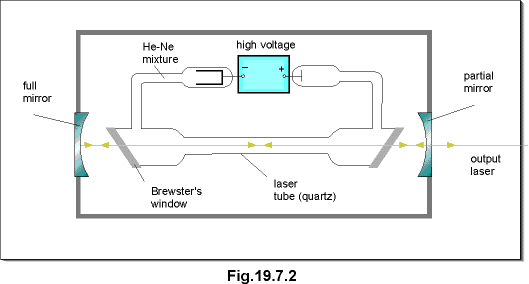
Gas Laser (He-Ne Laser) |
|
|
 |
1 |
|
In He-Ne laser, the excited helium atoms collide
with neon atoms to bring them to metastable state. Afterwards, stimulated
emission results as the excited neon atoms are collided with a suitable
photon that triggers the stimulated emission. |
1 |
|
|
|
| c. |
State
three different everyday applications of lasers. In each case, explain
how the properties of lasers are exploited. |
6
marks |
|
|
|
|
Any three: |
|
|
-
Welding metals
The very high intensity of laser can heat a small area of the target
to a very high temperature.
-
Surgery
The very narrow and high intensity of laser can be used as a very sharp
knife.
-
Holography to produce 3D image.
The coherent optical property of laser makes the interference of light
in space easily controlled.
-
Printing
A very narrow beam of laser could "write" precisely on the drum of
a laser printer for the toner powder to spread on the drum.
-
Optical communication
The uni-directional property of laser allows it to travel for a very
long distance without much attenuation. Its monochromatic property does
not result in confusion of signals, due to dispersion.
-
Reading of digital information
A very narrow coherent beam of laser can locate the pits and falls
on the surface of a CD reliably.
-
Military
The very high intensity of laser enables it to be used in military
to destroy enemy missile or planes.
|
2 for each application |
|
|
|
| d. |
State
one application of lasers in the physics laboratory and explain why they
are used. |
2
marks |
|
|
|
|
Laser is commonly used in physics laboratory to demonstrate
the optical properties of light, e.g. reflection, refraction, diffraction
through a single slit, interference by double slit or diffraction grating. |
1 |
|
The reasons why laser is welcomed are |
|
|
-
intense so that the whole class can see the result without the need of
blackening the classroom
-
narrow so that the angle of reflection/refraction can be demonstrated/measured
clearly
-
monochromatic so that light of different orders passing through the diffraction
grating can be clearly located.
|
1 |
|
|
|