| a. |
Explain
the terms threshold frequency, work function and stopping potential used
in connection with the photoelectric effect. |
6
marks |
|
|
|
|
Threshold frequency is the minimum frequency
of light that can cause photoemission from a particular metal. |
2 |
|
Work function is the energy required for removing
an electron from the metal. It can be regarded as the work done in moving
the electron against the electrostatic attraction between the electron
and the positive charge left behind. |
2 |
|
Stopping potential is the potential that can
stop the photoelectric current in the circuit below. It is used to measure
the kinetic energy of the photoelectrons:
 |
2 |
|
 |
|
|
|
|
| b. |
An
experiment is set up with a photocell connected to a variable voltage source
via a sensitive ammeter. A light source is arranged so that the intensity
and frequency of light can be varied. Sketch graphs to show how the ammeter
reading changes when
i)
the intensity of light varies, keeping the frequency and the applied voltage
constant
Explain briefly. You may assume that, in each case, photoelectrons are
emitted when the varying quantities meet the requirement. |
6
marks |
|
|
|
|
 |
|
|
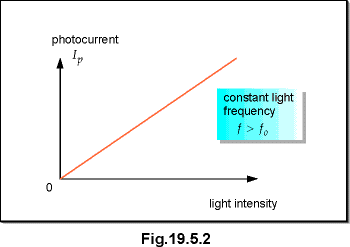
As light intensity increases, the number of
photons hitting the metal per second is increased. Thus, the rate of emission
of photoelectrons is increased, causing the photocurrent to increase. |
1 |
|
|
|
|
ii)
the frequency of light varies, keeping the intensity and the applied voltage
constant. |
|
|
|
|
|
 |
1 |
|
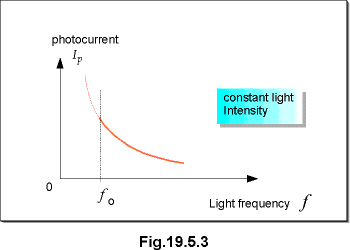
Increasing the frequency increases the energy
of each photon. To keep the intensity of light the same as before, the
number of photons required is less. Thus, the photocurrent decreases as
a result of a drop in the number of photoelectrons. |
|
|
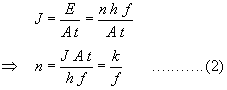
The number of photons per second, n,
is inversely proportional to the frequency for a fixed intensity J
:
|
|
|
Thus, the photocurrent I is inversely
proportional to the frequency of radiation:

|
1 |
|
|
|
|
iii)
the applied voltage varies from negative to positive, keeping the intensity
and frequency constant. |
|
|
|
|
|
 |
1 |
|
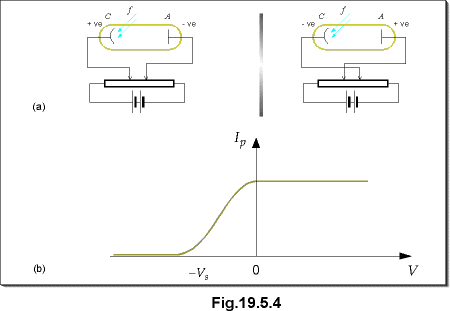
The positive potential does not increase the
photocurrent because the photocurrent depends on the number of photons
reaching the cell (but, independent of the accelerating potential.) |
|
|
If the negative potential is large, some less
energetic photoelectrons cannot reach the anode. The photocurrent would
drop. If the negative potential is so large that the k.e. of photoelectrons
cannot overcome the energy barrier, photocurrent falls to zero. |
1 |
|
|
|
| c. |
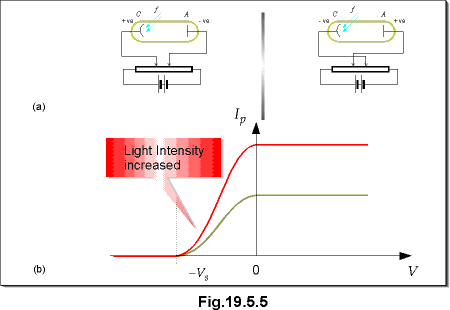
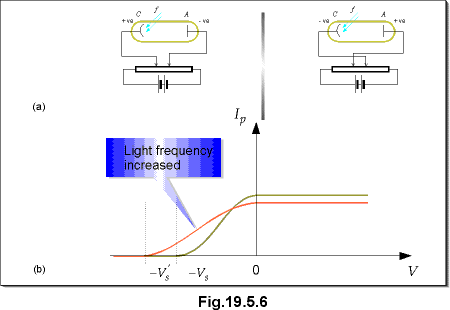
Copy
the graph you have drawn in (b) iii) and sketch on it the curves for
i)
increased light intensity, with the light frequency being kept constant
Explain briefly
the shape of your graphs. |
4
marks |
|
|
|
|
 |
2 |
|
|
|
|
ii)
increased light frequency, with the light intensity being kept constant. |
|
|
|
|
|
 |
2 |
|
|
|
|
Thank you, Sarah, for reminding me the above
mistake in the original prints of the textbook. |
|