| a. |
Explain
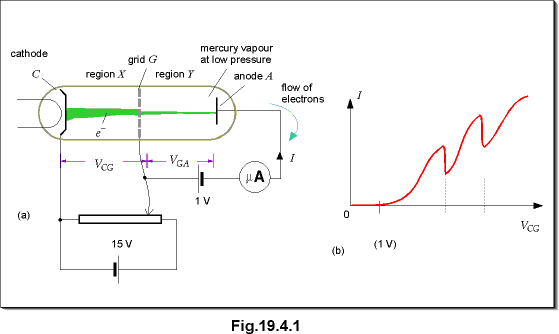
what is meant by “excitation by collision”. Draw the experimental set-up
for investigating the collisions of moving electrons with gaseous mercury
atoms. Discuss the importance of the results. |
6
marks |
|
|
|
|
Excitation by collision is the process
in which an atom is collided inelastically by an electron and therefore
gains some energy without ionization. |
1 |
|
Franck and Hertz Experiment |
|
|
 |
3 |
|
In this experiment, if the voltage across C
and G is greater than that across G and A, i.e. VCG >
VGA, electrons should have no problem in reaching the
anode (i.e. current can be detected). However, when VCG
is increased, it is found that there are some drop in current. This tells
us that some of the electrons have lost their energy in their way to the
anode, so that their kinetic energy is not large enough to overcome the
energy barrier set by the 1 V cell. |
1 |
|
The explanation to the loss in kinetic energy
is inelastic collision with the mercury atoms. Every atom has a set of
definite energy levels. Normally, they are in the ground state. When the
energy of the colliding electron are small, they cannot raise the energy
of the mercury. We say that the collision is elastic. However, when the
energy of the colliding electron is large, the atom will be excited and
some of the energy of the electron will be taken away. |
|
|
Thus, the result of Franck Hertz Experiment
provides an evidence that there are discrete energy level in atoms. |
1 |
|
|
|
| b. |
Describe
how you could analyze the optical spectrum from a light source. Write down
the equation that enables you to find out the wavelength of light. |
3
marks |
|
|
|
|
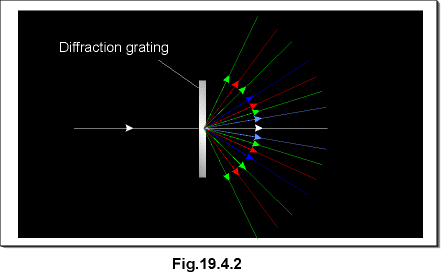
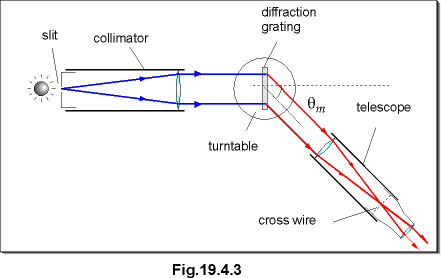
The optical spectrum is analyzed by the use
of a spectrometer and a diffraction grating. |
|
|
 |
1 |
|
When light passing through a diffraction grating,
it would be spread out according to its wavelength. The angle of diffraction
is given by |
|
|
 |
1 |
|
where d is the slit separation of the
grating and m = 0, 1, 2, ... |
|
|
The angle of diffractin can be measured by
a spectrum as shown below: |
|
|
 |
1 |
|
|
|
| c. |
Discuss
and contrast the formations of
i)
line emission spectrum |
5
marks |
|
|
|
|
Line spectrum is produced by exciting the gaseous atoms
at low pressure. When viewed through a diffraction grating, discrete lines
are seen. This shows that such kind of light has only a set of well-defined
wavelengths. |
1 |
|
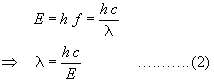
When an atom excited returns to a lower energy level, a
package of energy in the form of photon is emitted. Since atoms have well-defined
energy levels, the photons emitted are also of well-defined energy. |
|
|
The wavelength cannot be any values because
 |
1 |
|
|
|
|
ii)
continuous spectrum |
|
|
|
|
|
A continuous spectrum is emitted from the excited atoms
in a solid or gas at high pressure. The wavelength can be any values within
a range. Since atoms are closely packed, they easily collide with one another.
An excited atom easily has energy exchange with other atoms. Thus, it is
likely that the energy emitted can be any values. |
1 |
|
|
|
|
iii)
absorption spectrum. |
|
|
|
|
|
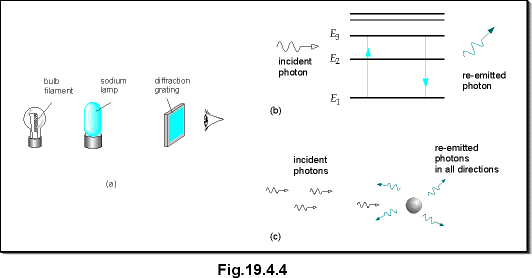
An absorption spectrum is a continuous spectrum with some
missing wavelength. It is produced by passing a white light source (continuous
spectrum) through a gas at low pressure. |
|
|
The atoms in the gas pick up those photons that can cause
excitation. When they return to the ground state, the some photon is emitted
but in all directions. As a result, the intensity of that wavelength in
the original direction is much lower than other wavelengths. |
1 |
|
Experiments show that the absorption spectrum occurs at
the same position as the line spectrum for a given sample of gas. |
|
|
 |
1 |
|
|
|
| d. |
State
the properties of light from a laser. |
2
marks |
|
|
|
|
Lasers are |
|
|
-
powerful
-
coherent
-
monochromatic
-
parallel/unidirectional
|
2 |
|
|
|