| a. |
Explain
what is meant by “ionization by collision”. Describe an experiment in which
the ionization potential of an atom in gaseous form could be measured. |
6
marks |
|
|
|
|
When an atom is given with sufficient amount
of energy, the outer shell electron will be able to leave the atom, leaving
the atom a positive ion. This is called ionization. |
|
|
In "ionization by collision", the energy is
obtained from a fast moving electron. It is a kind of inelastic collision,
such that the kinetic energy of colliding electron is imparted to the atom
causing ionization. |
1 |
|
 |
3 |
|
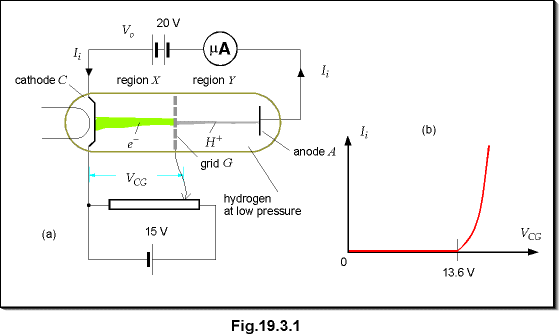
In this experiment, electrons are accelerated
by the E-field between the cathode and the grid. On leaving the grid, electrons
have to pass through an energy barrier which is set up by the "negative"
anode. |
|
|
In normal situation, electrons cannot pass
through this energy barrier because the anode is at -20 V, while the maximum
energy of the electron leaving the grid is only 15 eV. |
1 |
|
However, current is detected when the voltage
of the grid is raised to about 13.6 V. This cannot be explained without
considering the ionization of hydrogen atom inside. |
|
|
When the potential of the grid is raised to
13.6 V, the energy of electrons is now large enough to ionize the hydrogen
atoms. This leaves behind positive ions. |
1 |
|
It is these positive ions that become charge-carriers
between the grid and the anode. |
|
|
|
|
| b. |
Visible
light or X-rays may be emitted when fast-moving electrons collide with
atoms. Using atomic theory, explain in each case how the radiation is emitted. |
4
marks |
|
|
|
|
Visible light is emitted when the outer shell
electron of an atom is excited to a higher energy level and then returns
to the ground state (, giving out a package of energy in the form of photon.) |
1 |
|
The excitation can be caused by |
|
|
-
heating the material to a considerably high temperature
-
a fast moving electron
-
another photon of similar energy
|
1 |
|
|
|
|
X-rays is emitted when the inner shell electrons
are excited to a higher energy level (orbit) and return to the ground state.
The amount of energy required is large, so is the energy package released.
Thus X-ray has very high frequency, according to
 |
1 |
|
X-rays is generated by excitation by collision.
A very high potential is required to accelerate electrons and makes them
collide with a target with very high speed. |
1 |
|
|
|
| c. |
Electrons
may be emitted when a piece of metal is illuminated with suitable radiation.
i)
Explain what is meant by “suitable radiation” in the above sentence. |
6
marks |
|
|
|
|
Free electrons (negative in charge) are bound to move inside
a metal by the strong electrostatic attraction between them and the protons
(positive in charge). |
|
|
In order to cause the electrons to leave the metal, energy
is required. The energy for an electron to leave the metal is known as
work function, F. |
|
|
Photons which have energy in excess of the work function
could cause an electron to leave the metal. Thus, radiation of high enough
frequency f could produce photoelectric effect. |
1 |
|
 |
1 |
|
|
|
|
ii)
Discuss how the classical wave theory cannot give a satisfactory explanation
for the above phenomenon. |
|
|
|
|
|
In classical wave theory, the intensity is given by |
|
|
 |
|
|
where E is the energy received by an
area A in time t. |
|
|
Thus, the energy imparted to an object is proportional
to the intensity, area and time of exposure only: |
1 |
|
 |
|
|
This cannot explain why a lower intensity but
higher frequency radiation could cause photoelectric effect. |
1 |
|
|
|
|
iii)
Describe an experiment to measure the kinetic energy of the electrons emitted
from the metal. |
|
|
|
|
|
 |
1 |
|
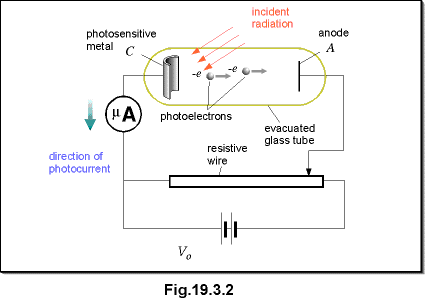
In this experiment, the anode is made negative. The potential
of the anode is adjusted until the photocurrent stops. The p.d. across
the electrode is known as the stopping potential Vs. |
|
|
The kinetic energy of the photoelectron is equal to the
energy barrier set by this potential:
 |
1 |