| a. |
Explain
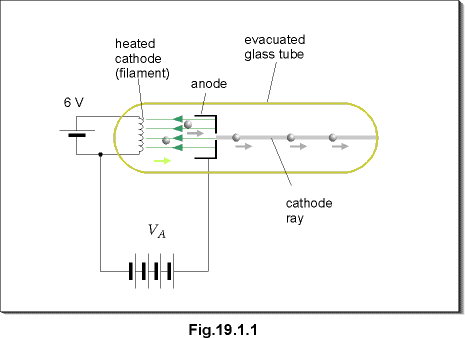
what is meant by thermionic emission. With the aids of a diagram, discuss
how cathode rays could be obtained from an electron gun that makes use
of thermionic emission. |
3
marks |
|
|
|
|
Thermionic Emission: |
|
|
As the kinetic energy of electrons is proportional
to the temperature, when a metal is heated, electrons become more energetic.
Some are able to leave the metal surface. This forms an electron cloud
round the metal. |
1 |
|
|
|
|
Electron gun |
|
|
It consists of a heated cathode (at -ve potential)
and an anode in the form of a hollow cylinder (at +ve potential). Electrons
emitted from thermionic emission are accelerated by the electric field
between the electrodes and leave the anode with high speed. |
1 |
|
 |
1 |
|
|
|
| b. |
Derive
an expression for the speed of an electron, emitted from an electron gun
in which the electrons are accelerated by a p.d. VA. State the
assumption(s) in your derivation. |
2
marks |
|
|
|
|
For each electron moving past a p.d. VA,
the loss in electrical potential energy is
 |
|
|
By conservation of energy, the gain in kinetic
energy is
 |
1 |
|
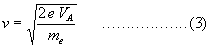
Assuming that the electrons are initally at
rest, i.e. u = 0, |
0.5 |
|
 |
0.5 |
|
|
|
| c. |
Using
a diagram, illustrate how the path of a cathode ray in crossed electric
and magnetic fields is a straight line. Hence, describe an experiment to
measure the charge-to-mass (q/m) ratio of an electron. Give details of
the measurements and show how a value of q/m would be obtained from them.
Theory of magnetic field is not required. |
6
marks |
|
|
|
|
 |
2 |
|
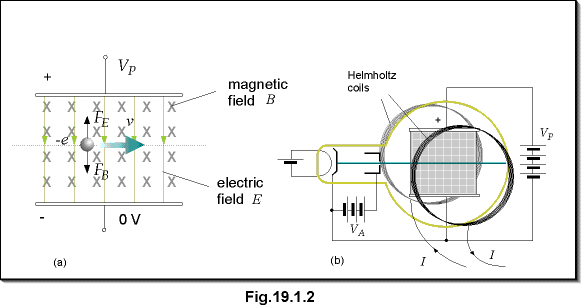
As an electron moves in a crossed electric - magnetic field,
it experiences two forces: electric force FE and magnetic
force FB as shown in (a). Since the two forces are opposite,
by adjusting the size of the fields, it is possible for the two forces
to balance each other. i.e.

In this case, the path of electrons is a straight line. |
1 |
|
Figure (b) shows the Thomson's
Method in measuring q/m for electrons. |
|
|
The electric field is set up by the p.d. Vp
between two plates at separation d. The electric force is therefore
 |
|
|
The magnetic field is set up by a pair of Helmholtz coil,
with magnetic flux density B. As the electrons move with speed v,
the magnetic force is
 |
|
|
As the path of electrons is a straight line,
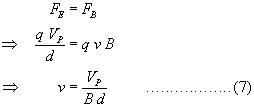 |
1 |
|
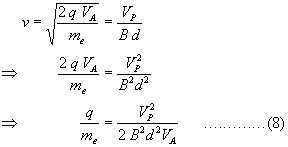
Combining with the equation (3) in a, the charge to mass
ratio of electrons is given by |
|
|
 |
1 |
|
The measurements include p.d. across the plates, Vp,
the accelerating p.d. VA, the plate separation d
and the magnetic flux density B. |
1 |
|
|
|
| d. |
Give
a brief account on the production of visible light from an ordinary fluorescent
tube. Details of the fluorescent tube fixture are not required. |
4
marks |
|
|
|
|
Initially, a high voltage from the ballast (inductor) sets
up a conducting path between the electrodes of the fluorescent tube. Afterwards,
the movement of electrons is maintained by the a.c. mains voltage (~200
V) or even lower (because there is p.d. across the inductor). |
1 |
|
Electrons are set to move to and fro between
the electrodes. As they move, their speed is increasing. Since there is
mercury vapour in the tube, the moving electrons may collide inelastically,
causing excitation. |
1 |
|
As the excited mercury atoms return to the ground state,
radiation would be emitted, in the form of ultra-violet rays. |
1 |
|
The fluorescent material coated uniformly round the inside
of the tube emits visible light as the UV falls on them. |
1 |
|
|
|