| a. |
Derive
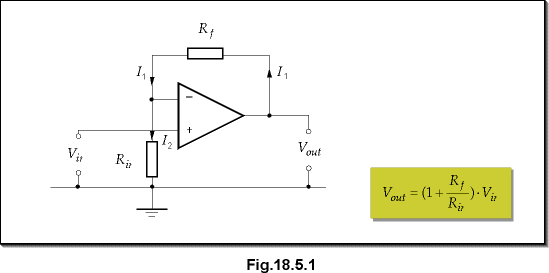
an expression for the closed-loop voltage gain of a non-inverting amplifier
which uses an op amp with input resistor Rin and feedback resistor
Rf, stating the assumptions in your derivation. |
6
marks |
|
|
|
|
 |
|
|
Assumptions: |
|
|
-
The input resistance of the op amp is very large. So, current does not
flow into it.

-
The op amp is not saturated. So, the differential input p.d. is almost
zero.

|
|
|
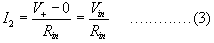
Consider Rin |
|
|
 |
|
|
Consider Rf |
|
|
 |
|
|
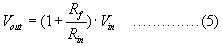
Combining (1), (3) and (4), we have |
|
|
 |
|
|
|
|
| b. |
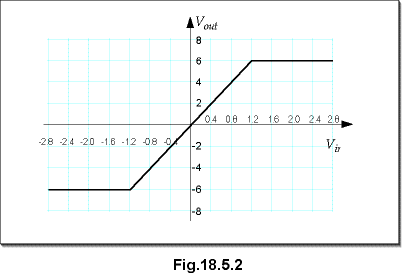
Discuss,
with a suitable graph, how the output voltage varies with the input voltage
for a non-inverting amplifier. |
2
marks |
|
|
|
|
 |
1 |
|
Suppose the saturated output voltage of the
circuit is ±6V and the gain is 5. When the input voltage is small,
the output voltage varies linearly with the input. But when the input is
too large, the op amp saturates. |
1 |
|
|
|
| c. |
Sketch
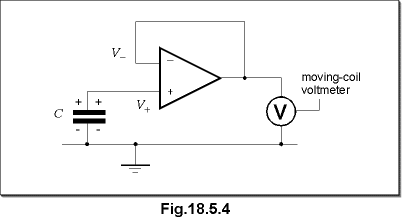
a diagram for a voltage follower. Explain the key feature of a voltage
follower used in measuring the voltage of a charged capacitor. |
3
marks |
|
|
|
|
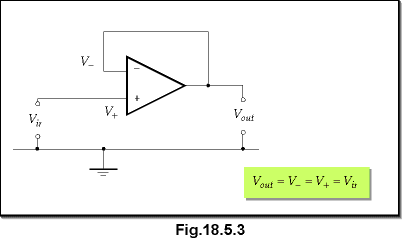 |
|
|
Voltage follower used in measuring the voltage of a charged
capacitor |
|
|
 |
|
|
Key features |
|
|
-
very high input resistance, so the charge on the capacitor is not affected.
-
output voltage is exactly equal to the input voltage. No conversion is
necessary.
|
|
|
|
|
| d. |
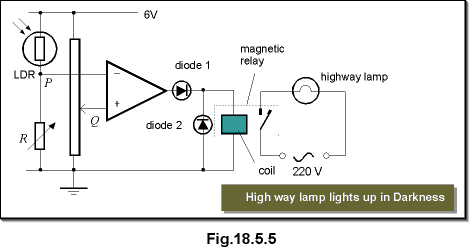
Design
a circuit using an op amp in open-loop configuration that automatically
switches on or off a highway lamp according to light intensity. |
5
marks |
|
|
|
|
 |
5 |
|
|
|