| a. |
Explain
what is meant by negative feedback? State the advantages of connecting
an operational amplifier (op amp) with negative feedback. |
4
marks |
|
|
|
|
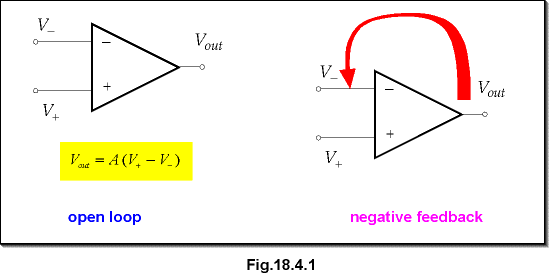
The open loop gain A of an op amp is
so large that even a small difference in the input voltage causes saturation. |
|
|
 |
1 |
|
In an op amp, the inverting input and the output
are in anti-phase. |
1 |
|
Negative feedback is to make part of the output
voltage feed back to the inverting input terminal, in an attempt to reduce
the output voltage (or the gain the the circuit). |
1 |
|
Advantages of op amp in negative feedback |
|
|
-
more stable: not easily saturated
-
independent of temperature
-
independent of frequency
-
gain can be controlled (by setting values of resistance)
|
1 |
|
|
|
| b. |
State
the features of an op amp connected in the closed-loop configuration. |
2
marks |
|
|
|
|
Features |
|
|
-
the input resistance between the inverting and non-inverting inputs of
the op amp is very large (in order of 106 W)
Effectively, no current enters the op amp through its input terminals
-
As the op amp has a long range of linear region, the p.d. between the inverting
and non-inverting inputs of the op amp is zero (when it is not saturated)
|
2 |
|
|
|
| c. |
Derive
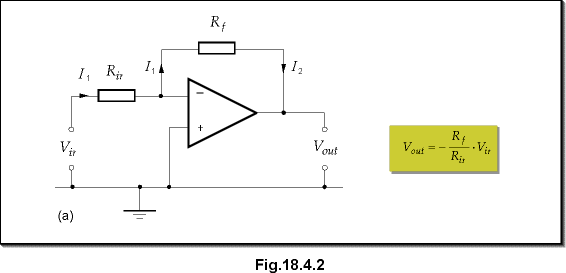
an expression for the closed-loop voltage gain of an inverting amplifier
which uses an op amp with input resistor Rin and feedback resistor
Rf. Hence, sketch a diagram for an inverter. |
6
marks |
|
|
|
|
 |
1 |
|
Since there is no current through the op amp, I1
= I2. |
|
|
Also, V+ = V-. |
1 |
|
Current through Rin is |
|
|
 |
1 |
|
Current through Rf is |
|
|
 |
1 |
|
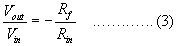
Since I1 = I2, the
voltage gain for the inverting amplifier is |
|
|
 |
1 |
|
An inverter has a gain = -1. This requires
Rf = Rin. |
|
|
 |
1 |
|
|
|
| d. |
What
is a voltage comparator? Explain how a voltage comparator, using an op
amp, could be used to convert a sine wave into
i)
an evenly spaced square wave |
4
marks |
|
|
|
|
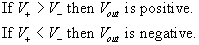
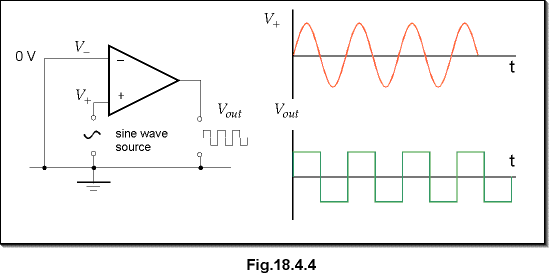
A voltage comparator is the op amp in open-loop configuration.
It can be used to compare two voltages applied to the inverting inputs
(V-) and the non-inverting input (V+). The op
amp is either positive saturated or negative saturated. |
|
|
 |
1 |
|
Sine waves to square waves (evenly
spaced) |
|
|
 |
2 |
|
|
|
|
ii)
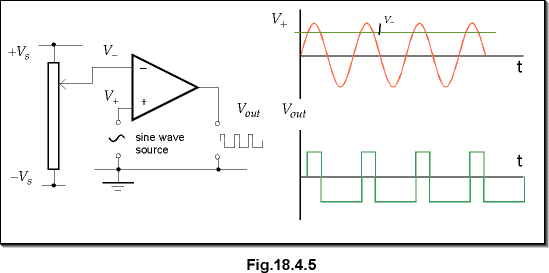
a square wave with different lengths of mark and space. |
|
|
|
|
|
Sine waves to square waves (evenly
spaced) |
|
|
 |
1 |
|
|
|