| a. |
A
charged capacitor is connected across an inductor with negligible resistance.
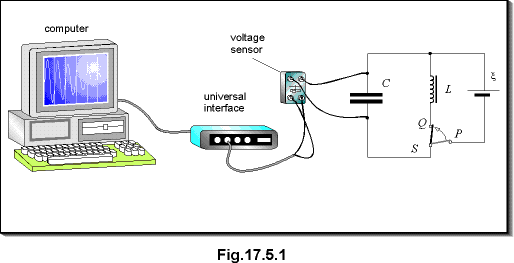
Outline an experiment, using a computer data-logger and a voltage sensor,
to investigate the variation in the p.d. across the capacitor. Carefully
discuss what happens to the energy stored in the circuit. Sketch graphs
to show how the energies stored in the capacitor and the inductor vary
with time. |
8
marks |
|
|
|
|
 |
2 |
|
Fully charge the capacitor by placing the switch
at P. When switched to Q, the capacitor would discharge through
the inductor. The charge on C begins to oscillate, as well as the
current. The voltage across C is revealed on the screen of the computer. |
2 |
|
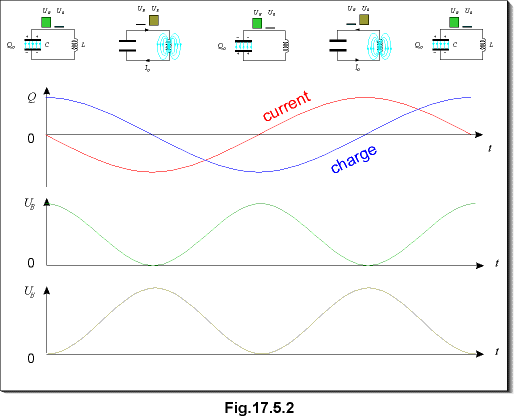
When the capacitor is fully charged, the energy
of the system is mainly electrical form stored in C. When the capacitor
is fully discharged, the current is the maximum. The energy of the system
is mainly the magnetic energy stored in L. |
2 |
|
Time-variation of
charge, current and energy |
|
|
 |
2 |
|
|
|
| b. |
Explain
the meaning of resonance. Either
i)
discuss how LC oscillators could be used to detect metallic objects, or |
6
marks |
|
|
|
|
Resonance describes the phenomenon that
when the energy transfer into an oscillating system is the most efficient.
This occurs when the natural frequency of the oscillating system matches
the frequency of the energy source. Usually, resonance is accompanied with
maximum amplitude. |
2 |
|
Metal detector |
|
|
 |
1 |
|
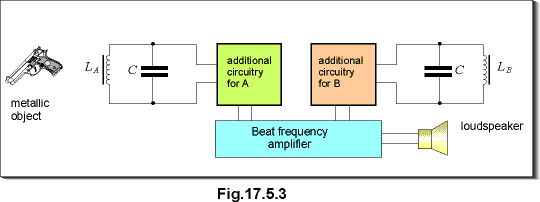
There are two oscillatory circuits in a metal
detector. Initially, the two circuits are tunned to have the same natural
frequency. Thus, the beat frequency when the signals from the two circuits
merge is zero. |
1 |
|
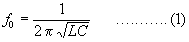
When a metallic object is placed nearby, the
inductance of circuit A is changed. This also changes its natural frequency: |
|
|
 |
1 |
|
Thus, the beat frequency when the signals from
the two circuits merge is non-zero. It is higher when the size of the metallic
object is larger because LA is changed more. |
1 |
|
|
|
|
ii)
discuss the operating principle of a tuning circuit used in a radio. |
|
|
|
|
|
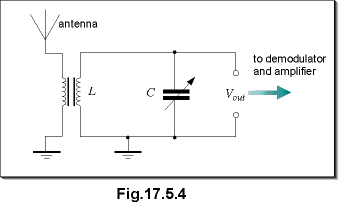
Tuning circuit |
|
|
 |
1 |
|
At any time, radio waves of all frequencies reach the antenna. |
|
|
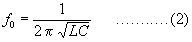
In order to pick up waves of a particular frequency, the
natural frequency of the circuit is tuned to be that frequency by varying
the value of C. |
1 |
|
C can be varied by varying the area of overlap between
the plates. The more is the area of overlap, the higher is C. |
1 |
|
The natural frequency of the circuit is given by |
|
|
 |
1 |
|
|
|
| c. |
A
circuit consists of an inductor, a capacitor and a resistor connected in
series across an a.c. supply. Explain why the instantaneous voltage across
the inductor could be greater than the instantaneous applied voltage. |
2
marks |
|
|
|
|
 |
1 |
|
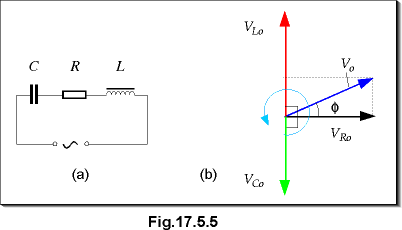
In the LRC circuit, the voltage across the
inductor and the voltage across the capacitor are in anti-phase. When they
add together vectorially, the resultant could be very small. Thus, the
resultant voltage (i.e. the applied voltage) could be smaller than the
voltage across the inductor. |
1 |
|
|
|