| a. |
A
source of a.c. voltage is connected by wires of negligible resistance across
a capacitor. Explain, without the use of mathematical expressions, why
i)
a current flows |
8
marks |
|
|
|
|
When an a.c. source is applied to the capacitor,
the voltage across the plates varies with time. Since the voltage across
a capacitor is proportional to the charge stored on it, the charge on the
capacitor also varies with time, and in phase with the voltage. Because
the charge varies, there is flow of charge between the source and the capacitor.
This constitutes a current. |
2 |
|
|
|
|
ii)
the current is not in phase with the voltage |
|
|
|
|
|
When the capacitor carries no charge, it accepts
charges most readily. i.e. the rate of change of charge is the largest,
OR the current is the largest. (Compare this to charging a capacitor by
a dry cell via a resistor: when the switch is closed, the current is the
largest initially; then the current falls with time.)
When charges accumulate on the capacitor, it is not as easy to put charge
on it as before. i.e. the rate of change of charge falls as charges increases.
In particular, when the capacitor is fully charged, the rate of change
of charge on it is zero. OR, the current is the zero.
To summarize, when the voltage is the largest, the current is zero;
when the voltage is the smallest, the current is zero. i.e. V and I are
not in phase. |
2 |
|
|
|
|
iii)
the size of current depends upon the frequency of the supply voltage |
|
|
|
|
|
Current is the rate of change of charge. When the rate
of change is large, the current is large. At low frequency, the charge
on the capacitor changes slowly, so the current is small. At high frequency,
the charge on the capacitor changes rapidly, so the current is large. |
2 |
|
|
|
|
iv)
the power output of the source is zero. |
|
|
|
|
|
When the capacitor is being charged, the energy stored
on it increases with time. There is a flow of energy from the source to
the capacitor. When the capacitor discharges, the energy stored on it decreases
with time. There is a flow of energy from the capacitor back to the source.
Since there is no resistive components in the circuit, the current flow
would not cause energy dissipation. In other words, the average power output
of the source is zero, although the energy exchange takes place at all
time. |
2 |
|
|
|
| b. |
What
do you understand by power factor? |
2
marks |
|
|
|
|
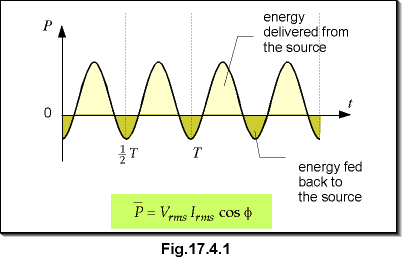
In a circuit with capacitive and/or inductive components,
the current may not be in phase with the applied voltage. If the phase
difference between V and I is f, the power consumption
varies as follows: |
|
|
 |
|
|
The area above the time-axis represents energy delivered
from the source. The area under the time-axis represents energy fed back
to the source. |
|
|
It can be proved that the average power consumption by
the source is |
|
|
 |
|
|
where the cos f is known as
the power factor of the circuit. |
|
|
|
|
| c. |
If
a resistor, of resistance R, is connected in series with a capacitor, of
capacitance C, to an a.c. voltage of frequency f and peak voltage V, derive
expressions for
i)
the phase difference between the voltage and the current. |
6
marks |
|
|
|
|
 |
1 |
|
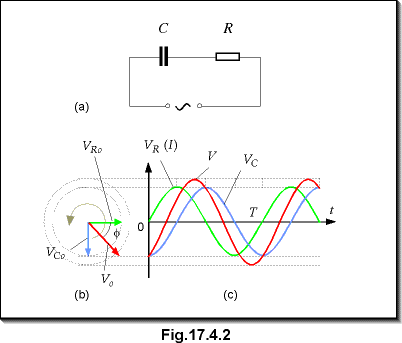
Suppose the peak current is Io and the
peak applied voltage is Vo. Fgure (b) above shows the
phase relationship between V and I. |
|
|
The current always leads the voltage across C by
90o. The current leads the applied voltage. |
|
|
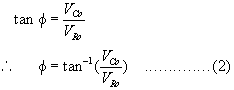
The phase angle between V and I is |
|
|
 |
1 |
|
The peak voltage across the resistor is
 |
|
|
The peak voltage across the capacitor is
 |
|
|
Thus, the angle at which V lagged behind
I is
 |
1 |
|
|
|
|
ii)
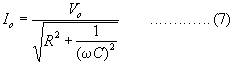
the peak current through the resistor. |
|
|
|
|
|
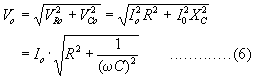
The resultant of VC and VR
is the applied voltage: |
|
|
 |
|
|
Thus, the peak current is |
|
|
 |
1 |
|
|
|
|
iii)
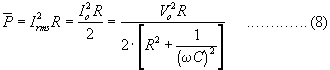
the average power consumption. |
|
|
|
|
|
The average power consumption is |
|
|
 |
2 |
|
|
|