| a. |
An
inductor and a capacitor are connected one at a time to a variable-frequency
power source. State how, and explain in non-mathematical terms why, the
current through the inductor and the capacitor varies as the frequency
is varied. |
6
marks |
|
|
|
|
When an inductor is connected to an a.c. source,
the current varies with time. This produces a varying magnetic flux across
the coils. |
|
|
By Lenz's Law, an e.m.f. would be induced in
such a way as to oppose the changing current. |
1 |
|
The higher is the frequency of the current,
the higher is the induced e.m.f. and the lower is the current. |
1 |
|
Thus, the current through the inductor varies
inversely with the frequency. |
1 |
|
|
|
|
When a capacitor is connected to an a.c. source,
the charge on the capacitor varies with time. When the capacitor is fully
charged, the voltage across it is largest and the current is instantaneously
zero. |
1 |
|
If the rate at which the a.c. frequency changes
is low, the flow of charge into and out of the capacitor is also low. This
gives rise to low current flow. |
1 |
|
Conversely, if the rate at which the a.c. frequency
changes is high, there is rapid flow of charge into and out of the capacitor.
This gives rise to a high current flow. |
|
|
Thus, the current through the capacitor varies
directly with the frequency. |
1 |
|
|
|
| b. |
Explain
why the speaker unit in most hi-fi systems consists of more than one loudspeaker
of different sizes. Using a suitable diagram, discuss how the signals from
an amplifier are routed to the appropriate loudspeakers. |
5
marks |
|
|
|
|
The diffraction of sound from a source depends
on the relative size of the source and the wavelength. |
1 |
|
The degree of diffraction is more for longer
wavelength. i.e. more for lower pitch, less for higher pitch. |
1 |
|
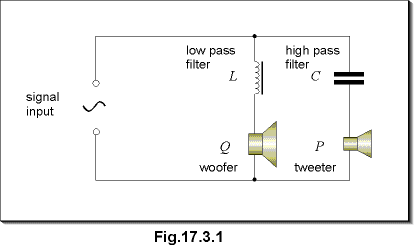
In a Hi-fi system, it is desirable to have
all sounds diffract equally. Thus, loudspeakers of different sizes are
used. Small loudspeakers are for high pitch, large for low pitch. |
1 |
|
 |
1 |
|
In the above circuit, the inductor allows low
frequency current to flow readily but blocks the high frequency signals.
Thus, a large loudspeaker is used in that branch. |
|
|
The capacitor allows high frequency current
to flow readily but blocks the low frequency signals. Thus, a small loudspeaker
is used in that branch. |
1 |
|
|
|
| c. |
A
charged capacitor is connected across an inductor. Discuss qualitatively
how the charge stored in the capacitor and the current through the inductor
change with time. |
5
marks |
|
|
|
|
 |
1 |
|
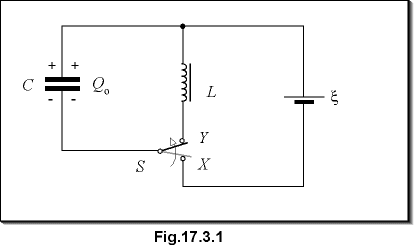
When the switch is made to Y, the charge on
C begins to decrease. There is a small current flow initially. This induces
an e.m.f. across L. |
1 |
|
As the charge on C decreases, the energy in
C decreases but the energy in L increases. |
|
|
As the charge on C drops to almost zero, the
rate of change of current is also zero. But the current at that time is
the largest. |
1 |
|
This large current does not stop suddenly because
energy is stored in L. This causes the charge on the upper plate of C changes
from +ve (initially) to (-ve). |
|
|
Very soon, the charge on C increases to a maximum
again. Then the current is zero. |
1 |
|
The above process is only half a period. |
|
|
In another half of the period, the -ve charge
on the top plate of C begins to flow to the lower plate via the inductor. |
|
|
When the charge on C is empty, the current
is the largest (but opposite to the 1st half). |
|
|
Since the current keeps on flowing, the charge
on C is restored. |
1 |
|
The above process repeat on an on, oscillating
continuously. |
|
|
|
|