| a. |
Using
suitable diagrams, discuss how a vector of constant magnitude rotating
at a uniform angular speed could be used to represent a sinusoidal quantity. |
2
marks |
|
|
|
|
|
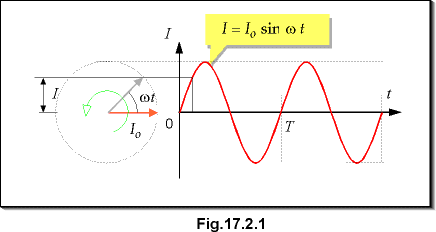
Consider a vector of magnitude Io
rotating anti-clockwise. The value of the projection on the vertical axis
varies with time. From the diagram below, this time-varying quantity is
sinusoidal. i.e.
 |
|
|
 |
|
|
|
|
| b. |
A
pure inductor is connected to a variable-frequency power source. Explain
why the voltage across the inductor is non-zero. State and explain the
phase relationship between the current and the applied voltage. Use a phase
vector diagram to represent the two quantities and sketch to show how these
quantities varies with time. |
6
marks |
|
|
|
|
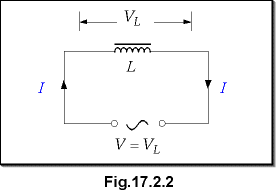
The diagram shows a pure inductor in an a.c.
circuit: |
|
|
 |
|
|
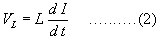
As the current changes, the magnetic flux across
the inductor changes. This induces a back e.m.f. according to Lenz's Law.
Thus, the voltage across the inductor is |
1 |
|
 |
|
|
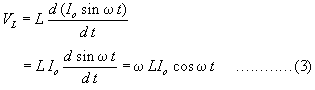
Putting (1) into (2), the voltage across the
inductor is |
|
|
 |
|
|
which is non-zero. |
1 |
|
Equation (3) can be written as |
|
|
 |
1 |
|
By comparing (4) to (1), the voltage across
the inductor L is p/2 radian or 90o
ahead of the current. |
1 |
|
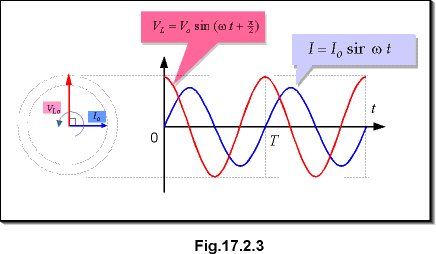
The phase diagram for I and VL
is |
|
|
 |
2 |
|
|
|
| c. |
A
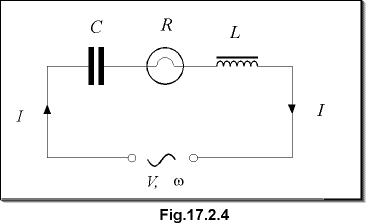
circuit is set up containing an inductor, a capacitor, a lamp and a variable
frequency source with the components arranged in series. Explain in detail
why, as the frequency of the supply is varied, the lamp is found to increase
in brightness, reach a maximum value and then become less bright. |
8
marks |
|
|
|
|
 |
|
|
The peak voltage across the capacitor is |
|
|
 |
|
|
Vc is 90o lagged
behind the current. |
|
|
The peak voltage across the inductor is |
|
|
 |
|
|
VL is 90o leading
the current. |
|
|
The peak voltage across the resistor is |
|
|
 |
|
|
VR is in phase with the current. |
2 |
|
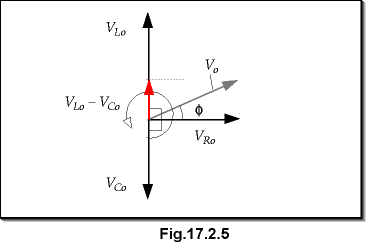
The resulting phase
diagram is |
|
|
 |
1 |
|
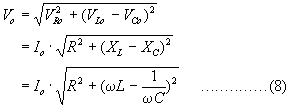
The applied peak voltage is |
|
|
 |
|
|
Thus, the impedance of the circuit is |
|
|
 |
1 |
|
 |
2 |
|
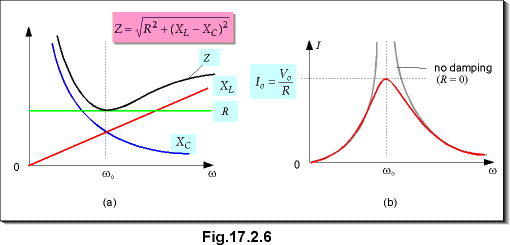
If the frequency of the a.c. source is increased,
Z is large initially but reaches a minimum at a particular frequency and
then increases again as shown in (a) above. |
|
|
Thus, the current through the circuit is small
initially, reaches a maximum at that frequency and then decreases again
as shown in (b) above. |
1 |
|
The frequency at which Z is minimum and I is
maximum is given by |
|
|
 |
1 |
|
|
|