| a. |
Explain
what is meant by the peak value and the root mean square value of an alternating
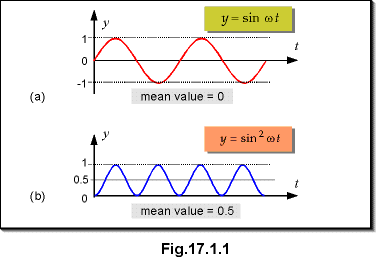
current. By using a plot of sin2wt
against t, or otherwise, establish the relation between the peak value
and the root mean square value of a sinusoidal alternating current. |
4
marks |
|
|
|
|
A sinusoidal current could be expressed mathematically
as

where the amplitude Io is the peak current.
The root mean square current Irms is the square root
of the mean of the square of I.
In mathematical form,
 |
1 |
|
Consider the following diagram, which shows
(a) a plot of sin wt and (b) a plot of
sin2wt. The mean value of
y = sin2wt is clearly
0.5. i.e.
 |
1 |
|
 |
1 |
|
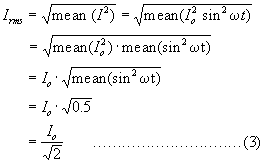
The r.m.s. current is related to Io
by the following formula
 |
1 |
|
|
|
| b. |
State
and explain the physical significance of root mean square current in an
a.c. circuit. |
3
marks |
|
|
|
|
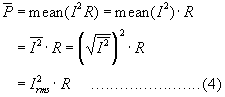
The average power when a varying current flows
through through a device of resistance R is
 |
2 |
|
Thus, the r.m.s. current is the equivalent
d.c. current that produces the same power. |
1 |
|
|
|
| c. |
Explain
why a moving coil ammeter cannot be used to measure an alternating current
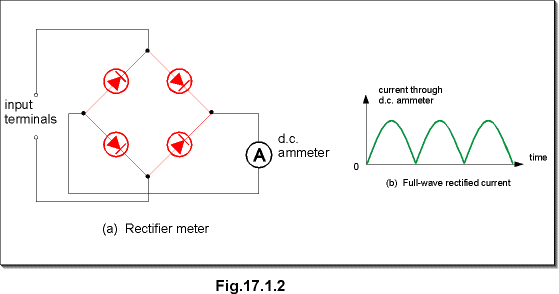
even if the frequency is low. Draw a diagram of a bridge rectifier circuit
which could be used with such an ammeter and explain its action. Discuss
whether the meter could be calibrated to give root mean square value of
the current passing through it. |
5
marks |
|
|
|
|
A moving coil ammeter cannot be used to measure a.c. because
the torque that drives the pointer to deflect is not a constant. At high
frequency, the pointer does not deflect at all. At low frequency, the pointer
oscillates and does not give any steady reading. |
2 |
|
Circuit to rectify a.c. into d.c.
for the meter to measure current: |
|
|
 |
2 |
|
Although the ammeter depends on the mean current flowing
through the ammeter (there is no consumption of power by the ammeter),
the ammeter could be calibrated to read r.m.s. current. This is because
the r.m.s. value of a sinusoidal current is proportional
to the mean value. |
1 |
|
Note: However, when the ammeter
is used to read non-sinusoidal current (e.g. sawtooth), the value is not
exactly the r.m.s. value of this current. This is because the ratio Irms/
(mean I) is not the same for both sinusoidal and sawtooth. |
|
|
|
|
| d. |
An
inductor is connected to a variable-frequency power source. State how,
and explain in non-mathematical terms why, the current through the inductor
varies as the frequency is varied. |
4
marks |
|
|
|
|
 |
|
|
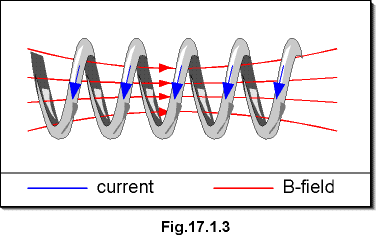
When a current is flowing through a coil (inductor),
a magnetic field is established as shown above. The magnetic flux cross
the coil changes when the current changes. |
1 |
|
By Lenz's Law, an e.m.f. is induced to oppose the changes. |
1 |
|
The faster is the current changes, the higher
is the induced e.m.f. to oppose the change. |
1 |
|
In a circuit with constant voltage, the higher
is the induced e.m.f. in the coil, the smaller is the current, according
to
 |
|
|
To summarize, the higher is the frequency,
the lower is the current. |
1 |
|
|