| a. |
An
aluminium ring placed with its plane horizontally is dropped from a certain
height above a thin bar magnet arranged vertically with its N-pole pointing
upward and its axis passes through the center of the ring. With the aid
of suitable diagrams, discuss how current is induced inside the aluminium
ring on its way downward, passing through the bar magnet. |
3
marks |
|
|
|
|
 |
|
|
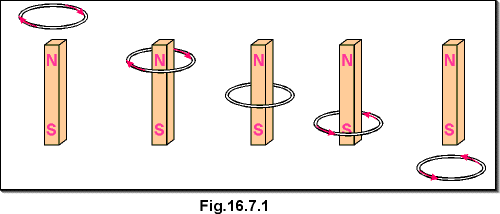
Before reaching the magnet, current flows clockwise.
A N-pole is formed below the ring to oppose the entering motion. |
1 |
|
On leaving the magnet, current flow anti-clockwise.
A N-pole is formed above the ring to oppose the exiting motion. |
1 |
|
When the ring is mid-way, current change in
direction and is instantaneously zero. |
1 |
|
|
|
| b. |
State
and explain what happens to the ring in (a) if it is made from superconducting
material. |
2
marks |
|
|
|
|
If the ring is made from superconducting material,
the current set up by the initial increase in flux would continue to flow
indefinitely. Thus, the speed of fall decreases with time. At a certain
position, it would stop moving, while the current is kept flowing to produce
a magnetic force that balances the weight. |
2 |
|
|
|
| c. |
A
vertical square loop of wire of side b is moved horizontally at a constant
speed across a rectangular region of horizontal magnetic field of uniform
flux density B, with the plane of the loop at right angles to the field
lines. Show that the mechanical energy input to the loop of wire is equal
to the electrical energy dissipated in the resistance of the wire. |
4
marks |
|
|
|
|
 |
1 |
|
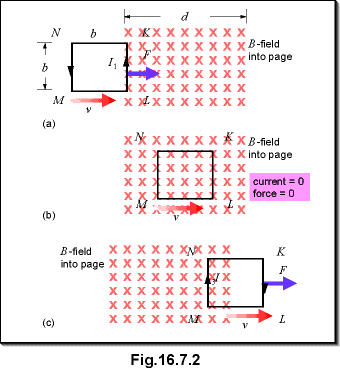
Suppose the resistance of the wire is R. |
|
|
Entrance |
|
|
The induced e.m.f. is |
|
|
 |
|
|
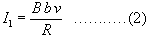
The induced current is |
|
|
 |
1 |
|
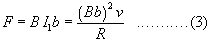
The applied force is |
|
|
 |
|
|
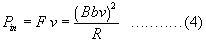
The mechanical power input is |
|
|
 |
1 |
|
The electrical power consumed by R is |
|
|
 |
1 |
|
Inside the field |
|
|
When the loop is completely inside the field, the flux
linkage is constant. There are no induced e.m.f., no induced current and
no energy dissipation. Applied force is not necessary. |
|
|
Exit |
|
|
When the coil leaves, the induced e.m.f. is also |
|
|
 |
|
|
Thus, the power input and output are the same as that at
the entrance. |
|
|
Energy is conserved. |
|
|
|
|
| d. |
A
large aluminium disc is mounted on a horizontal axle between the poles
of a permanent magnet. Explain clearly your expected observations, and
the physical principles involved when
i)
the disc is spun to rotate clockwise |
4
marks |
|
|
|
|
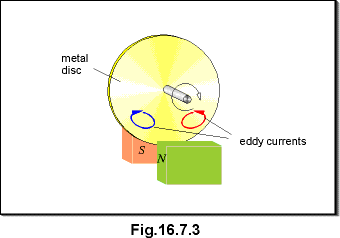
The motion of the disc is rapidly retarded by the eddy
current. |
1 |
|
 |
2 |
|
|
|
|
ii)
the disc of (i) is replaced by a similar disc, but with evenly spaced slots
arranged radially on its surface. |
|
|
|
|
|
Since there are slots on the disc, the extent of eddy current
would be less. Retardation is much less than before. |
1 |
|
|
|
| e. |
The
speedometer of a bicycle consists of a permanent magnet attached to a spoke
of the front wheel and a sensor fixed to the bike frame. Discuss how a
computer connected to the sensor is programmed to calculate the speed of
the bicycle. |
3
marks |
|
|
|
|
When the bicycle moves, the magnet rotates with the wheel.
As the magnet passes over the sensor coil, the magnetic flux in the coil
rises and then falls. |
1 |
|
This produces an induced e.m.f. and an induced
current in the coil. The current, in the form of pulses, is sent to a computer
which counts the number of turns performed by the wheel in each second. |
1 |
|
From this information and the radius of the wheel, the
speed of the bicycle can be calculated and is shown on the display. |
1 |
|
|
|