| a. |
Two
long parallel wires, each of length l and separated by a distance
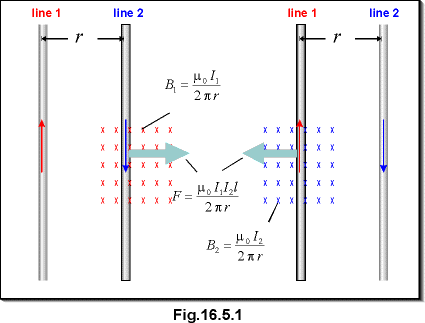
d, carry a current I in the opposite direction. Draw a diagram of this
arrangement and on it show
i)
the magnetic field at each wire due to the other, and |
|
|
ii)
the corresponding forces,
giving their magnitudes. |
3
marks |
|
|
|
|
 |
3 |
|
|
|
| b. |
How
may a similar arrangement be used to define the ampere unit of current?
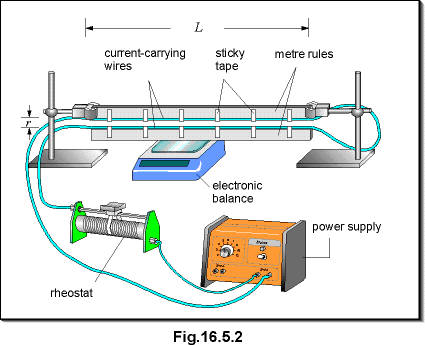
Describe an experiment using an electronic balance for the absolute measurement
of a current. |
5
marks |
|
|
|
|
A current of one ampere in two straight parallel conductors
of infinite length and negligible thickness placed 1 m apart in a vacuum
will exert a force of 2 × 10⁻⁷ N per metre of conductor. |
2 |
|
 |
1 |
|
When the current is switched on, the wires carrying opposite
current would repel each other. The lower wire is pushed downward. Thus,
there is an increase in the balance reading, given by |
|
|
 |
1 |
|
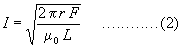
The current is therefore |
|
|
 |
1 |
|
|
|
| c. |
By
considering the force on free electrons of charge e moving with a constant
velocity v in a path perpendicular to a uniform magnetic field of flux
density B, explain
i)
the production of an e.m.f. x
when an electric current is passed through an n-type semiconductor crystal
in a direction perpendicular to a magnetic field |
8
marks |
|
|
|
|
 |
2 |
|
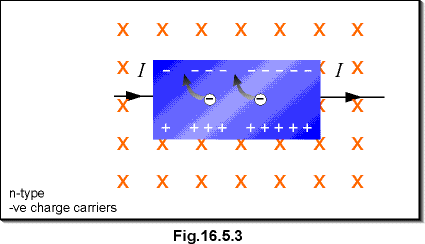
When current flows through the conductor, the
magnetic force acting on the charge carrier cause it to move to one side
according to the Fleming's Left hand rule. . |
1 |
|
This establishes an e.m.f. and an electric
field so that the coming electrons would move undeflected |
1 |
|
|
|
|
ii)
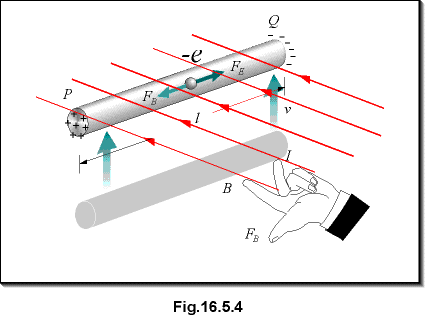
the production of an e.m.f. x‘
in a straight conductor moved perpendicular to a magnetic field. |
|
|
|
|
|
 |
2 |
|
When the conductor moves up, by Fleming's left
hand rule, the electrons would move to the right side (towards Q).
As the electrons accumulate, they would establish an e.m.f. Other electrons
would then experience both magnetic and electric force equal in magnitude
but opposite in direction. |
2 |
|
|
|