| a. |
Briefly
explain electrical conduction in a wire made of p-type semi-conducting
material. The cross-section of the wire has thickness t and width w. Deduce
an expression for the current I in the wire in terms of the dimensions
of the cross-section of the wire, the number of charge-carriers per unit
volume, n, the charge on the charge-carrier, q, and its drift velocity,
v. |
5
marks |
|
|
|
|
A p-type semi-conductor conducts electricity
by positive charge-carriers (holes). (It is made from a pure silicon that
contains impurities of valency 3 atoms, e.g. Al) |
1 |
|
 |
1 |
|
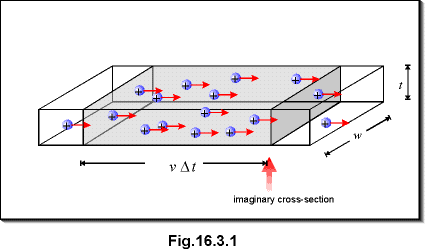
In time Dt, all
the charge-carriers in the shaded region would pass through the imaginary
cross-section. Thus, the number of charge-carriers passing through the
cross section is |
|
|
 |
1 |
|
Therefore, in time Dt,
the amount of charge flowing is |
|
|
 |
1 |
|
where q is the charge on each charge-carrier. |
|
|
This contributes to a current I given by |
|
|
 |
1 |
|
|
|
| b. |
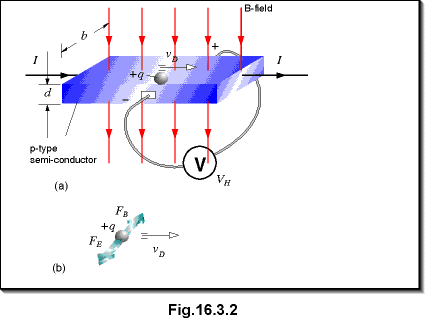
The
current-carrying wire in (a) is placed in a magnetic field. Account for
the Hall voltage in the wire. By drawing a diagram that shows the directions
of the drift velocity, the magnetic field and the forces on a charge-carrier,
derive an expression for the Hall voltage. |
6
marks |
|
|
|
|
 |
|
|
The magnetic force acting on each charge-carrier is |
|
|
 |
|
|
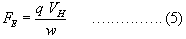
The electric force is due to the voltage set up by accumulated
charges. |
|
|
 |
|
|
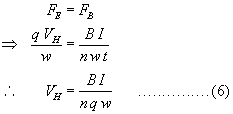
When the particles move in a straight line, the two forces
balance. Thus the Hall voltage is given by |
|
|
 |
|
|
|
|
| c. |
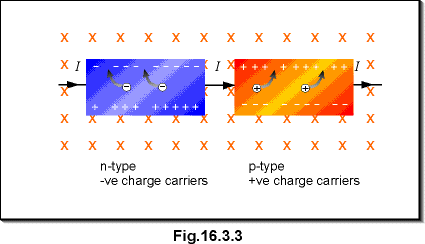
Explain,
without experimental detail, how the direction of Hall voltage could be
used to determine whether a slab of semi-conducting material is n-type
or p-type. |
3
marks |
|
|
|
|
 |
1 |
|
When a conductor is placed the magnetic field, the magnetic
force acting on the charge-carriers is always given by the Fleming's left
hand rule, whether it is +ve or -ve. |
1 |
|
As a result, the Hall voltage are opposite in directions
for materials of +ve charge-carriers and -ve charge-carriers. |
1 |
|
|
|
| d. |
Compare
the uses of a Hall probe and a search coil in measuring magnetic fields. |
2
marks |
|
|
|
|
Hall probe is used to measure steady magnetic field. |
1 |
|
Search coil is used to measure varying magnetic
field. |
1 |
|
|
|