| a. |
The
singly-charged ions of an isotope are performing circular motion with different
speeds in a uniform magnetic field. Show that their rates of revolution
are the same. Explain how you would compare their speeds of motion from
the radii of their paths. |
3
marks |
|
|
|
|
 |
|
|
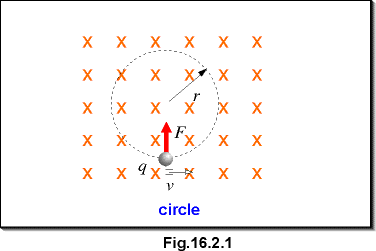
Consider a charged particle of mass m
moving in a magnetic field of flux density B and at right angles
to the field lines. Suppose the speed of motion is v. The magnetic
force is |
|
|
 |
|
|
The force does not change the speed but would
change the direction. As a result the particle performs circular motion.
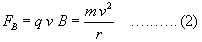
FB provides the centripetal force: |
|
|
 |
1 |
|
where r is the radius of the path. |
|
|
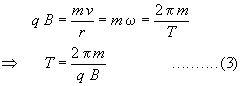
The period of motion is given by simplifying
(2): |
|
|
 |
|
|
Thus, T is independent of speed. Ions
of the same isotope has the same mass. Thus, all ions move with the same
period. |
1 |
|
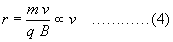
From equation (2), the radius of the path is |
|
|
 |
|
|
Thus, ions with higher speed move in a larger
circle. |
1 |
|
|
|
| b. |
A
charged particle is projected with an initial velocity v in a uniform magnetic
field, making an angle q
with the field lines. Discuss how the energy of the particle changes with
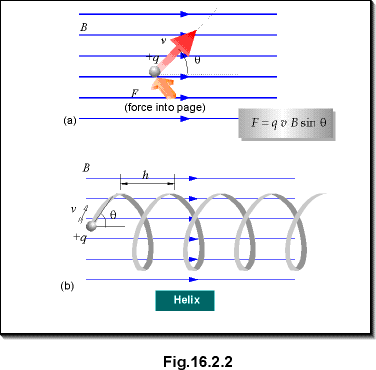
time. Using a diagram, give a detail account on the movement of the particle
in the magnetic field. |
6
marks |
|
|
|
|
 |
2 |
|
The velocity can be resolved into two components:
one parallel to (v//) and the other perpendicular ( )to
the field lines. )to
the field lines. |
|
|
v// is unaffected because the magnetic force
is zero. |
1 |
|
 has a constant magnitude but varying in direction because the motion is
circular.
has a constant magnitude but varying in direction because the motion is
circular. |
1 |
|
Thus, the kinetic energy of the particle is
unchanged. |
1 |
|
The path of the particle is a helix as shown
above. |
1 |
|
|
|
| c. |
If
the magnetic field in (b) is superimposed by a uniform electric field at
right angles to the magnetic field and the particle is projected so that
its velocity is perpendicular to both the electric and magnetic fields,
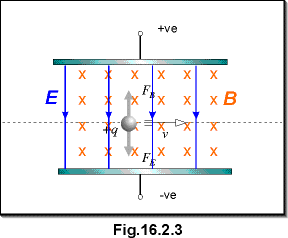
show that it is possible for the particle to move in a straight line, draw
a clear diagram showing the forces acting on the particle and derive an
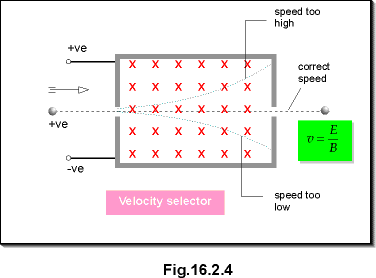
expression for the required projection speed vo. Describe the
path of the particle if the projection speed is
i)
greater than vo |
|
|
ii)
less than vo. |
5
marks |
|
|
|
|
 |
1 |
|
The electric force acting on the charged particle
is downward: |
|
|
 |
0.5 |
|
The magnetic force acting on the charged particle
is upward: |
|
|
 |
0.5 |
|
If the electric and magnetic forces balance,
FE = FB, then the path is a straight
line. |
|
|
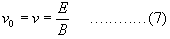
For this to occur, the required speed is |
|
|
 |
1 |
|
|
|
|
 |
2 |
|
|
|
| d. |
Very
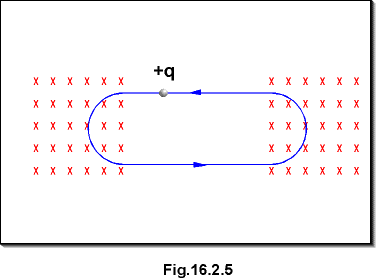
hot plasma can be trapped inside a container without physical walls. Explain
how this is accomplished. |
2
marks |
|
|
|
|
 |
|
|
Strong magnetic field can be set up as shown
above. Charge particles moving at right angle to the field lines would
be deflected in semi-circular path. In this way, the particle is reflected
as if it strikes on a solid wall. |
|
|
|
|