| a. |
Explain
how the N-pole of a bar magnet is defined. |
1
mark |
|
|
|
|
When a bar magnet is suspended freely, it would
align along N-S under the influence of the Earth's magnetic field. The
pole pointing north is called N-pole (or north-seeking pole). |
1 |
|
|
|
| b. |
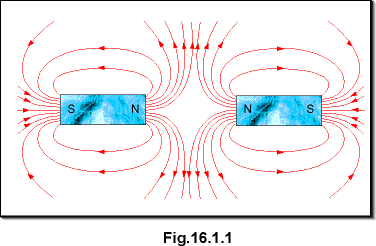
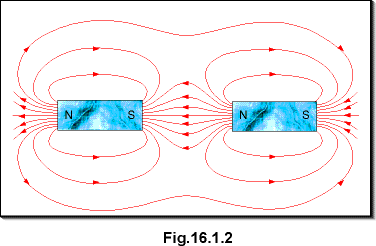
Draw
the magnetic field patterns for a pair of bar magnets placed end-to-end
along a straight line with
i)
their like N-poles facing each other |
4
marks |
|
|
|
|
 |
|
|
|
|
|
ii)
their unlike poles facing each other.
You may ignore the
effect of the Earth’s magnetic field. |
|
|
|
|
|
 |
|
|
|
|
| c. |
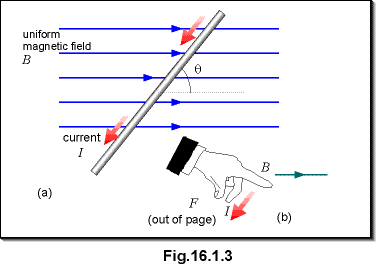
Write
down a formula for the magnitude of the magnetic force on a straight current-carrying
wire placed in a magnetic field, explaining clearly the meaning of each
symbol in your formula. |
2
marks |
|
|
|
|
 |
1 |
|
The magnetic force on the wire is |
|
|
 |
|
|
where B is the magnetic flux density, I is
the current in the wire, l is the length of the wire in the field
and q is the angle that the wire makes with
the field lines. |
1 |
|
|
|
| d. |
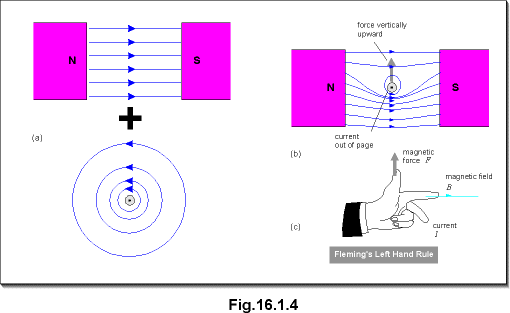
By
drawing a diagram of the magnetic field pattern round a current-carrying
wire placed in a uniform magnetic field, at right angles to the field lines,
explain how the direction of the magnetic force can be deduced. |
3
marks |
|
|
|
|
 |
2 |
|
When a wire is placed in the uniform field (Fig.a), the
field lines add vectorially giving a catapult field as shown in Fig.b.
The field lines at the bottom are higher in density and push the wire upward. |
1 |
|
|
|
| e. |
Describe
an experiment to demonstrate the magnetic force on a current-carrying wire
placed in a magnetic field. Explain how you would verify that your formula
in (c) is correct. |
4
marks |
|
|
|
|
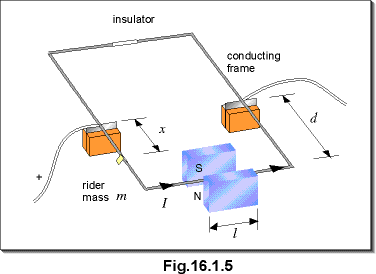
Experiment using a current balance |
|
|
 |
2 |
|
Set up a horizontal uniform magnetic field using a pair
of face magnets. Current is then allowed to flow through the section of
wire in the B field. |
|
|
The magnetic force produces a couple which
could be balanced by a paper rider. |
|
|
By measuring the distance x and d
as shown above, the magnetic force can be measured. |
1 |
|
We apply the formula in (c) in a special case
such that q = 90o. |
|
|
Current is varied by increasing the voltage
of the power supply. |
0.5 |
|
Length of wire in the magnetic field could
be increased by adding more face magnets in series. |
0.5 |
|
|
|
| f. |
State
two applications of the magnetic effect on a current-carrying wire. |
2
marks |
|
|
|
|
Examples of applications: |
|
|
-
Loudspeaker
-
Galvanometer
-
Motor
-
Propulsion of boat (refer to text book P.341)
|
any 2 |
|
|
|