| a. |
An
electric circuit consists of a resistor of resistance R connected across
the terminals of a cell. Describe the mechanism by which heat is produced
in the resistor. Derive an expression for the rate at which heat energy
is generated when a current I flows through the resistor. |
5
marks |
|
|
|
|
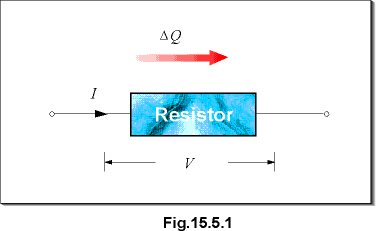
In the electric circuit, a p.d. is applied
across the resistor. This sets up an electric field in which free electrons
are caused to move by an electric force. As electrons move, they collide
with the molecules in the resistor and their motion is retarded. A retarding
force exists to balance the electric force. Work is done against this retarding
force. Heat is produced. |
2 |
|
 |
1 |
|
Suppose the p.d. across the resistor is V.
We have V = I R. In time Dt, the
charge flowing through the resistor is |
|
|
 |
|
|
The electrical energy converted into internal
energy in time Dt is |
|
|
 |
1 |
|
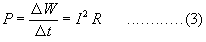
The rate at which heat is produced is |
|
|
 |
1 |
|
|
|
| b. |
Briefly
describe the electrical transmission system from the power station to the
domestic consumer. Explain why such a system is used. |
4
marks |
|
|
|
|
 |
2 |
|
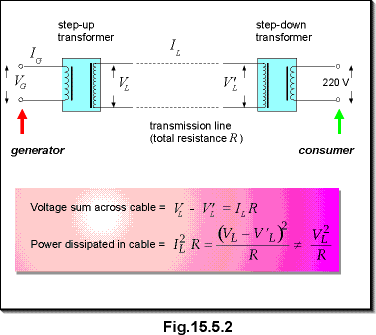
Electricity generated at the power station
is stepped up to an extra high voltage before applying to the transmission
lines. Before the electricity is supplied to the consumer end, it is stepped
down. |
|
|
Given the same power transfer, stepping up
the voltage reduces the current through the cable according to |
|
|
 |
1 |
|
This minimize the power loss in the cable according
to |
|
|
 |
1 |
|
|
|
| c. |
Describe
the ring circuit for delivering electricity to the electrical appliances
inside a consumer unit. State two advantages of using ring circuit. |
4
marks |
|
|
|
|
 |
1 |
|
In the ring circuit, the live and the neutral
are each in the form of a ring. Electrical appliances are connected across
the two rings. |
1 |
|
Advantages of ring circuit |
|
|
-
Cable resistance is decreased
-
If a section of the cables in the rings is broken, all the devices can
still operate
|
2 |
|
|
|
| d. |
Explain
the difference in application between a circuit breaker and a ground fault
circuit interrupter. |
3
marks |
|
|
|
|
A circuit breaker is to prevent very large current, for
instance, short circuit or overloading. This avoid the cable/appliance
from overheating and catching fire. |
1 |
|
Ground fault circuit interrupter (GFCI) is
designed to detect any leakage of current due to accidental earthing. The
interrupter would shut off the mains in very short while. |
1 |
|
Current leakage usually occurs when there is partial breakdown
of insulation within a device. As a result, the case of the device is at
a high voltage and potentially dangerous (in the event of electric shock). |
1 |
|
GFCI could also detect accidental human contact with the
live wire. This reduces the chance of electrocute. |
|
|
|
|
|
|
|